
Alicante and its surroundings: attractions, MAP, and a ready-made sightseeing plan. What to see? [2026]
If you're visiting Alicante for the first time, it's worth dedicating a day to the city itself. I've prepared an Alicante sightseeing itinerary covering 12 main attractions , which can be covered in about 4 km on foot and takes less than 2 hours to walk . If you have more time, the Alicante area offers other interesting places, including Altea , Calpe , Guadalest , Villajoyosa , Elche , Santa Pola , and Valencia – it's worth dedicating an additional 2-3 days to exploring them. Maps show routes, attractions, parking, and GPS points, and I've provided practical information for each location.
Alicante or Międzyzdroje?
A strange question? Not necessarily. Alicante in Spain (like Międzyzdroje in Poland) is generally considered a typical beach and consumer resort where people come to do nothing. Whereas “nothing” means lying down, drinking and eating in any order. Some people eat, drink and then lie down, while others drink, drink, drink and finally lie down. You can also imagine a different arrangement of these activities, but I’ll leave that to your imagination.
In practice, this opinion is unfair to both Międzyzdroje and Alicante. Both places offer much more than just these three basic options. This post will be about that, although this time only in relation to Alicante (Międzyzdroje will have its time another time).

Where is Alicante?
This is where I always start, but rather than go into too much detail on this topic I'll just post a simple and clear map underneath that explains everything.

If you look closely at the map above, you will quickly notice that Alicante is almost at the same latitude (distance from the equator) as the capital of Tunisia (Tunis) in Africa. This fact is quite telling of the weather to expect in Alicante. In short, it is warm or very warm all year round and most days are sunny (the sun shines here for over 300 days a year). In summer, it is hot and dry, with temperatures often exceeding 30°C, but the sea breeze moderates the heat. Winters are mild, rarely dropping below 10°C. Precipitation is small and occurs mainly in autumn and early winter.
What to do in Alicante?
First, lie down, then eat and drink something—that is, RELAX! Once you've recharged your batteries (and that usually happens very quickly), come back to this post and read it carefully. Below you'll find some ideas and inspiration for a truly enjoyable holiday in Alicante, which (thanks to the great weather in this part of Spain) can be enjoyed practically year-round. So, if you're spending the summer in Międzyzdroje, don't worry! Spring and autumn (even early spring and late autumn) are divine in Alicante, and in fact, I recommend these two seasons the most!
If laziness and passive relaxation tire you out, you can always use my Alicante sightseeing itinerary , which can be found in the second part of this post. It's a set of ready-made ideas, even for a few days!
Travel Insurance (Is It Necessary?)
I don't want to spend too much time on this topic, so I'll be really specific. I'll be brief: I never leave home on a trip alone without insurance. On a trip we are constantly moving to new places, our heads are occupied with delights and other pleasures. We are more relaxed and it is not difficult to have an adventure. Lack of insurance is asking for serious trouble.It is also worth remembering that the so-called EHIC, i.e. the insurance that we have as citizens of the European Union, does not reimburse everything. It only reimburses what is reimbursed in a given country (e.g. in France, 35% of the costs of state rescue services are paid out of pocket). We could go into details for a long time, but doing so is pointless, because a solid weekly insurance for one person in Europe, compared to the cost of the entire trip it's surprisingly cheap. You can easily find really good deals for around 10-15 EUR total for the whole week (!!!), which is the equivalent of two or three beers.
I usually look for the best deals in this area offer comparison - [click] (in this case it's Rankomat) and I buy them online. You can do it really quickly and cheaply.
Below is an example of a good and not at all the cheapest offer from a price comparison site (for an entire week in 2025).

Two parameters are key in the offers:
- goat goat (KL) - the minimum amount is PLN 250 (EUR 000)
- Civil protection (OC) - the minimum amount is PLN 250 (EUR 000)
it is worth paying attention to two additional parameters:
- Consequences of Accidents (NNW) - at your discretion
- travel luggage insurance - at your discretion
Alicante - map of tourist attractions
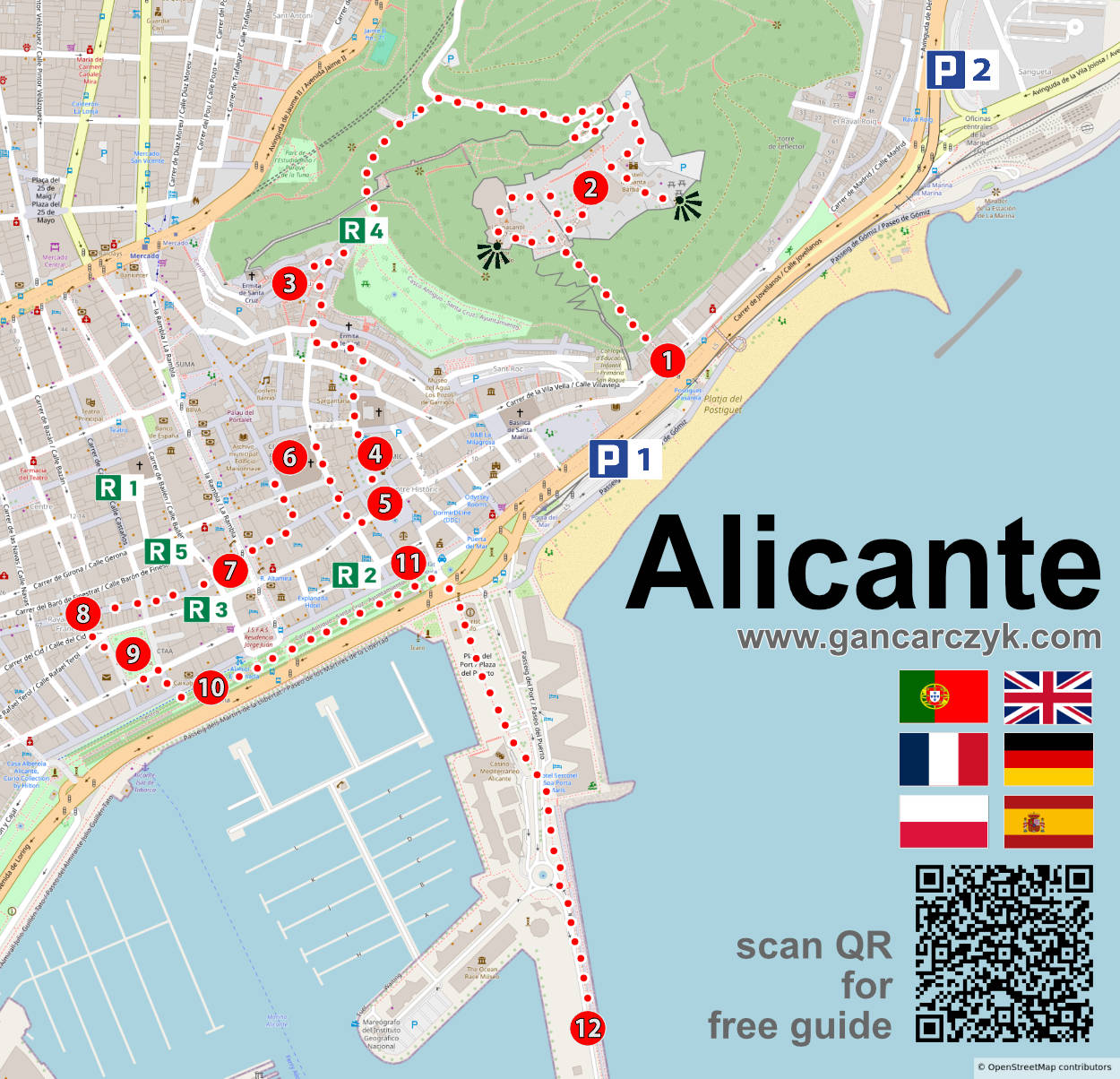
Of course, you can also find interesting places and attractions in Alicante itself. I recommend and encourage you to set aside a day to explore the interesting places in Alicante. The itinerary can be organized so that one day is perfectly sufficient, and it will be a truly enjoyable experience. Below you'll find a map I created (I'm including it again for your convenience), marking all the attractions and the sightseeing route.
The sightseeing plan is also available as an interactive PDF map. You can download it for free! You can find the map, along with brief instructions, in the post: Alicante – interactive PDF MAP – [click]
Tip:
If you lose your map, don't worry! You don't have to remember any pages!
Type in Google: Alicante gancarczyk
I'll show up at the top of search results!
The same applies to other majors!

1. Elevator to Castillo de Santa Barbara
2. Santa Barbara Castle
3. Alicante Old Town
4. The Sanctuary of the Holy Face
5. Town Hall
6. Concatedral de San Nicolas de Bari
7. Plaza Portal de Elche
8. The Carrer of the Bolets
9. Gabriel Miro Square
10. Passeig Esplanada d'Espanya
11. Casa Carbonell
12. Alicante Pier
First, notice the numbered red dots. These are the main attractions that form the basis of the entire sightseeing plan. The numbers you see on the map can be found in several different places throughout this post. They are located in the table of contents at the beginning of the article and in the tour route descriptions. These numbers are the starting point for the paragraph titles, where you'll find more detailed descriptions and additional information for each attraction (e.g., GPS coordinates, ticket information, etc.). The attraction numbers are connected by small red dots, which represent the approximate route I'm suggesting. This route logically connects the attractions described in this guide.
Secondly, I've also placed green markers with the letter R and a number on the map. These indicate the locations of the restaurants I've highlighted. To make selection easier, I've briefly described each restaurant later in the text.
Use GPS coordinates
I provide precise GPS coordinates for each attraction. This may not seem particularly useful at first glance, but in practice, the exact opposite is true. Thanks to these coordinates, you do not have to stick to a specific sightseeing path. You can explore the city basically as you like.
How to use GPS coordinates in practice? Just click on the link next to them. Then the navigation will open on your phone and automatically calculate the path to your destination, but… you don't have to follow this path! Walk as you like, wherever you want and treat the indication on the phone only as an indication of whether you are approaching your destination or whether you have already taken the wrong direction. Visiting the city is not about walking the shortest route, but enjoying its atmosphere. Thanks to GPS coordinates, you don't have to worry about getting lost, and at the same time you have unlimited freedom of sightseeing.
In short: click on the coordinates, walk and check from time to time to see if you are going in the right direction. No nerves, no stress, pleasure. Simple and beautiful!
Alicante sightseeing plan
Attractions are visited in order from number 1 to 12. By following this route, you will follow the exact route marked on the map.
The beginning of the route and the direction of the tour are not a random choice! The first point of my plan, the elevator to the castle (1) will take us to the top of the hill where the Castle of St. Barbara is located (2). This way you avoid the unpleasant climb on foot to the top of the hill. After that the tour route is downhill or flat and you don't have to climb any hills.
The entire route is approximately 4 km long and you can cover it at a leisurely walk in less than two hours. Of course, the time I have given only includes walking from point to point without stopping. However, there are a few places on the route where you will definitely stop for longer. You will be stopped by the fantastic views of the city and its surroundings and (especially in the old part of the city) the beautiful streets. Don't rush. During this trip, you have as much time as you need. If you want to take nice pictures and there are a lot of people in the frame, wait. In a few moments, the frame will clear or even become completely empty.
Taking advantage of the fact that this time the sightseeing plan is not too crowded, I also marked a few selected restaurants on the map (green icons with the letter R). Each of them stands out with something and if there is such an opportunity, I encourage you to spend some time in one of them. Coffee and something sweet, something cold to drink or a bigger meal after a walk, or maybe even dinner? Each of these ideas is good!
Parking lots in Alicante
If you're coming to Alicante from another city just to do some sightseeing, you'll probably need a well-located car park to leave your car while you're sightseeing. Below are two locations (both marked on the map). One of the car parks is paid and the other is free. The paid car park is right next to the lift (100m) and Postiguet Beach. Of course, it's a bit further from the free car park to the starting point of the tour (about 600m).
Parking P1 paid near the lift and beach (payment at machines), GPS coordinates:
38°20’42.7″N 0°28’42.0″W
38.345202, -0.478326 - click and route
There are “local helpers” in the car park who will expect a small payment from you after parking. They are not car park employees. The parking fee must be paid at the parking meter (in 2024 it cost 4 EUR for about 1,5 hours of parking).
Parking P2 free, GPS coordinates:
38°20’59.7″N 0°28’21.3″W
38.349927, -0.472571 - click and route
Detailed descriptions of attractions in Alicante
1. Elevator to the Castillo de Santa Barbara
The first point in the plan sounds innocent enough, but in practice it will probably turn out to be the most troublesome point of the program. There is often a long queue to get to the elevator even in the off-season. In the season it is almost certain that you will have to wait even a few dozen minutes to get on the elevator. Unfortunately I have no way to do this. It is simply the way it is and you have to accept it.

The more nervous ones decide to skip the lift and walk to the top of the rock, but they quickly regret it, especially when it's really hot. Theoretically, an alternative to the lift is buses that go from the center of Alicante almost to the entrance to the castle, but at the first stop they are completely full, and at the next stops, where more people are waiting, they don't even stop (I experienced this myself).
The only thing I can suggest is to arrive at the elevator early enough (even before it opens) and hope that other people who want to go in will want to sleep longer that day.
Elevator operating hours:
from November 15 to February 27:
daily from 10:00 to 18:00.
from February 28 to June 16:
daily from 10:00 to 20:00.
from June 17 to September 4:
daily from 10:00 to 23:00.
from September 5 to November 14:
daily from 10:00 to 20:00.
Elevator to St. Barbara's Castle, GPS coordinates:
38°20’48.3″N 0°28’36.8″W
38.346739, -0.476887 - click and route
2. Castle of Santa Barbara (Castillo de Santa Bárbara)

Dominating the city atop Benacantil Hill (166 m above sea level), Santa Barbara Castle is surrounded by massive walls and towers, extending over several levels. From the walls and towers, we have the best access to spectacular views of the entire Costa Blanca, the port, and the Mediterranean Sea. You won't find a better location to enjoy the views of the coast and surrounding Alicante. Therefore, I suggest thoroughly exploring the castle (you'll also stumble upon several small but enjoyable exhibitions) and its walls, as truly beautiful views await around every corner!

As for the specifics related to the history of the building, the first fortifications on the hill were built in Muslim times, when in the 1248th century the Moors built a defensive fortress here. After the Reconquista in 4, the castle was captured by the Castilian king Alfonso X the Wise, and its current name comes from St. Barbara, whose day of the fortress' recapture fell on December XNUMX.
In the following centuries, the castle was rebuilt by the Spanish, serving a key military function until the 19th century.
The fortress is divided into three main levels:
– the highest part (13th-14th centuries) – includes the Torre del Homenaje and the oldest parts of the castle, from where there is the best view of Alicante.
– central part (16th century) – contains Renaissance buildings, courtyards and the chapel of St. Barbara.
– lower part (18th century) – this is the area that was expanded to meet the needs of artillery and city defense.

Interesting facts:
Moor's Head – looking at Benacantil Hill from the side of Postiguet Beach, you can see a characteristic shape resembling the profile of a male face.
Mysterious tunnels – beneath the castle are hidden corridors and dungeons that in the past served both as a prison and an escape route during sieges. Some of them are now closed, but urban legends mention hidden entrances in the center of Alicante.
Castle of St. Barbara, GPS coordinates:
38°20’56.7″N 0°28’40.6″W
38.349071, -0.477953 - click and route
If you have a car and you didn't manage to get to the lift or the minibus taking tourists to the castle, you can drive near the castle and park in the car park, from where it's quite close to the castle gate, but still uphill.
Parking near the castle gate, GPS coordinates:
38°20’59.2″N 0°28’49.9″W
38.349777, -0.480537 - click and route
3. Alicante Old Town


Located near the streets of Calle San Rafael, the oldest part of Alicante delights with a labyrinth of narrow, winding streets that wrap around the hill of the Castle of Santa Barbara. White, low houses, often decorated with colorful flower pots, give this place a unique, Andalusian atmosphere. Walking through this district, you can come across charming squares, small chapels and hidden courtyards. Many of the streets are so narrow that residents can almost shake hands through their windows.


Interesting facts:
Calle San Rafael was once one of the main arteries of the old town, connecting the Santa Cruz district with the port.
In some houses you can find remnants of Moorish tiles that have survived from the times of Arab rule.
On the walls of the houses you will find many mysterious paintings and symbols. Local residents claim that some of them have protective meaning.
A landmark in the oldest part of the city, GPS coordinates:
38°20’52.5″N 0°28’56.6″W
38.347909, -0.482396 - click and route
4. Holy Face Square (Placa de la Santissima Fac)
Placa de la Santissima Fac is one of the lesser-mentioned but quite pleasant places in Alicante. It is located in the historic center of the city, near the Cathedral of St. Nicholas and the City Hall. The square is surrounded by elegant, classical buildings that emphasize its historical character. It is a place where you can feel the peace and atmosphere of old times, relaxing in the shade of the trees or enjoying a coffee in one of the nearby cafes.
The name of the square refers to the Holy Face (Santíssima Faç), a relic kept in a sanctuary in the nearby monastery of Monforte del Cid. This cult has a centuries-old tradition in the Alicante region and plays an important role in local religious celebrations.
Interesting facts:
The tradition of pilgrimage – every year from this square a pilgrimage sets off to the monastery in Monforte del Cid, where the relic of the Holy Face is kept. It is one of the most important religious events in Alicante, gathering thousands of believers.
Trace of the past – Below the surface of the square are the remains of old walls and structures from the Middle Ages. Some of them have been discovered during archaeological work, but most of them remain hidden underground.
A peaceful oasis – although the square is located in the heart of the city, unlike other tourist spots, there is a calm, almost intimate atmosphere here, which makes it an ideal place to relax.
Holy Face Square, GPS coordinates:
38°20’44.0″N 0°28’53.8″W
38.345560, -0.481604 - click and route
5. Casa Consistorial (Alicante City Hall)

Baroque town hall from the 18th century, distinguished by its harmonious, symmetrical façade and elegant columns. Its interior houses historical halls with intricately carved ceilings and portraits of past mayors. The most famous element of the town hall is the "Cota Cero" - a reference point for measuring height above sea level throughout Spain. It is located on the main staircase inside the building.
Interesting facts:
In one of the rooms you can see the desk at which King Ferdinand VII himself worked during his visit to Alicante.
The facade of the building has traces of bullets from the Spanish Civil War.
In one of the rooms there is a hidden, almost invisible hatch in the floor – it leads to an underground tunnel that once served as an escape route.
Town Hall, GPS coordinates:
38°20’42.5″N 0°28’52.3″W
38.345143, -0.481197 - click and route
6. St. Nicholas' Co-Cathedral

The temple was built in the 17th century on the site of a former mosque, and its architecture combines Renaissance and Baroque elements. The most impressive part is the blue dome that dominates the city. Inside, it is worth paying attention to the Chapel of the Communion, considered one of the most beautiful Baroque works in Spain.
Interesting facts:
In the basement of the temple, the foundations of an old mosque that existed in this place before the Reconquista were discovered.
The Co-Cathedral houses one of the oldest organs in the Valencia region. Its sound can only be heard during special concerts.
Concatedral de San Nicolas de Bari, GPS coordinates:
38°20’44.3″N 0°28’57.5″W
38.345636, -0.482628 - click and route
7. Plaza Portal de Elche (square with a fig tree)

A small but atmospheric square that has been a meeting place for the inhabitants of Alicante for centuries. Its biggest attraction is the huge fig tree, whose branches create a natural canopy. It was planted at the end of the 19th century and is still growing and in good shape!
Once upon a time, this was the location of one of the main city gates leading to Elche (hence the name of the square), and public executions took place in the square.
Portal Square of Elche, GPS coordinates:
38°20’39.4″N 0°29’00.3″W
38.344284, -0.483404 - click and route
8. El Carrer dels Bolets (mushroom street)

A colorful and fairy-tale street full of giant mushrooms that make walking along this road feel like a journey into the world of Alice in Wonderland. It was created to revitalize the commercial part of the city and attract families with children. Before its reconstruction, the street was one of the most neglected in the center of Alicante.
Each mushroom has its own unique design and some have interactive elements, and at night the mushrooms glow gently, which gives the street an even more magical look.
Mushroom Street in Alicante, GPS coordinates:
38°20’37.8″N 0°29’09.2″W
38.343833, -0.485887 - click and route
9. Gabriel Miro Square

One of the most picturesque squares in Alicante, surrounded by huge trees and romantic fountains. A great place to relax. The square is named after the famous writer Gabriel Miró, who often walked here.
The vegetation in the square is so dense that on hot days the temperature is several degrees lower than in the rest of the city.
Plaza Gabriel Miro, GPS coordinates:
38°20’36.0″N 0°29’06.2″W
38.343334, -0.485054 - click and route
10. Passeig Esplanada d'Espanya (waterfront promenade)

This is Alicante’s calling card – a beautiful seaside promenade with a mosaic of over six million coloured stones. The wave pattern is designed to give the illusion of movement, and the effect is clearly visible in photos.
There is something going on almost constantly on the promenade, and you can come across concerts and street performers every few steps.
Curiosity:
Underneath the promenade there are tunnels leading to the former network of bunkers from the Civil War.
Alicante Promenade, GPS coordinates:
38°20’34.8″N 0°29’01.2″W
38.343007, -0.483676 - click and route
11. Casa Carbonell

An elegant building from the early 20th century, which was intended as a residence for the wealthy industrialist Enrique Carbonella. It is a symbol of luxury and prestige in Alicante.
Urban legend has it that Carbonell was thrown out of a nearby hotel and decided to build his own, more impressive building. The façade resembles French palaces and definitely stands out among the other buildings on the Esplanade.
Carbonell House, GPS coordinates:
38°20’39.7″N 0°28’51.3″W
38.344346, -0.480912 - click and route
12. Alicante Pier

A place to meet, walk and admire sunsets… I think that’s enough about the pier 🙂
If you look around carefully, you can see submerged fragments of the former port fortifications.
Alicante Pier, GPS coordinates:
38°20’24.1″N 0°28’42.5″W
38.340014, -0.478460 - click and route
Selected restaurants in Alicante
R1 – Nou Manolin Restaurant
An iconic restaurant in Alicante, famous for its excellent tapas and fresh seafood. The restaurant has an elegant yet casual atmosphere, perfect for both a dinner with friends and a romantic get-together. Special attention should be paid to the dishes prepared at the open bar, including grilled shrimp and Iberian hams.
Fun fact: Nou Manolin is frequently visited by celebrities and is sometimes referred to as one of the best tapas bars in all of Spain.
Manolin Now, GPS coordinates:
38°20’43.2″N 0°29’06.7″W
38.345336, -0.485190 - click and route
R2 – La Taberna del Gourmet restaurant
Michelin-starred restaurant specializing in refined tapas and Mediterranean cuisine. Here you will find both classic dishes and modern interpretations of traditional flavors. Fresh seafood, local cheeses and excellent steaks are particularly recommended.
The restaurant uses only the highest quality products from local suppliers, which makes each dish delight with its freshness and authentic taste.
The Taberna del Gourmet, GPS coordinates:
38°20’39.7″N 0°28’53.9″W
38.344351, -0.481631 - click and route
R3 – El Portal Taberna & Wines Restaurant
This place combines modern gastronomy with elegant décor and an excellent wine list. The restaurant is known for its creative versions of classic Spanish dishes, and its menu includes both seafood and high-quality meats. It is also a great place for a night out - in the evenings there is an energetic atmosphere with live music.
The restaurant offers one of the best wine lists in Alicante, and the sommeliers are happy to advise on the perfect pairings for drinks and dishes.
El Portal Taberna & Wines, GPS coordinates:
38°20’38.3″N 0°29’01.1″W
38.343984, -0.483643 - click and route
R4 – La Ereta Restaurant
The restaurant, located on a hill, right next to the Santa Bárbara Castle, offers wonderful views of the city and the sea. The menu is based on seasonal products and combines tradition with modernity. It is worth trying the tasting dishes here, which allow you to discover the full flavors of the region.
The chefs at La Ereta often experiment with local ingredients, creating unique flavour combinations inspired by the Alicante tradition.
La Ereta, GPS coordinates:
38°20’54.8″N 0°28’53.6″W
38.348549, -0.481546 - click and route
R5 – Bodeguita Restaurant 1999
A cozy restaurant with a wide range of tapas and meat dishes, including excellent steaks and grilled specialties. It is the perfect place for an evening dinner in an intimate atmosphere. The decor refers to classic Spanish taverns, which adds to the charm of this place.
Interesting fact: the restaurant is famous for its original method of preparing steaks – the meat matures in special conditions, which gives it exceptional tenderness and taste.
Bodeguita 1999, GPS coordinates:
38°20’40.5″N 0°29’02.4″W
38.344570, -0.484000 - click and route
Alicante - hotels and accommodation
Staying in Alicante is a real adventure. The city lives almost constantly. During the day it may be a bit more leisurely, when most guests enjoy the beach and sea, but in the evening Alicante invites you to countless bars and restaurants serving great food and great drinks. Meetings and fun often last until dawn.
Below you will find several accommodation options. Do not treat them as specific indications of the hotels that I recommend. Treat them as a good start for further searches. The links I have posted use the search engine mechanism, which, in addition to a specific hotel, always offers other, similar offers, often more attractively priced. Additionally, the links contain filters prepared by me. They prevent the display of offers that could unnecessarily clutter the search results and appropriately narrow the search area to the area that interests us. So you do not have to do it manually every time. I recommend using these links, because they make searching easier and save time.
Eurostars Centrum Alicante – [click]

UNIQ flats – [click]

Eurostars Portico Alicante – [click]

El Mirador Ap – [click]

Cheap flights
Below, you'll find a tool I created that looks like a regular search engine, but is actually really fast and clever. It allows you to instantly check flight prices to your destination.One click on the "OK" button without entering anything, you can check the current prices of airline tickets from all airports in the country (Poland is entered by default). The form works in real time and immediately generates current call prices! If you want to check connections from another country (or city), simply enter its name in the box. Later (if the list proves interesting), you can modify the search parameters on the landing page (starting city, dates, currency, language, etc.). The search engine works on all devices (phone, computer, tablet) and automatically adjusts functionality to the device type and screen size.
The landing page is probably the world's largest airline ticket comparison and search engine: Skyscanner
The website works in 24 languages and if it opens in a language other than your preferred one, simply switch it (in the menu or the globe icon in the upper right corner).
Attractions near Alicante
When suggesting something to do in Alicante, I have to start not with the city itself, but with a broader view of the surrounding area. Alicante has a very good location and you will find many really attractive places nearby. So before we move on to the city guide, first take a look at the map below.

On the map, I've marked the locations of interesting places and the approximate driving time between them. The distances between them are short, so you can see more than one attraction in a single day. You could easily fill two or three days exploring these places. Valencia is the furthest from Alicante (a little over two hours by car). You should set aside a full day to explore Valencia , as the city is beautiful and full of attractions!
Car rental in Alicante
If you decide to explore the Alicante area, you'll need a car. Renting a car in Alicante is easy, and prices are reasonable. This is thanks to the wide range of local and chain rental companies. Alicante is a very popular tourist destination, and almost all chains have offices here. Local rental companies compete effectively with them. Based on my own experience, I've written a guide to renting a car in Alicante. So, if you want to quickly learn how to rent a car cheaply and safely in Alicante – [click] – read my guide.
Alicante area sightseeing plan
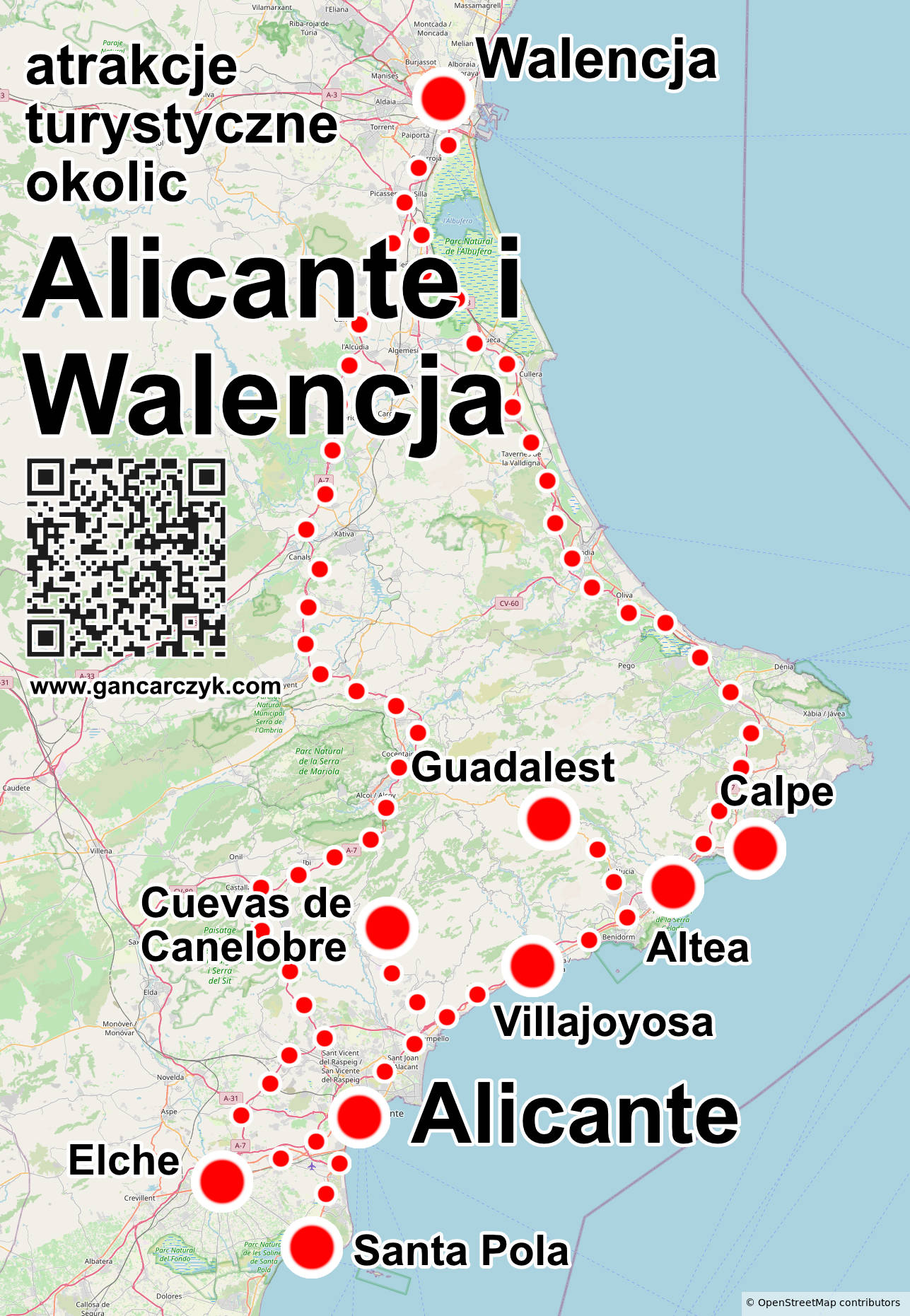
Sightseeing around Alicante can be organized into a neat and easy-to-follow itinerary. I've included a proposed itinerary above, drawn on a ready-made map. Perhaps you'll like my idea or be inspired to create your own? Furthermore, further down in this text, you'll find some basic yet very useful information about each of the places marked.
Valencia

Valencia is amazing! And these two words would be enough to describe this city.
A visit to Alicante is a great opportunity to visit Valencia, which is undoubtedly a unique city. On the one hand, two words were enough to convey the emotions that accompany visiting it, and on the other hand, creating Valencia guide – [click] I could probably write endlessly.
But one thing is certain: you can't miss the opportunity to visit Valencia! That would be a huge mistake!
Altea

Valencia Region, Spain
Altea is a charming town known for its white houses, cobbled streets and beautiful old town with the church of Nuestra Señora del Consuelo. Altea's beach offers a quiet place to relax, while the port and promenade are full of local restaurants and cafés.
Several adjacent car parks near the centre of Altea, GPS coordinates:
38°35’58.8″N 0°03’21.3″W
38.599656, -0.055927 - click and route
The main walking street in Altea, GPS coordinates:
38°35’55.6″N 0°03’09.1″W
38.598782, -0.052519 - click and route
Calpe

Calpe is a popular tourist destination, the main attraction of which is the Penyal d'Ifac, a huge rock that has become a symbol of the region. From its top there is a magnificent view of the coast. Calpe also offers beautiful beaches and the Roman ruins of Baños de la Reina.
A small parking lot at the entrance to the beach where the above photo was taken, GPS coordinates:
38°38’21.4″N 0°02’29.3″E
38.639273, 0.041478 - click and route
Parking in the center of Calpe, GPS coordinates:
38°38’28.7″N 0°04’11.0″E
38.641305, 0.069726 - click and route
Parking near the beach in Calpe, GPS coordinates:
38°38’42.2″N 0°04’14.8″E
38.645056, 0.070766 - click and route
Guadalest

Guadalest is a picturesque village perched on a hilltop overlooking a blue lake and the surrounding mountains. It is famous for its well-preserved Castell de Guadalest, narrow cobbled streets and museums such as the Miniature Museum. It is a great place to stroll and admire the charming views.
Parking in Guadalest, GPS coordinates:
38°40’33.5″N 0°11’57.2″W
38.675979, -0.199234 - click and route
Canelobre Caves (Cuevas de Canelobre)

photo: chisloup on the rules CC BY-SA 3.0
source: wikipedia
Located just 24 kilometers from bustling Alicante, on the slopes of the Cabeco d'Or mountain range, they constitute one of the most spectacular examples of underground karst in this part of Spain. Although the region is primarily associated with the sandy beaches of the Costa Blanca, it is here, at an altitude of approximately 700 meters above sea level, that nature has created a space whose grandeur rivals that of Gothic cathedrals. The name "Canelobre" comes from the Valencian language and means chandelier or candlestick. This is a direct reference to the massive stalagmite located within, whose shape resembles a multi-branched candelabrum.
The cave's interior is one of the highest chambers in all of Spain, reaching a height of over 70 meters. What immediately strikes you upon entering is not only the vastness of the space but also its acoustics. Thanks to the natural contours of the walls and ceiling, sound carries almost perfectly, regularly transforming the caves into a concert hall. However, the history of this place is far less soothing than classical music. During the Spanish Civil War (1936-1939), Republican troops converted the caves into an engine repair workshop for Soviet Polikarpov I-16 fighter planes, known as "Mosca." It is from this period that the present-day entrance dates – a 45-meter-long tunnel carved into the rock to allow the transport of heavy equipment to the safety of the natural shelter.
The cave formation itself dates back millions of years, and chemical processes occurring under the influence of water saturated with calcium carbonate have created forms that stimulate the imagination. Here, you can see formations resembling jellyfish, rock draperies, and organs. Drop by drop, water builds these structures at a rate almost imperceptible to the human eye—stalactite growth is estimated at a mere millimeter per hundred years.
Interesting facts:
Golden Head: The mountain range where the caves are located is called Cabeçó d'Or. Legend has it that Arabs hid vast treasures in these mountains, attracting gold prospectors for years, although the name likely comes from the color of the rocks at sunset.
Constant temperature: Whether it's 40-degree heat outside or a colder winter day, the temperature inside the cave remains constant at around 17-18°C.
Stage lighting: Inside, a colored lighting system highlights the texture of the dripstones while avoiding a tacky "disco" effect. This allows for a better understanding of the three-dimensionality of the room.
Opening hours
Winter (from September 1 to June 30): Tuesday – Friday: 10:30 – 16:50; Saturdays, Sundays and holidays: 10:30 – 17:50.
Summer (July 1 to August 31) and Easter: daily from 10:30 to 19:30.
Note: The caves are closed on December 25 and January 1.
Parking at the Canelobre Cave, GPS coordinates:
38°30’36.1″N 0°24’42.6″W
38.510028, -0.411833 - click and route
Villajoyosa

Villajoyosa, also known as the “colorful city,” impresses with its vibrantly colored facades that line the coast. The city is famous for its chocolate-making tradition (you can visit the Valor chocolate factory) and its beautiful beaches.
Entrance to the underground car park by the beach with colourful houses, GPS coordinates:
38°30’18.3″N 0°13’48.0″W
38.505083, -0.230005 - click and route
Elche

Elche is a city known for the largest Palm Grove in Europe (Palmeral de Elche), a UNESCO World Heritage Site. The Basilica of Santa Maria and the Archaeological Museum are worth seeing. The palm grove offers shade and peace, while the Huerto del Cura Park is a true oasis.
Elche – parking near the park with palm trees, GPS coordinates:
38°16’14.8″N 0°41’44.4″W
38.270775, -0.695678 - click and route
Santa Pola

photo: Werner Wilmes on the principles CC BY-SA 2.0
source: wikipedia
Santa Pola, unlike many Alicante resorts, hasn't abandoned its fishing roots in favor of concrete and hotels. The heart of the town remains the port, where fishing boats depart every morning and the famous Subasta de Pescado (Fish and Seafood Auction) takes place in the afternoon. The centerpiece is the Castillo-Fortaleza, a 16th-century Renaissance fortress. It was built to protect local fishermen from attacks by Barbary pirates, who regularly raided these shores. Today, the castle walls no longer serve a defensive purpose. Within them lies the Museum of the Sea (Museo del Mar), where you can trace the history of the region, from Roman times, when the port was known as Portus Illicitanus, to the modern era.
However, what truly sets Santa Pola apart is its unique salt landscape. The Santa Pola Salt Lakes are a protected area covering almost 2500 hectares, where sea salt has been mined for centuries. It's not just an industrial plant, but above all, a paradise for birdwatchers. Thanks to their unique ecosystem, the pink salt lakes are home to enormous flocks of flamingos, which can be observed almost year-round directly from the N-332 road. The view is complemented by the Santa Pola Lighthouse (Faro de Santa Pola), perched on a cliff overlooking Tabarca Island (the only inhabited island in the Valencian region).
Xativa

Beautifully situated Xativa is known for its impressive castle, rich history and as the birthplace of the Borgia family – one of the most influential families of Renaissance Europe (two members of the family became popes – Alfonso de Borja as Callixtus III and Rodrigo de Borja as Alexander VI).
The majestic Xativa Castle, rises on a hill with a panoramic view of the entire area. The fortress consists of two parts:
Castillo Menor – the older part, whose origins date back to the Iberian and Roman eras, with some sections of the walls being over 2000 years old.
Castillo Mayor – the larger, newer part, expanded mainly by the Moors and later reinforced by Christians after the Reconquista.
Thanks to its location, the castle was a key fortress defending the road between Castile and Valencia. For centuries, it was the site of sieges, battles and political intrigues. During the War of the Spanish Succession (1701-1714), Xativa supported the Habsburgs, which brought the tragic revenge of Philip V on the city and the fortress. The King of Spain punished the city by ordering Xàtiva to be burned and its name to "San Felipe".
Curiosity:
To this day, the municipal museum of Xàtiva houses an inverted portrait of Philip V – the only such example in the whole of Spain, as a symbol of the inhabitants' antipathy towards this ruler.
Multi-storey car park near the centre of Xativa, GPS coordinates:
38°59’21.6″N 0°31’38.8″W
38.989344, -0.527431 - click and route
Parking near the main gate to the castle, GPS coordinates:
38°59’00.6″N 0°30’58.8″W
38.983491, -0.516341 - click and route
Important to me!
Give the article a good rating (5 stars welcome 😀)!It's free, a for me it is very important! The blog lives on visits and thus has a chance to develop. Please do it and ... thank you in advance!
If you like my guides, you will certainly find the one I created useful guide catalog - [click]. There you will find ready-made ideas for your next trips, descriptions of other tourist destinations and an alphabetical list of guides divided into countries, cities, islands and geographical regions.
I also post link to Facebook profile - [click]. Come in and press "Follow"then you will not miss new, inspiring posts.
Unless you prefer Instagram. I'm not a social media demon, but you can always count on something nice to look at on my instagram profile - [click]. The profile will gladly accept any follower who likes it.
I read ALL the comments (and many times). Under each of them I could write that Thank you very much, because you are real fantastic. I often come back to comments because they give me motivation and energy. For me this is invaluable a treasure trove of good emotions!
Thank you for this here (I don't want to clutter the comments with repeated thanks). Know that by leaving a kind word here, you are doing a really good job for me!
I make the content I create available free of charge with copyright, and the blog survives from advertising and affiliate cooperation. So, automatic ads will be displayed in the content of the articles, and some links are affiliate links. This has no effect on the final price of the service or product, but I may earn a commission for displaying ads or following certain links. I only recommend services and products that I find good and helpful. Since the beginning of the blog's existence, I have not published any sponsored article.
Some of the readers who found the information here very helpful, sometimes ask me how you can support the blog? I do not run fundraisers or support programs (type: patronite, zrzutka or "buy coffee"). The best way is to use links. It costs you nothing, and support for the blog is self-generating.
Pozdrawiam


Great compendium of knowledge about Alicante. We are going with the family in a month 🙂
I am using it once again (previously Apulia) and I will be coming back to this blog.
Bravo for a very cleverly thought-out guide, for the coordinates and great maps with routes and locations of attractions! And thanks for the parking lot tips (and sense of humor).
In my opinion, the proportions of text and photography are ideal.
I could go on and on with the superlatives, and the only minor drawback for a rather low-budget tourist is the lack of information about not-too-expensive pubs with good food.
I look forward to more great and useful posts! Thank you!
I can't think of a better guide! An invaluable resource for those who want to explore unfamiliar places. I'm incredibly impressed with the way the content is presented, so helpful, even essential, for a tourist hungry for interesting places. Thank you, great job!
Great, clear description. I hope to use it during my trip. Best regards.
This blog is a true treasure trove of knowledge! Very interesting sightseeing suggestions, proven tips, and tricks. The trip and recommended places were well-organized. Once again, I saved time planning my trip because everything I needed was comprehensively covered here!
Thank you for your titanic work in developing new places worth visiting
Great guide to Alicante. We are currently using it :). Thank you
Tomorrow Alicante, thanks for the tips
Thank you for this guide 😊
It has proven very useful recently in Madeira, and I will now use it when exploring Alicante and the surrounding area.
Best wishes
Very nice guide. I'm glad I found it. Thank you.
Thank you for a very good guide.
I recently used your Andalusia guide. It's really great.
great, I'm going on June 15, I think I'll take advantage of it, because it's described so well
Great collection of key information. I'll definitely be using it on my trip. Thank you so much for such detailed descriptions.
This is my second time with your guide (previously Barcelona) and once again your reliable help.
Thank you and best regards.
Warmest regards 😁☀️
Thank you for this city guide. I was wondering if I should visit this city someday, but after reading this description and seeing the photos, I already want to go there. Thank you so much for such useful tips and directions; this map with the points is fantastic. Best regards and I wish you many interesting journeys.
After reading this post, I want to visit this beautiful place. Interesting description, I'm looking forward to seeing more posts.
Great guide. Information presented very clearly.
great tips, cool option with numbers on the map.
Ich liebe den Reiseführer. Danke!