Tuscany – map, attractions, sightseeing plan, trips, the most beautiful places
The most beautiful landscape in the world
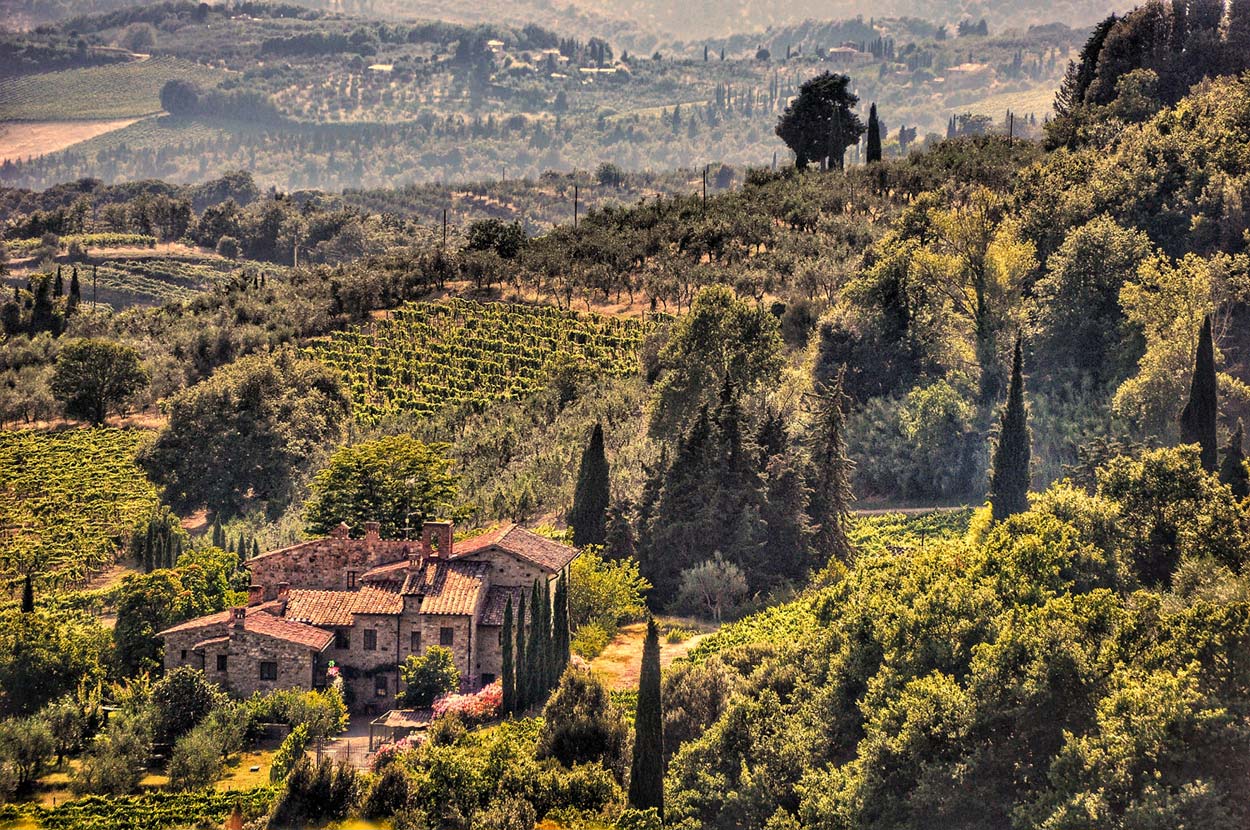
These are the words that will greet you on the official website of the Val d'Orcia valley in Tuscany, inscribed on the UNESCO list for its landscape values: the most beautiful landscape in the world. Undoubtedly, in Tuscany you will find a lot of wonderful scenery and more than once, when you see them, you will have to sigh with delight or stop for a moment to look a little longer, to preserve a fleeting moment in your memory. But this is just the beginning!
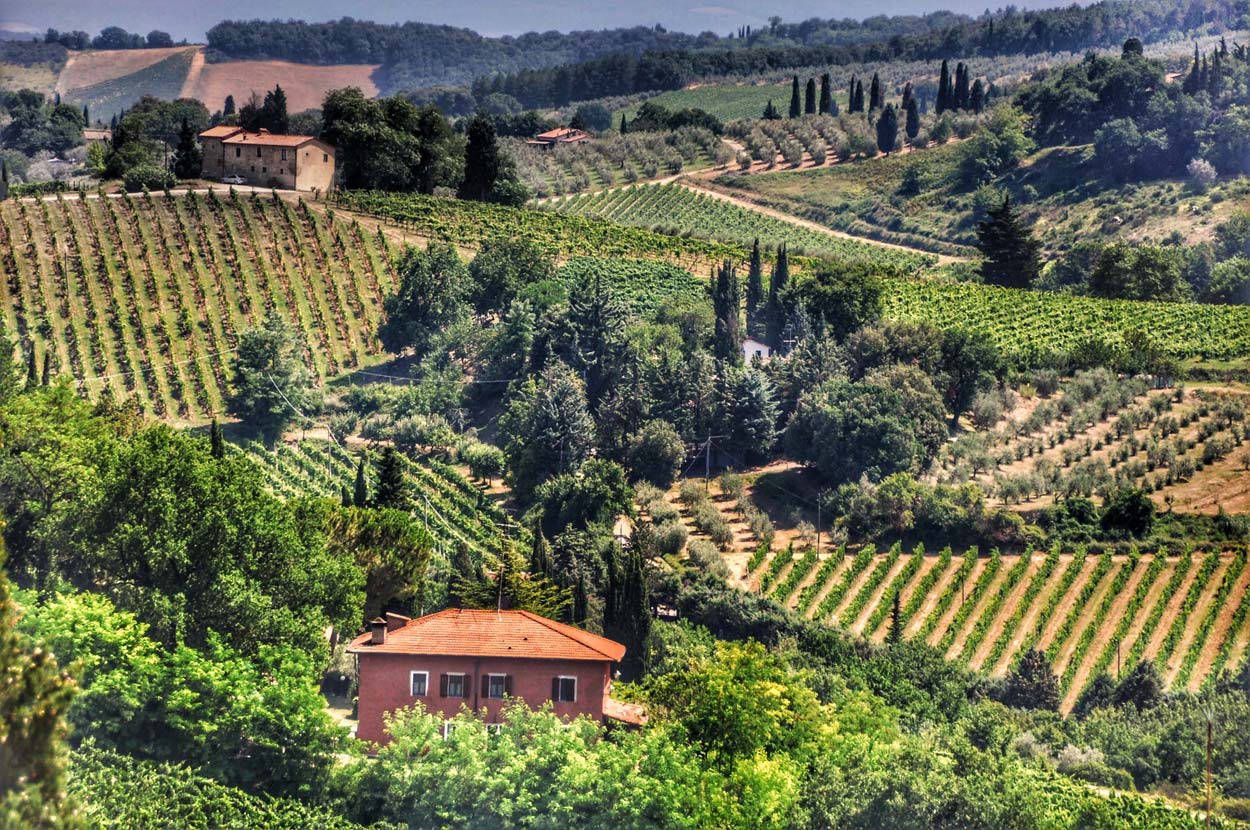
Among the Tuscan landscapes there are small medieval towns with a brilliant atmosphere, vineyards, olive presses, and thousand-year-old trails that were once traversed by travelers and merchants, and today can be walked by tourists. You will also discover here larger centers of culture, art and science with age-old universities, where the foundations of our modern knowledge and works that are today considered the greatest human achievements were created. All this is supervised by the capital of the region: Florence. A city that sparkles and exudes power, panache and seductive beauty. Nowadays, it is still the world's largest center for trade in gold and precious stones. This is where huge capitals meet and cross major routes to strike deals in the trade of luxury goods. This is what Tuscany is like!
The best guide in the world
Without exaggeration! This will definitely not be the world's best guide to Tuscany. However, it will be very practical and, I hope, really useful.
Visiting Tuscany usually comes down to a very difficult choice: what to see? Unfortunately, you can't see everything at once! You have to choose. This entry will definitely make your life much easier. It contains only the greatest attractions of this region. However, I warn you that when moving between the places I have selected, you will pass dozens of other, equally interesting places. The road will be full of beautiful views, countless vineyards, olive groves, presses and farms selling their own products (brilliant pasta, olives and balsamic vinegars). If something catches your attention while traveling between subsequent points of the itinerary, do not hesitate to change your plans. The freedom to explore and satisfy your curiosity in Tuscany is the best thing you can do. Stop, try, test and taste.
I have prepared this guide in such a way as to leave you plenty of space for your own experiences and modifications. I think this is the best way to fully feel this extraordinary region of Italy.
Where is Tuscany?
Italy is divided into 20 regions, one of which is Tuscany. The maps attached below present the location of Tuscany against the background of the map of Europe and the map of Italy.
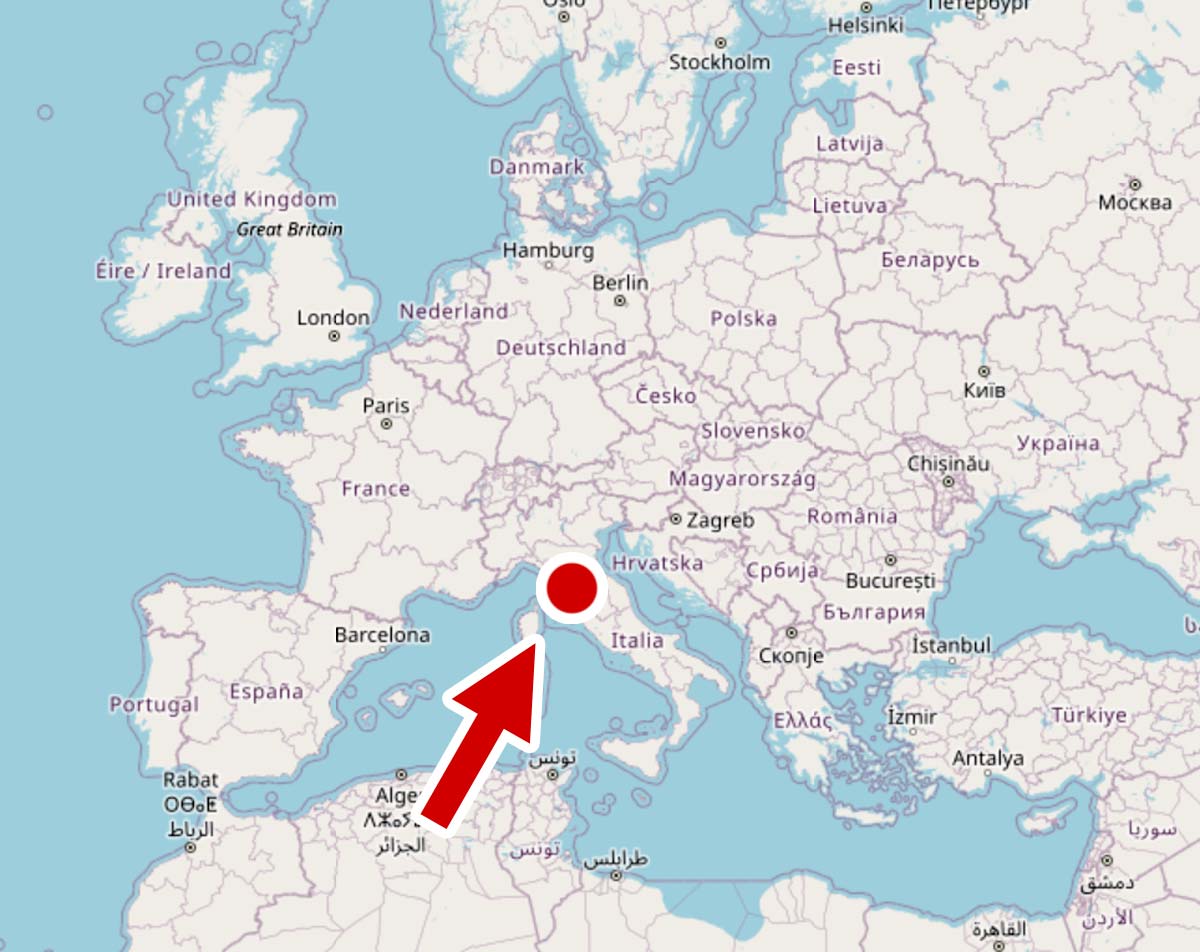
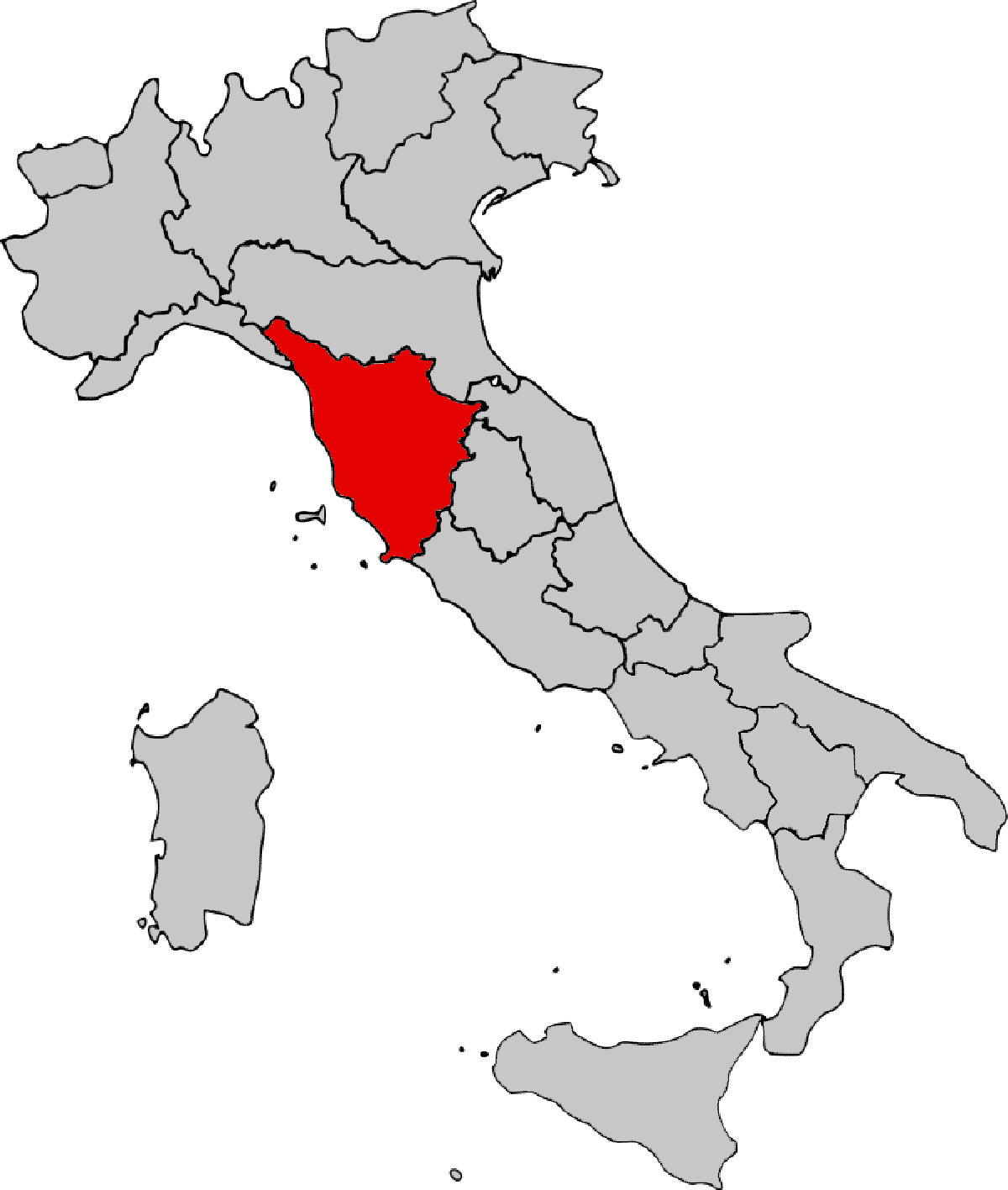
Looking at the maps, you can immediately notice the very favorable location of Tuscany for tourists. It is easily accessible from most countries in Europe by land, and those arriving by plane have at their disposal the Florence Peterola airport (Aeroporto di Firenze) and several airports located a short distance from Florence, served by low-cost airlines:
– Pisa Galileo Galilei airport (70 km from Florence),
– Bologna Guglielmo Marconi airport (85 km from Florence),
– Rimini Miramare airport (112 km from Florence).
Statistically, Tuscany is one of the largest regions in Italy. In terms of size, it is in fifth place, second only to Sicily, Piedmont, Sardinia and Lombardy.
This does not mean, however, that traveling in Tuscany will involve long journeys.
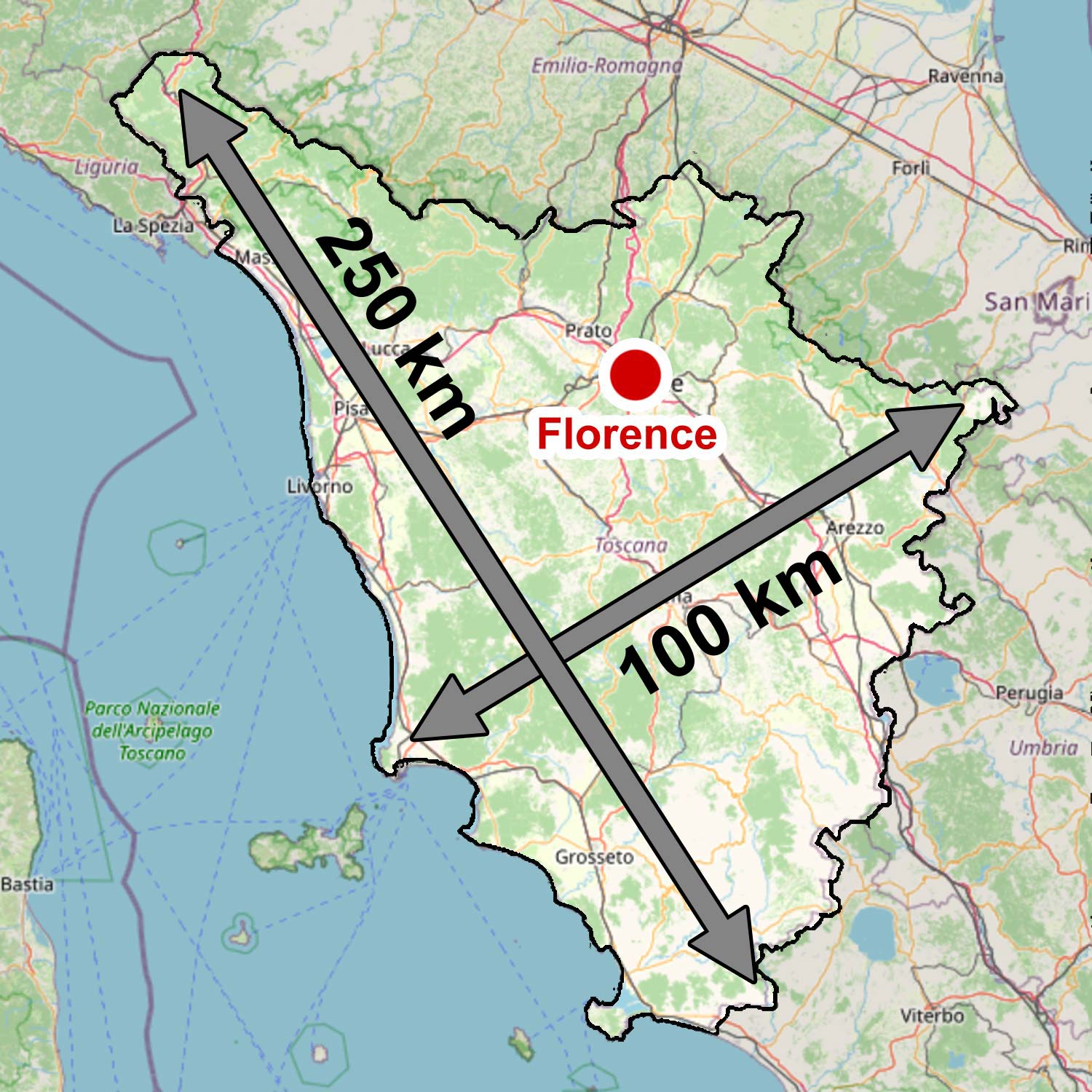
Generally, Italian regions are small in size, and even Tuscany, which is quite large by Italian standards, is in practice a size that is perfect for sightseeing.
A sensibly designed plan will allow you to significantly reduce the length of necessary journeys and leave plenty of room for the pleasures of active sightseeing. Days during which you will have to travel more than 150-200 km will be rare.
How to visit Tuscany?
To put it briefly and concretely, there are basically two sensible ways to explore Tuscany: public transport or a rented (or your own) car.
Public transport
Tuscany is well connected, so moving between the main centers should not be a major problem or challenge. It will, of course, take more time and introduce several restrictions, mainly related to the need to adapt your activities to timetables, but it will allow you to reach the most important places.
In this guide, I won't focus on describing public connections because I haven't used them myself. So I won't talk about something I haven't tested in practice.
The website can significantly facilitate the organization of trips for people interested in this form of travel Omio – [click], which allows you to check timetables, bus, train, air and ferry connections.
Own car
If possible, I always rent a car. I value the freedom and independence that having my own means of transport guarantees me. Thanks to this, I am not limited to looking for accommodation near transport hubs or the time in which I have to return to the hotel to catch, for example, the last connection.
Sometimes I choose accommodation outside the city in agritourism, which at good prices can provide me with much greater comfort. At the same time, being slightly away from the main tourist traffic, it is much easier to feel the local atmosphere. I love sitting somewhere in the countryside having dinner with a view of the hills over which the sun is just setting and leisurely sipping local wine.
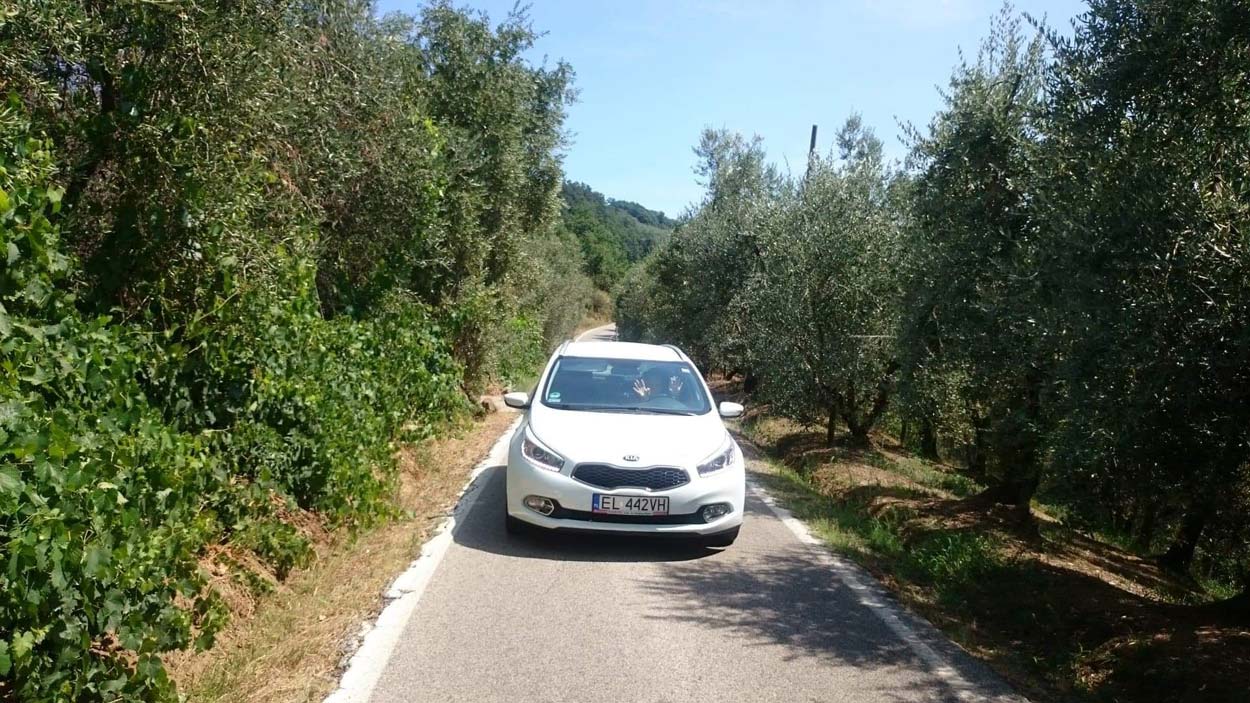
So I definitely recommend having your own means of transport. If you live so far away that you can't get here by car, just rent a car at the airport. I have prepared a special article about renting a car in Italy guide – [click]. With my guide, renting a car is not difficult or complicated, and at the same time it is very safe (the matter of choosing insurance). You just need to know how! I encourage you to read it: Italy – car rental without deposit and credit card [GUIDE]
Travel Insurance (Is It Necessary?)
I don't want to spend too much time on this topic, so I'll be really specific. I'll be brief: I never leave home on a trip alone without insurance. On a trip we are constantly moving to new places, our heads are occupied with delights and other pleasures. We are more relaxed and it is not difficult to have an adventure. Lack of insurance is asking for serious trouble.It is also worth remembering that the so-called EHIC, i.e. the insurance that we have as citizens of the European Union, does not reimburse everything. It only reimburses what is reimbursed in a given country (e.g. in France, 35% of the costs of state rescue services are paid out of pocket). We could go into details for a long time, but doing so is pointless, because a solid weekly insurance for one person in Europe, compared to the cost of the entire trip it's surprisingly cheap. You can easily find really good deals for around 10-15 EUR total for the whole week (!!!), which is the equivalent of two or three beers.
I usually look for the best deals in this area offer comparison - [click] (in this case it's Rankomat) and I buy them online. You can do it really quickly and cheaply.
If you need a good source of insurance outside of Poland, check out the highly rated EKTA insurance company - [click], available in several languages and selling insurance that works worldwide. If the page opens in the wrong language for you, simply change the language (top right).
Below is an example of a good and not at all the cheapest offer from a price comparison site (for an entire week in 2025).

Two parameters are key in the offers:
- goat goat (KL) - the minimum amount is PLN 250 (EUR 000)
- Civil protection (OC) - the minimum amount is PLN 250 (EUR 000)
it is worth paying attention to two additional parameters:
- Consequences of Accidents (NNW) - at your discretion
- travel luggage insurance - at your discretion
Tuscany – attractions map
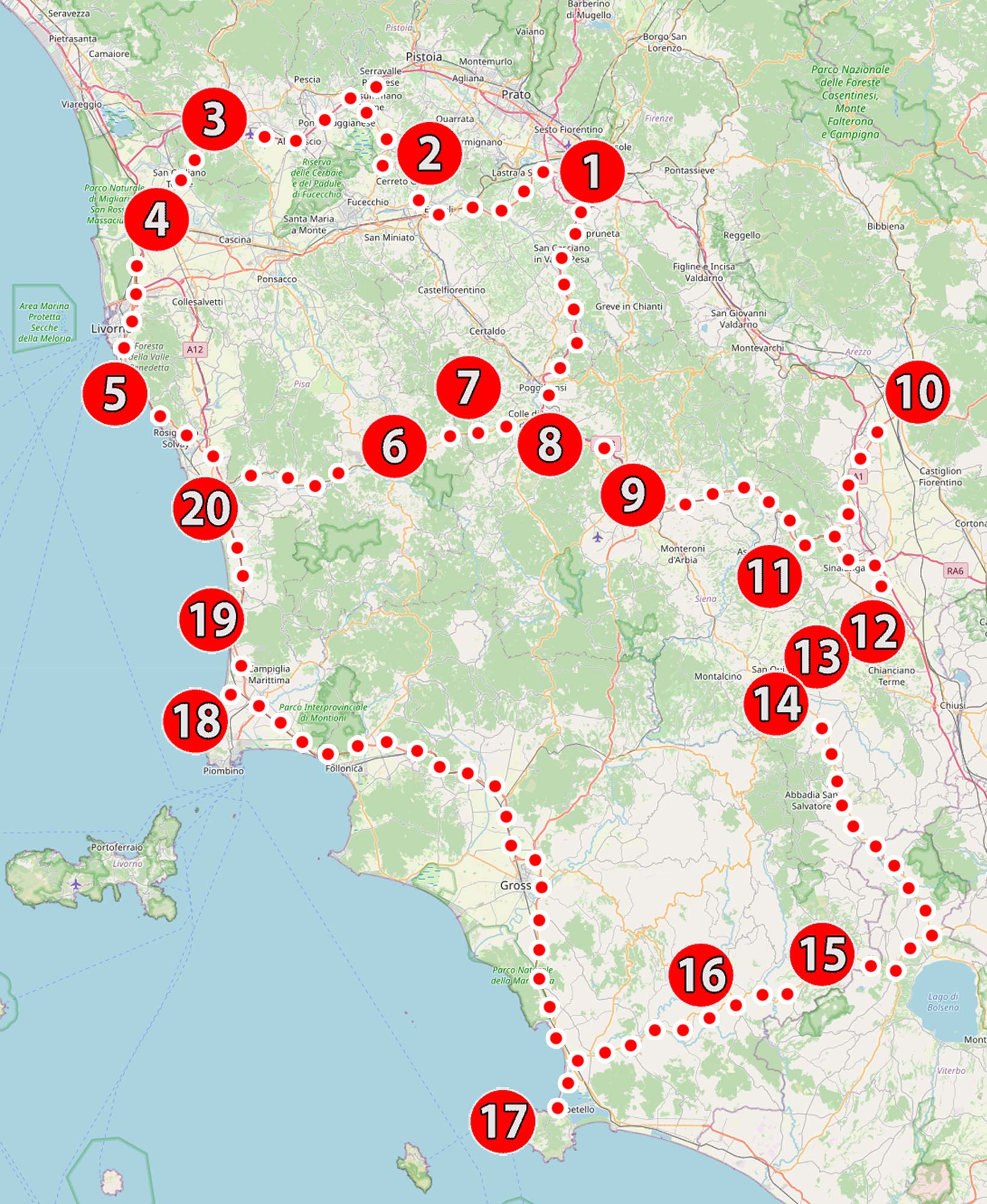
The main starting point for building a plan to visit Tuscany should be the map of Tuscany below, on which I have marked the location of 20 main attractions.
It's worth spending some time looking at it and checking the location of the places that interest you the most. If you click on the map, a higher resolution image will open with more details (routes, names of nearby towns, etc.)
Tip:
If you lose your map, don't worry! You don't have to remember any pages!
Type in Google: gancarczyk Tuscany
I'll show up first! It always works!
(for other fields as well)

List of tourist attractions on the map:
1. Florence
2. Vinci
3. Lucca
4. Pisa
5. Calafuria
6. Volterra
7. San Gimignano
8. Monteriggioni
9. Sienna
10. Arezzo
11. Val d'Orcia
12. Montepulciano
13. Pienza
14. Bagni San Filippo
15. Pitigliano
16. Terme di Saturnia
17. Monte Argentario
18. Baratti Bay
19. Marina di Castagneto Carducci
20. Marina di Cecina
Each attraction has its own unique number. You will also find this number in the table of contents at the beginning of the guide and in the chapter headings related to a broader description of attractions. Each attraction I mentioned has its own description, containing more details, interesting facts and very useful ones GPS coordinates of important places and parking lots, making it very easy to reach them. Use this data! They are very simple to use. Just click on the link next to them, a navigation on the phone will start automatically and will calculate the route to your destination (just don't forget to switch the navigation from walking mode to driving mode or vice versa).
Some of the attractions, in addition to the brief information in this entry, have their own articles devoted to them, containing a large amount of data and advice. Links to them (if such extended entries exist) can be found in the short descriptions attached later in the guide.
Work on extended descriptions is still ongoing, so the number of links will increase.
Tuscany guide extension
The great popularity of the guide and the numerous positive comments from you have prompted me to expand it. I decided to add more unique places and mark them on the map as additional suggestions.
Except 20 basic attractions (numbers 1-20) around which the main route is arranged, you will now find on the map 12 supplementary points (numbers 21-32). For quick distinction, basic and additional attractions are colored differently on the map.
The rule is simple: Have more time? Add an item from the optional list. Less interested in something on the main plan? Swap it for one of the new options. This way, you'll create a plan perfectly tailored to your needs. Let this be your dream Tuscany and the best trip of your life!

Tuscany map PDF
The expansion of the guide coincided with the idea of creating PDF maps of Tuscany, which you can take with you and always have with you on your phone. The idea is simple. First, you download a PDF map to your phone (a lightweight, small, and secure file). When needed, you open it and click on the point of interest. You immediately receive all the information and GPS coordinates for navigation. Click and go. Done! No typing, no searching, no remembering.
The downloadable file (free of charge) along with short instructions on how to get 100% out of the PDF map can be found in a separate post: Tuscany map PDF – [click].
However, if you happen to forget your map, it's not a big deal. Type "gancarczyk Tuscany" and I will appear first in the results. Generally, this rule also works for all other directions. Just enter my name and direction departure. It always works.
Tuscany sightseeing plan
When working on the Tuscany tour plan, I tried to prepare it in such a way that it would be useful to as many people as possible. I would like it to be able to be used by novices who are going to this area for the first time in their lives, but I also wanted it to be useful for people who have already seen something in Tuscany.
This created a concept that the more I thought about it, the more I liked it. Why? Because, apart from the fact that it is suitable for people with varying degrees of advancement in visiting Tuscany, it also allows for flexible adjustment of the duration of the trip to the length of the holiday.
So what is my plan? Divided Tuscany into several convenient areas to explore! Everything will be explained to you in the next chapter.
Visiting areas
Look at the map below. This is exactly the same map of attractions that we already know from this entry, but I applied a specific mask to it, separating several areas marked with letters: A, B, C, D i E.
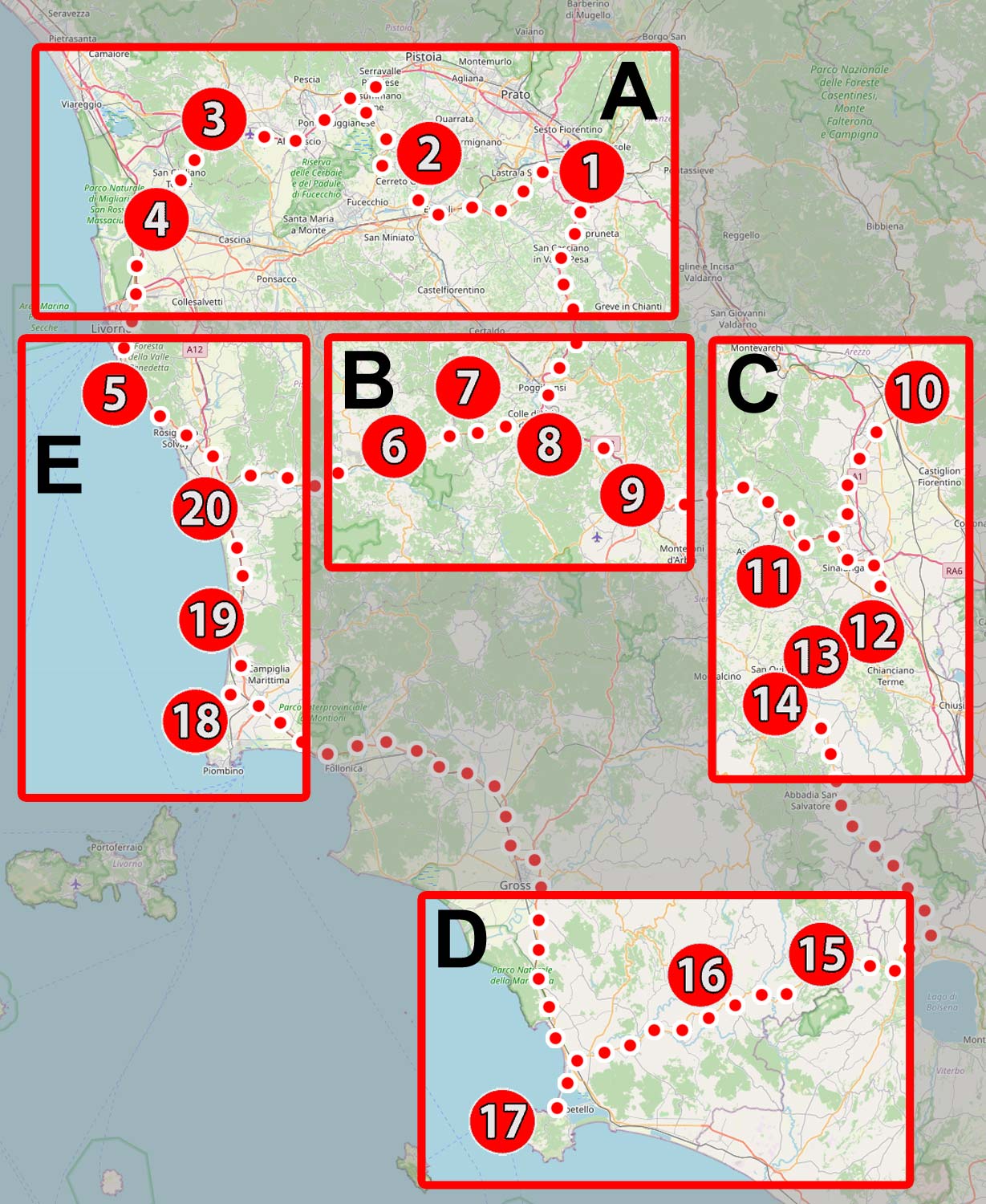
It is easy to name each area directly after the most important attractions in its area. So we have:
Distance A – around Florence and Pisa
Distance B – around San Gimignano and Siena
Distance C – Val d'Orcia (Orcia river valley) and Crete Senesi (desert area)
Distance D – south of Tuscany
Distance E – Tuscan coast
The areas include areas that do not overlap with each other, but they all have one common and very important feature: Two days are enough to visit each of them, or even more precisely, two nights.
Approaching the matter in this way, planning a visit becomes very easy. Just choose the areas that interest you the most and, knowing that you need to spend at least two days on each of them, choose their number according to the length of your vacation. Ready!
However, before you decide which areas to choose, read a few words about the content each of them offers!
Area A – around Florence and Pisa
All attractions in the area: (1) Florence – (2) Vinci – (3) Lucca – (4) Pisa
Total length of the route: approximately 120 km
Stravel time agreement (without visiting time): 2 h 30 min
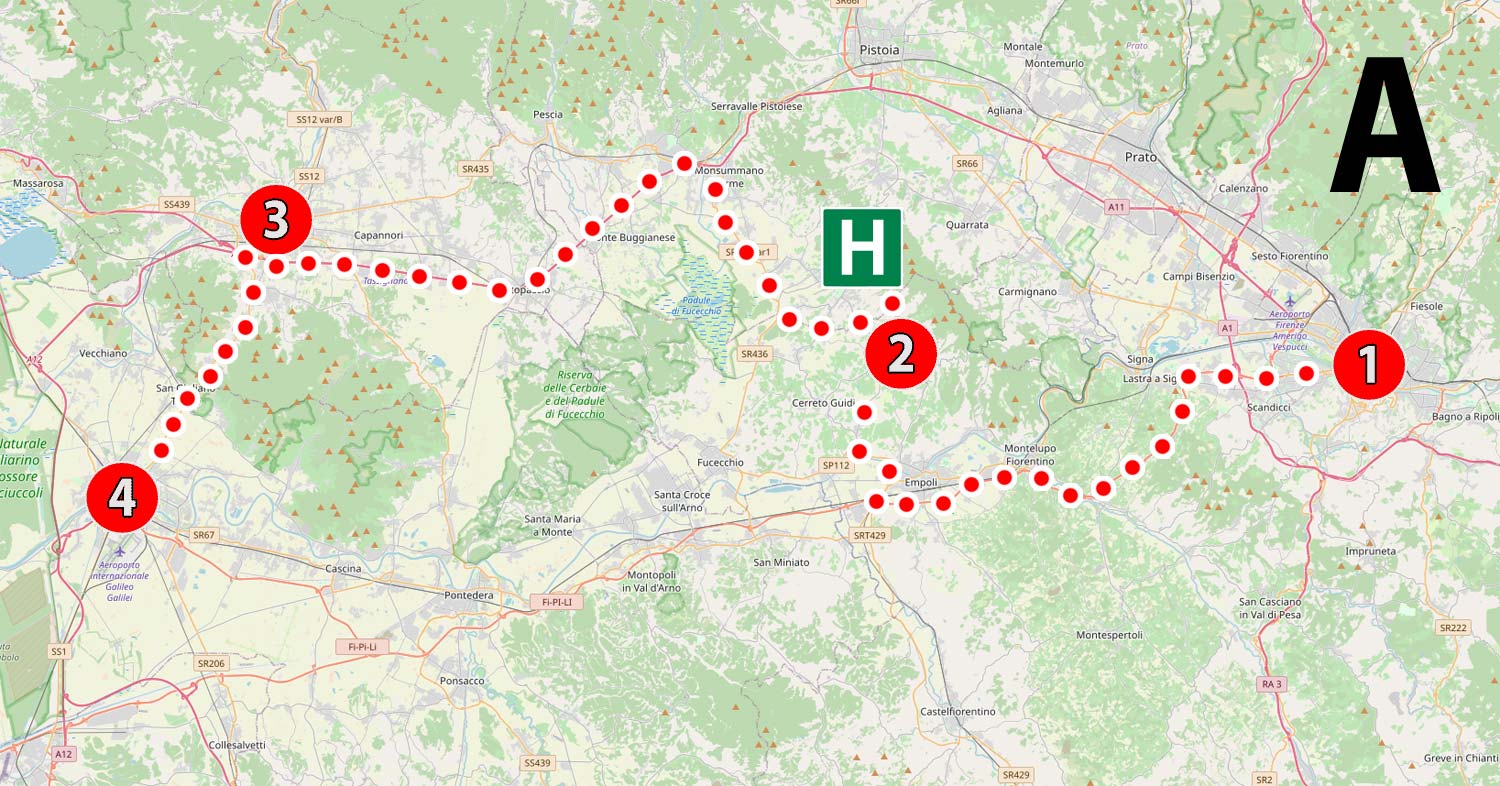
Just a few sentences earlier, I had optimistically assumed that two days would be enough to visit each area, but suddenly... area A the first problems appear. It's true that there are only four locations planned here, but what!!! I don't need to introduce Florence. The city will definitely take you all day to explore. If you decide to stay overnight in one of the other locations (we stayed near Vinci, specifically in the small town of San Baronto, where we have inexpensive but comfortable Hotel Monti, which we have been eagerly returning to for years, I marked its location with a green pictogram with the letter H), then the next day you can start visiting Vinci (2) in the morning, where Leonardo da Vinci was born and lived. Then Lucca (3) with its fantastic buildings, oval market and observation tower, and in the evening you will reach the legendary Pisa (4) to see how lean the world-famous tower is. If you plan an overnight stay in Pisa (4), you will have the opportunity to see it during the day and at night, under the glow of artificial lighting. As you can easily guess, this is an additional attraction. I am considering this idea.
Most trips in this area will be on fast roads, so it will be difficult to get beautiful views from the car, but there will be time for that.
Area B – around San Gimignano and Siena
All attractions in the area: (4) Pisa – (6) Volterra – (7) San Gimignano – (8) Monteriggioni – (9) Siena
Total length of the route: approximately 150 km
Total travel time (without visiting time): 3 h
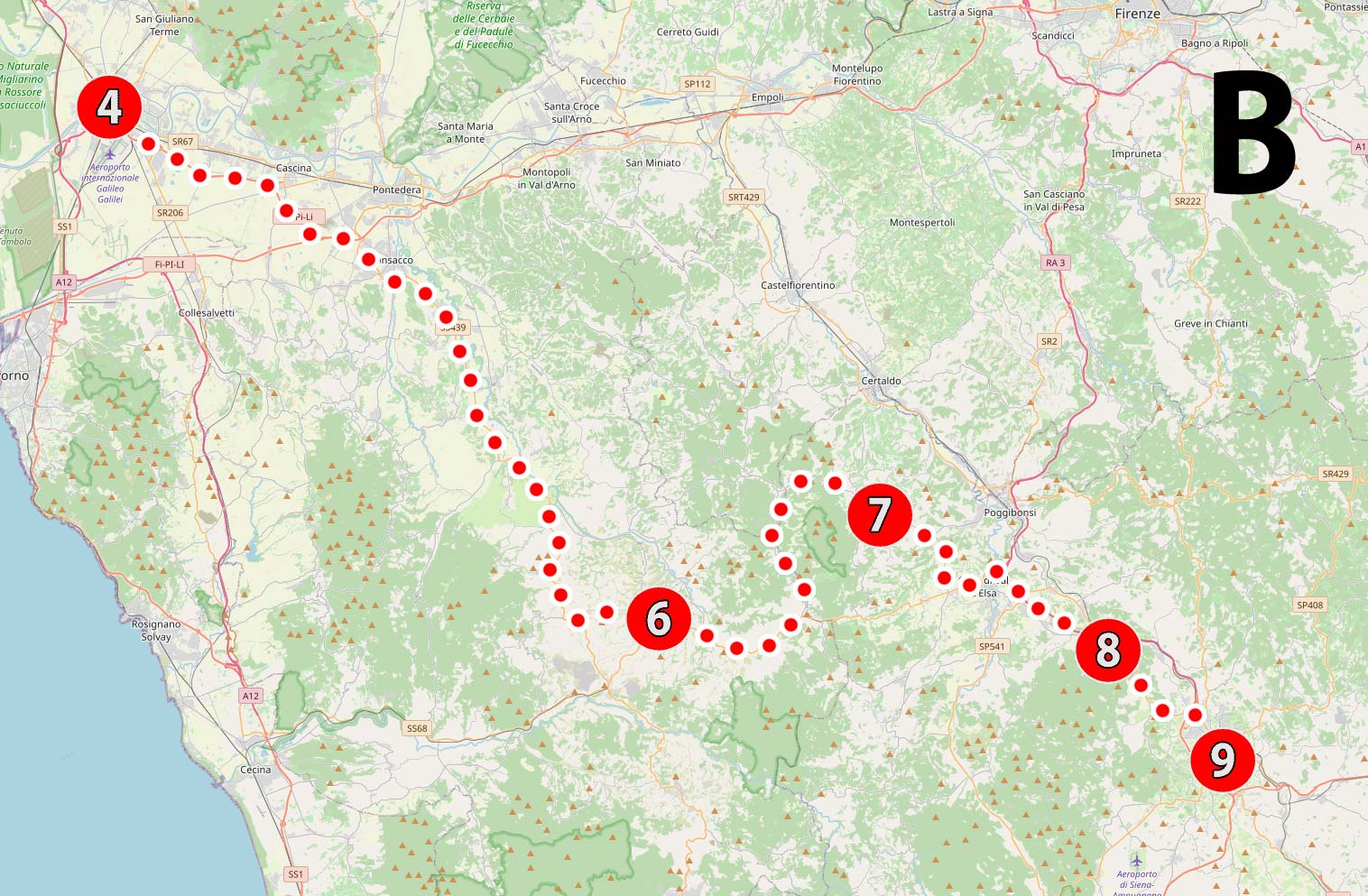
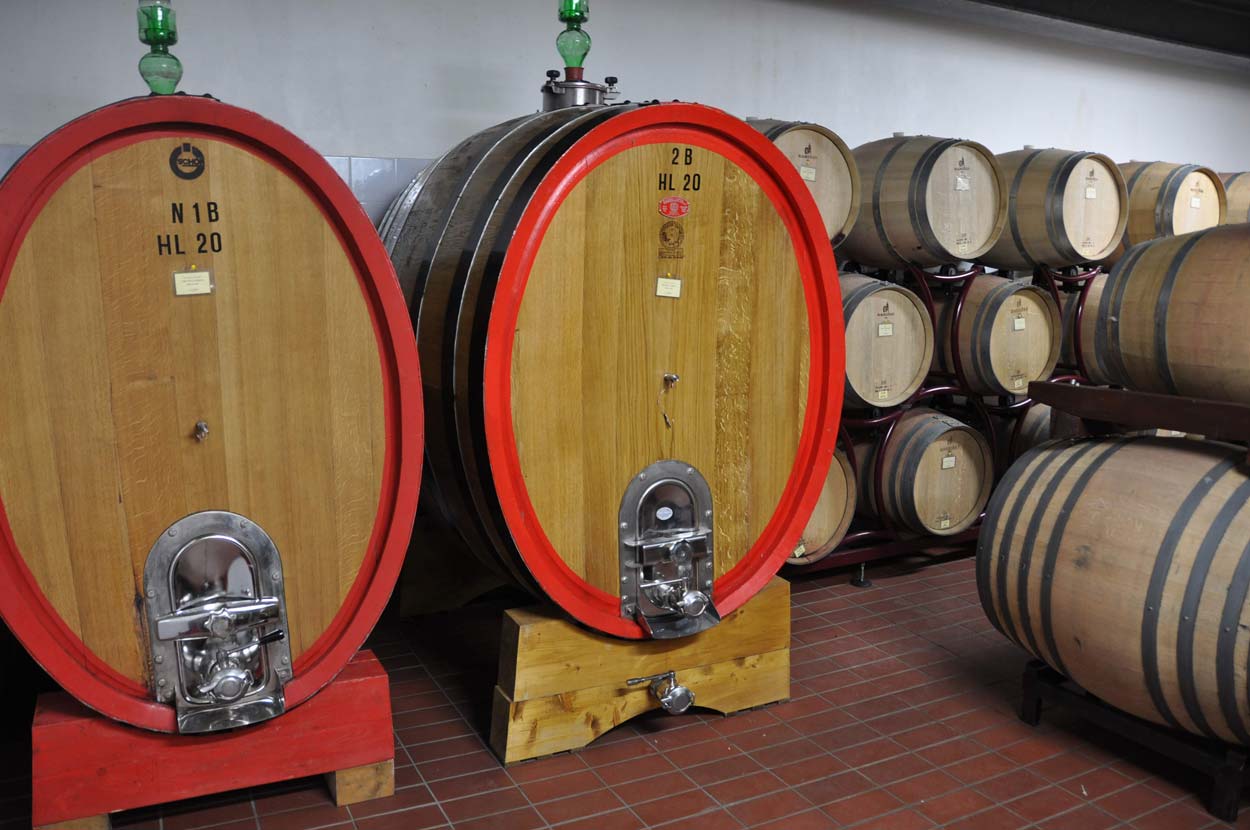
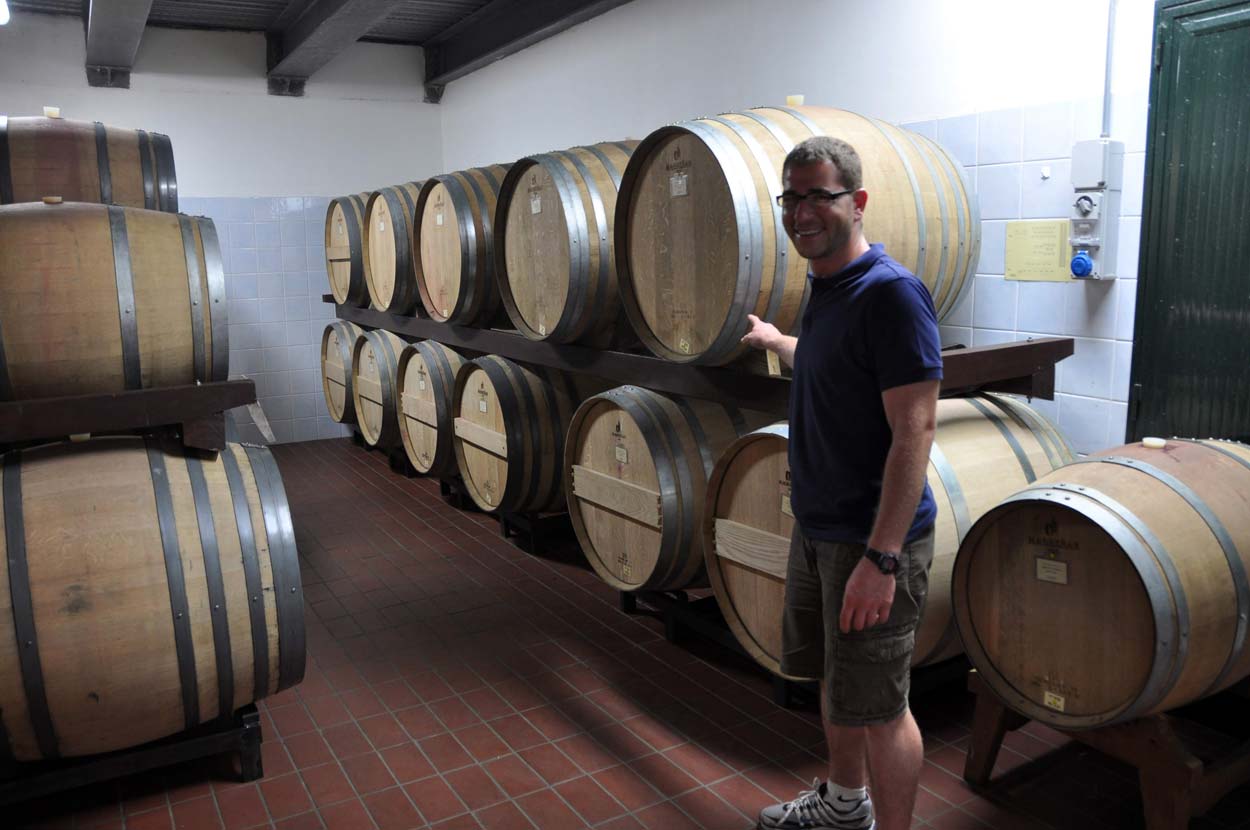
The second area is the quintessence of Tuscany, where you will begin to discover subsequent towns that will appear unexpectedly among the rolling Tuscan hills, surrounded by vineyards and olive groves. Every now and then you will see signs inviting you to visit subsequent vineyards to taste and purchase selected products. Don't be afraid to visit vineyards and olive presses. The hosts will be happy to welcome you and sometimes show you around their kingdom, among large barrels of fermenting and maturing wine. The experience is wonderful, and a souvenir in the form of purchased wines is perfect when, after returning home, on an autumn or winter evening, it is time to remember the trip. The taste of the original wine perfectly helps recall sunny memories.
Between the vineyards you will come across medieval towns whose delightful, narrow streets will lead you by the hand. San Gimignano, Volterra, Monteriggioni, and finally the absolutely brilliant Siena. It's hard to imagine a more beautiful set!
By the way, I would like to remind you that when traveling from one attraction to another, you do not have to choose the shortest or fastest route!
Area C – Val d'Orcia (Orcia Valley) and Crete Senesi
All attractions in the area: (9) Siena – (10) Arezzo – (11) Val d'Orcia (12) – Montepulciano – (13) Pienza – (14) Bagni San Filippo
Total length of the route: approximately 210 km (without exploring the Val d'Orcia valley)
Total travel time (without sightseeing time): 3 h 45 min (without exploration time in the Val d'Orcia valley)
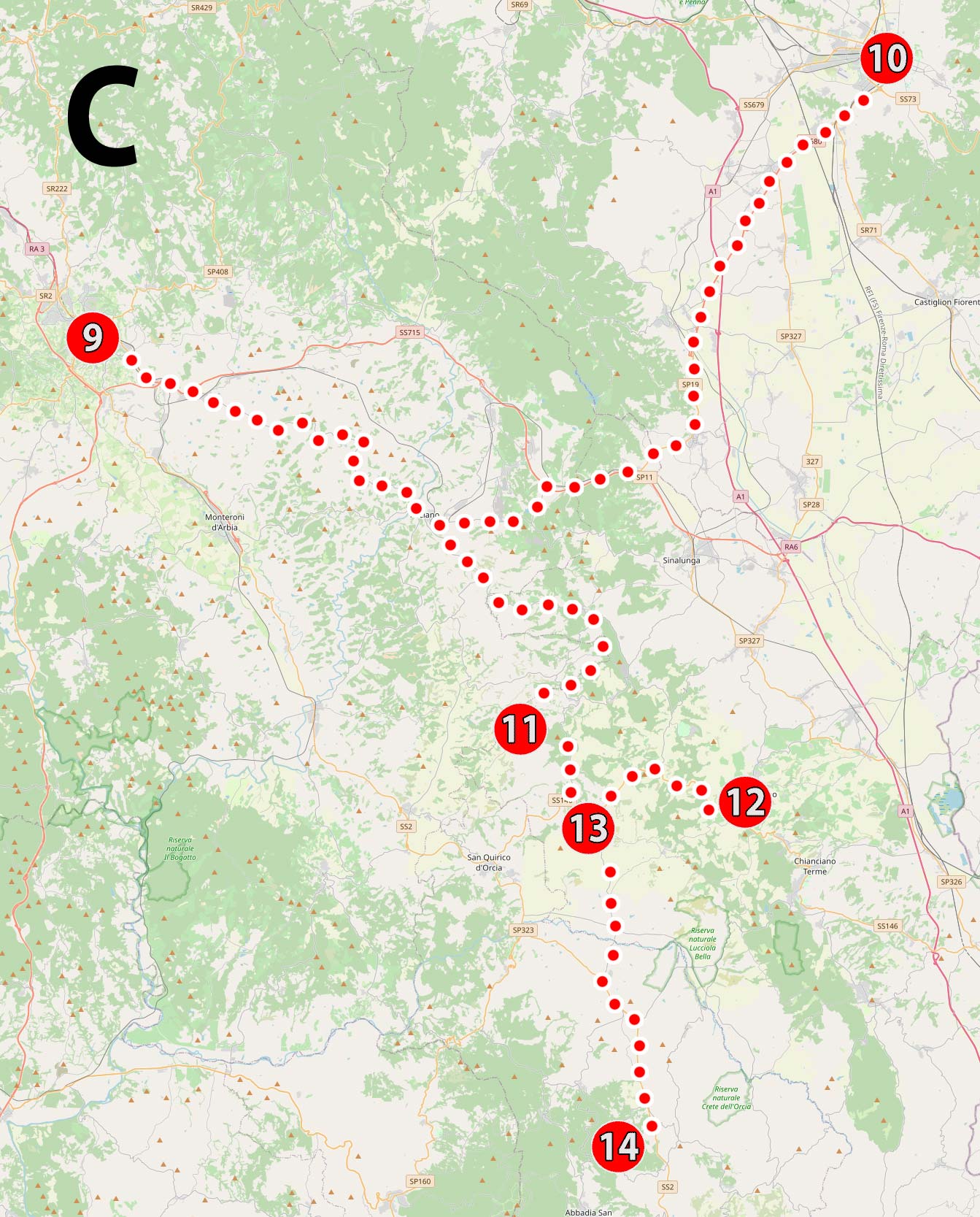
The third area is the next stage of getting to know the diversity that Tuscany offers us. A real nature rollercoaster!
Apart from interesting towns, we will focus on landscapes that we all know from exceptionally beautiful postcards, presenting vast, gently rolling hills illuminated by the rising or setting sun. We will look for the world-famous cypress formations and avenues typical of this landscape, but before that we will pass through the Crete Senesi area, which is the only Italian… desert! We will travel from the harsh Tuscan desert to the Tuscan greenery of vineyards and olive groves.
Finally, we will reach the first hot springs and thermal springs on the route of this trip, creating colorful waterfalls.
I suggest devoting one of the two days intended for visiting this area to a full-day wander around the valley. Val d'Orcia – [click]. Your imagination, willingness to look literally everywhere, and driving on roads that are not connected to navigation will be especially important here :)
Area D – south of Tuscany
All attractions in the area: (14) Bagni San Filippo – (15) Pitigliano – (16) Terme di Saturnia – (17) Monte Argentario
Total length of the route: approximately 140 km
Total travel time (without visiting time): 3 h
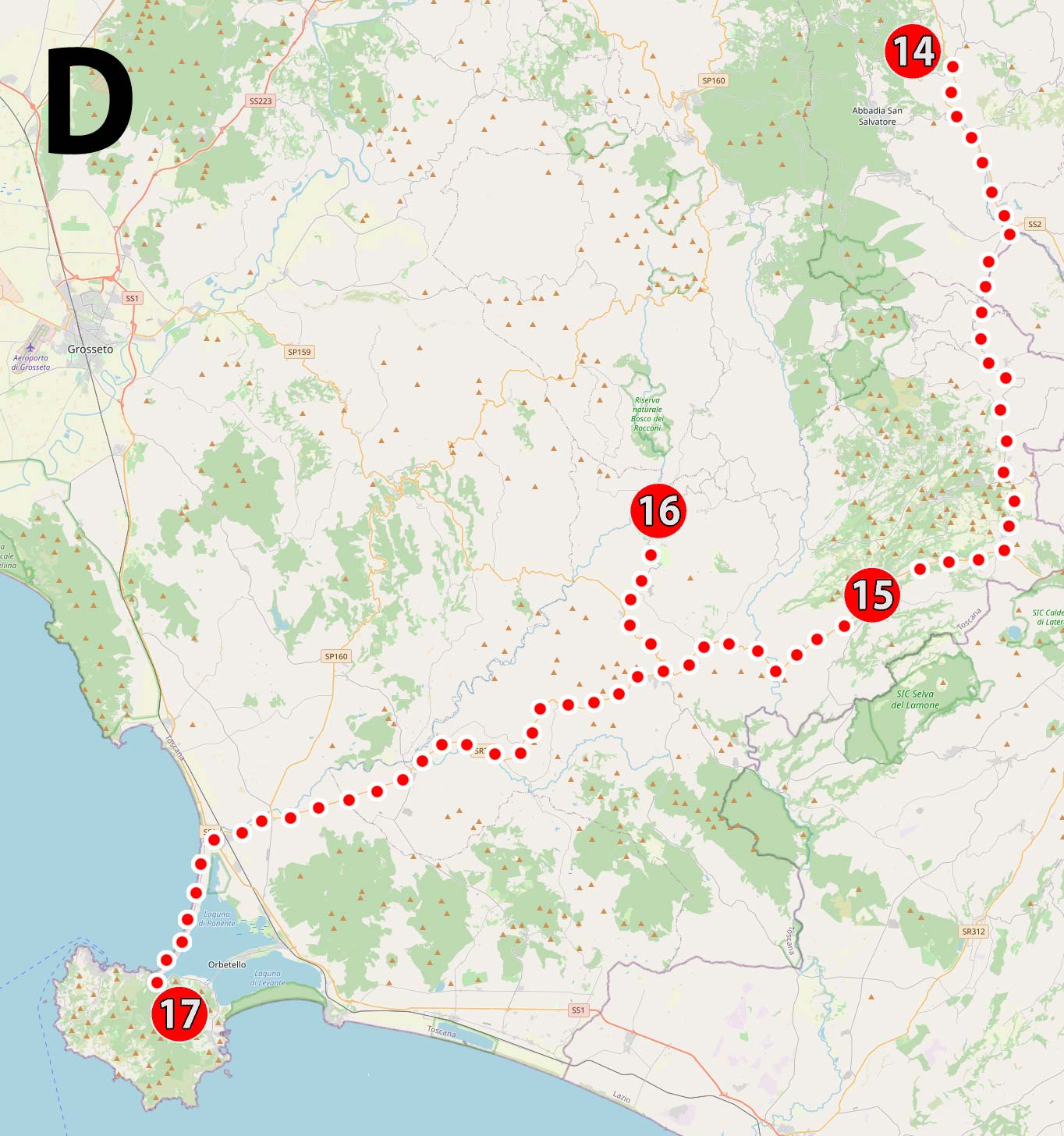
This time we will visit another very eye-catching and beautifully situated town, and further along the way we will be able to relax in the famous Saturnia thermal baths (you can use a high-quality resort with swimming pools or simply enjoy the amazing, natural swimming pools). At the end of the trip, we will reach the Tuscan coast, specifically the interesting Monte Argentario peninsula, which once... was an island! This is where the slightly lazier part of the trip begins :)
Area E – Tuscan coast
All attractions in the area: (17) Monte Argentario – (18) Populonia and the Gulf of Baratti – (19) Marina di Castagneto Carducci – (20) Marina di Cecina – (5) Calafuria
Total length of the route: approximately 210 km
Total travel time (without visiting time): 3 h 20 min
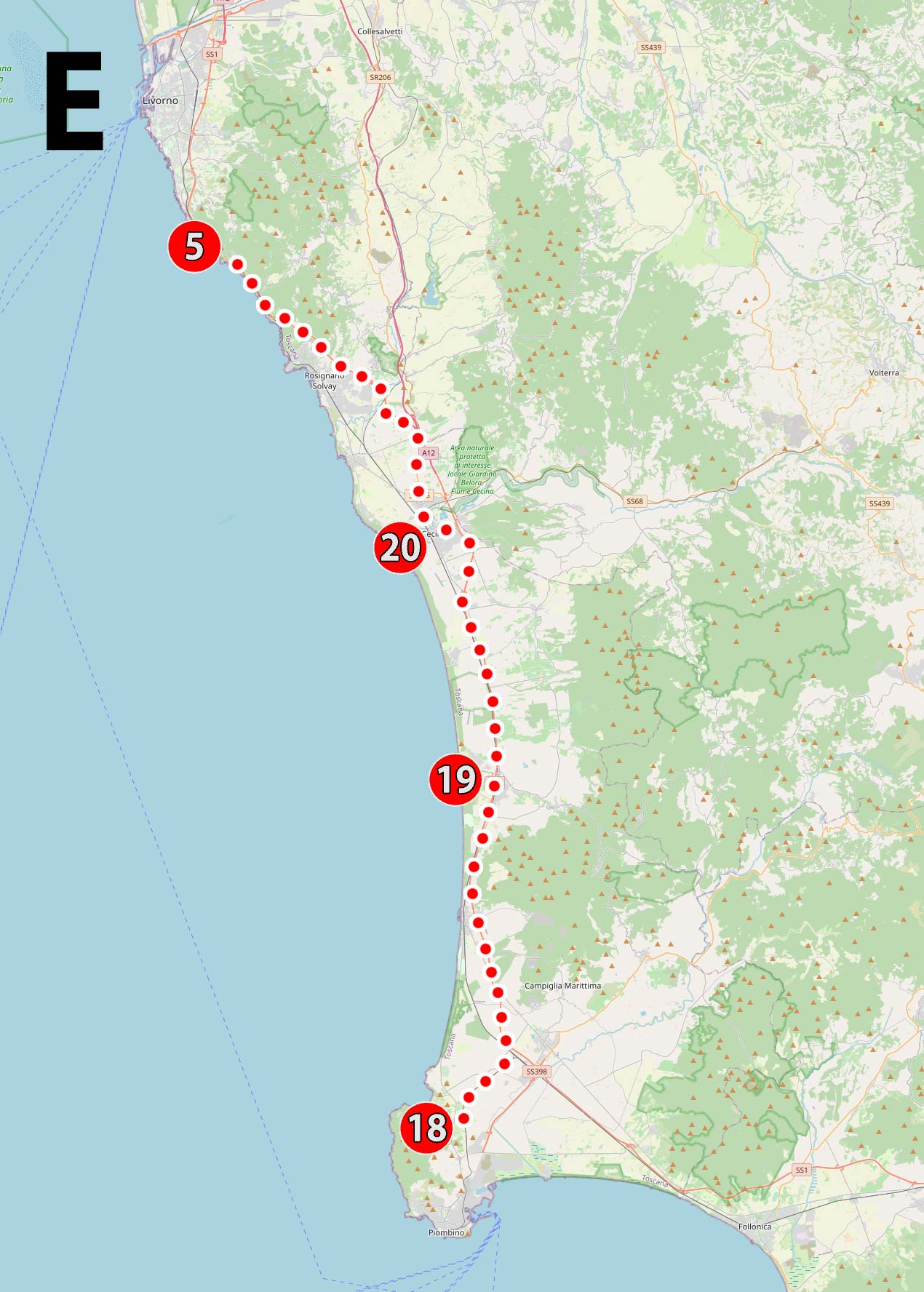
In the case of the last area, it is difficult to talk about sightseeing, although there are also such places (e.g. the extremely interesting Populonia). It should be treated rather as an opportunity for a short rest after a long and intense sightseeing and before returning home. If someone has a restless spirit, they can treat the beaches I have suggested as trip points that are an excuse to get to know the Tuscan coast. A particularly interesting part of the rugged coastline, on which you can even take a short walk, is located between Quercianella and Calafuria (5).
I guess that some people, contrary to me, will place this area not at the end, but at the very beginning of the trip and... they won't leave it anywhere 😀
This is possible, and even very likely, especially since some of the attractions in areas A, B and D are within reach of one-day trips from the Tuscan coast.
Yes Yes!!! I know that a plan is already forming in your head: what about lying on the seashore and just going inland from time to time to see something? This may also be an interesting proposition, and thanks to this entry you will be able to develop such a plan on your own quickly and without much effort!
I encourage you to experiment on your own! As you can see, there are many possibilities and there is no one best plan for visiting Tuscany in the world... as I loyally mentioned at the beginning.
Descriptions of attractions in Tuscany
Below you will find really short descriptions of all the attractions visible on the map of Tuscany. I include GPS coordinates of key points in the descriptions, including parking lots allowing you to stay near the attractions. I encourage you to use them. Every driver will appreciate such convenience. You click your finger, the navigation starts automatically and you're on your way.
For each attraction, I also include a link to accommodation. The links provided contain filters I have prepared. They prevent the display of offers that could unnecessarily clutter the search results and appropriately narrow the search area to the area that interests us. So you don't have to do it manually every time. I recommend using these links because they make your search easier and save time.
For some locations, I will also include links to hotels. Do not treat them as a recommendation of a specific hotel. When posting a link to a hotel, I use the search engine mechanism, which, next to the selected hotel, always suggests several alternative accommodations with similar parameters (location, quality, and often a more attractive price, etc.). So treat them as a very simple way to search for and compare many offers from one place with one click. Smart and effective.
1. Florence
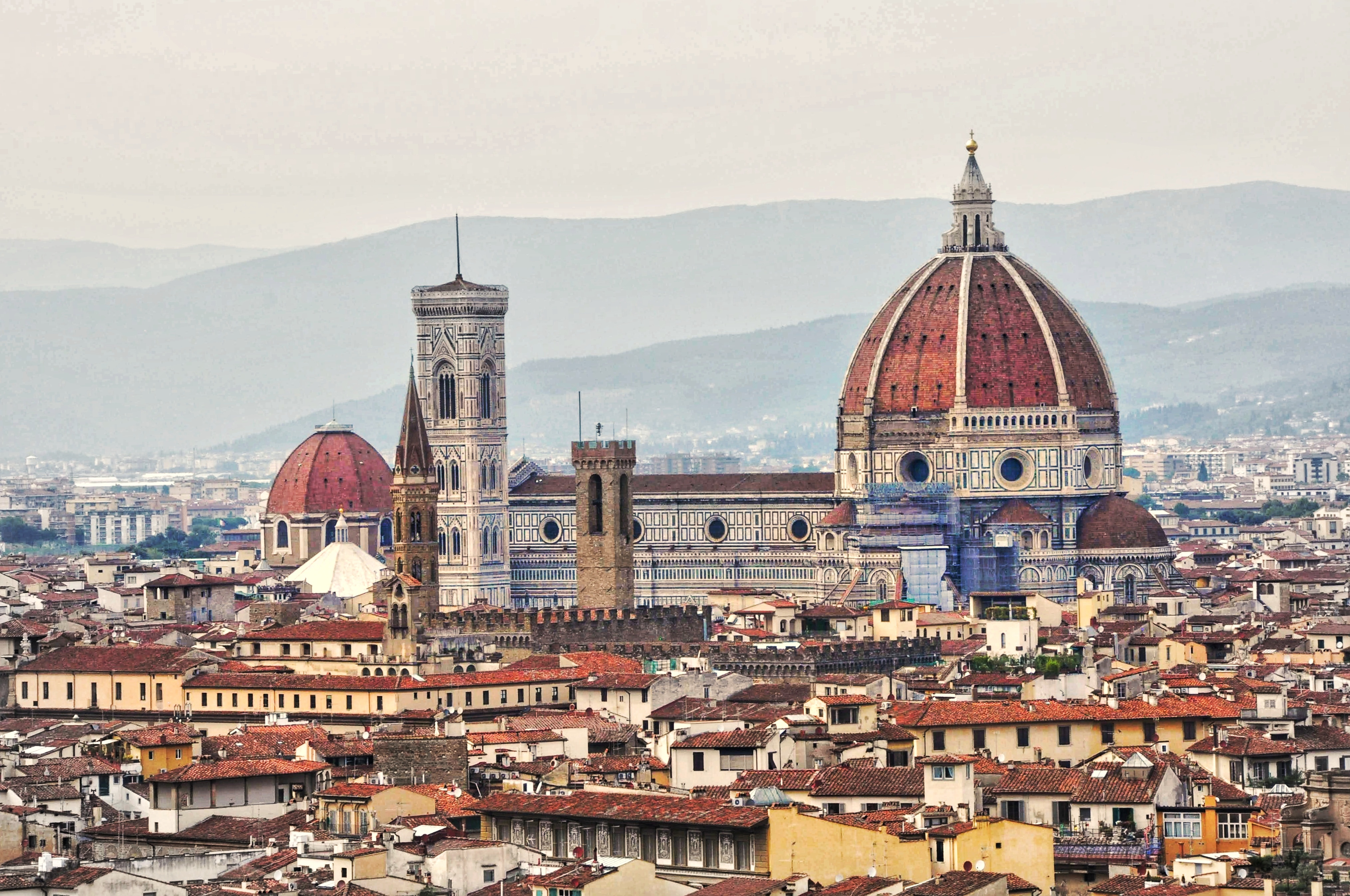
Florence is beautiful, captivating and filled with amazing stories that have significantly influenced and shaped the fate of the entire world. Walking through the streets of Florence, you can literally touch this history and feel the thrill of being so close to something extraordinary and unique in the world... but be careful! Florence is also kitschy, loud, crowded, damn expensive and insidious. This different, less pleasant face of Florence is the result of the modernity and popularity of the city, which is absolutely used to make quick money. The city streets are filled with tons of crap pretending to be souvenirs and traders (or rather scammers) wandering around looking for opportunities to make a quick buck.
However, if you know what awaits you and consciously ignore this slightly less pleasant appearance (it is possible and even quite easy) without paying much attention to it (although it is always worth watching out for petty thieves), Florence will charm you. The city will respond with a powerful charge of Renaissance taste, splendor, thoughts open to impossible things and will capture your memories forever!
I dedicated a separate guide to Florence – [click], because it cannot be described in one short note. Here I will include only some of the most important information that will allow you to quickly organize yourself and explore the city efficiently.
Firstly, parking the car. It is not that simple and obvious. Florence's entire downtown area is covered Limited Traffic Zone cars, marked as ZTL (Zona a Traffico Limitato). You can only enter it if you have the appropriate permissions. Tourists do not have such rights because the zone was created to limit the traffic they generate. You are not even allowed to enter the parking lot, which is located in the ZTL zone. Only vehicles authorized to stay in the ZTL zone can park there. Unauthorized entry into the ZTL area results in a high fine. There's no need to get caught. The area is monitored and the monitoring is regularly analyzed, so I do not recommend any combinations.
Accidental entry into the ZTL area is practically impossible, because each entrance is clearly marked with boards and traffic lights (I don't expect anyone to drive through a red light without reading the board).
There are periods during the day and at night when the ZTL zone does not apply and you can move around freely within it, but there is no point in providing this information here. When entry to the zone is allowed, the light changes from red to green and this closes the case. Anyway, below are the directions to several official parking lots available to tourists, located in a safe area right next to the border of the zone.
These parking lots are close to the most important attractions and it won't get any closer.
For better and faster orientation, I have prepared a simple map showing the location of parking lots and some of the most important and must-see attractions in the city.
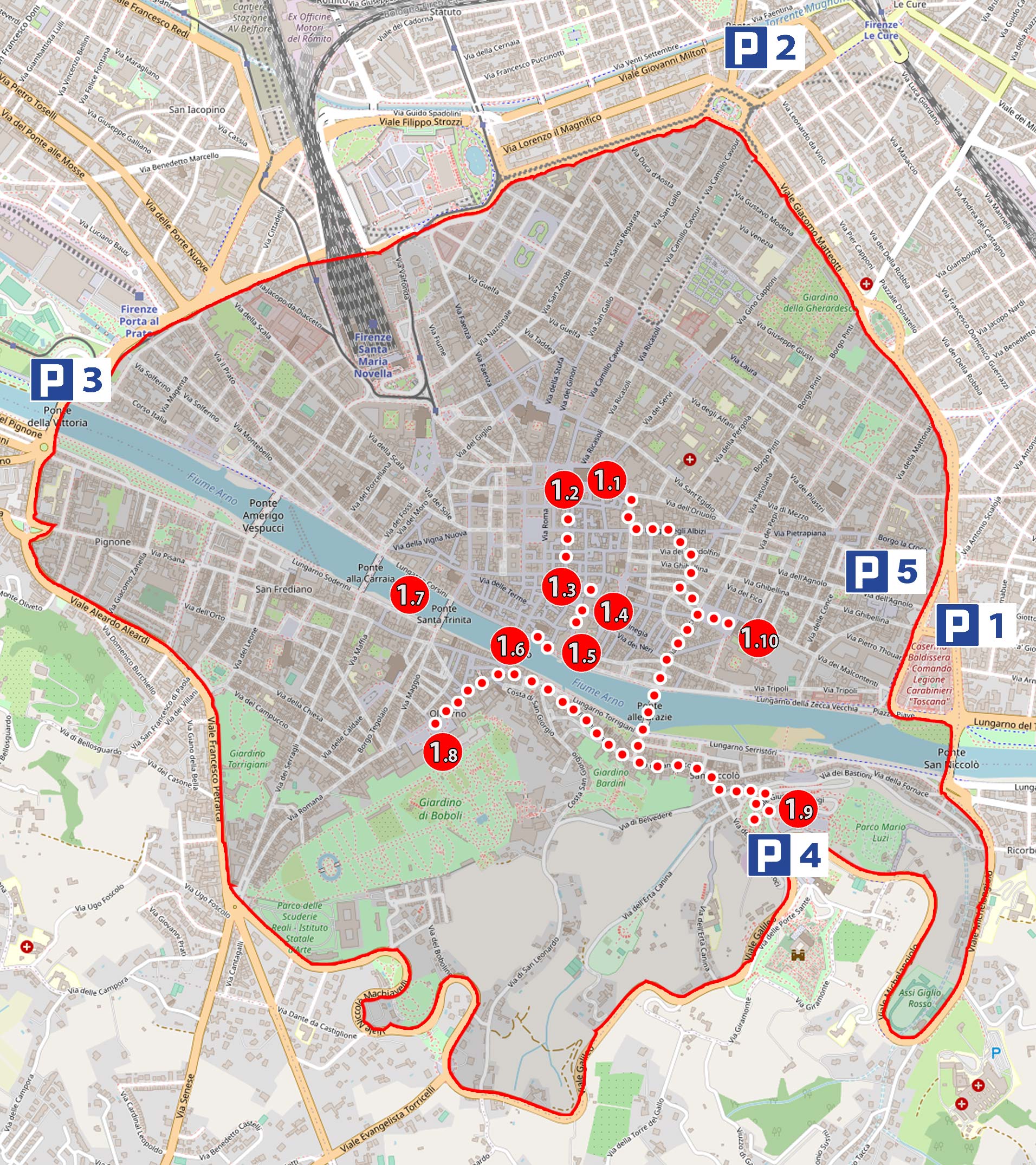
1.1 Cathedral of Santa Maria del Fiore (Cattedrale di Santa Maria del Fiore)
1.2 Giotto's Bell Tower (Campanile di Giotto)
1.3 Piazza della Signoria
1.4 Palazzo Vecchio
1.5 Uffizi Gallery (Galleria degli Uffizi)
1.6 Bridge of Vecchio (Ponte Vecchio)
1.7 Arno River
1.8 Palazzo Pitti
1.9 Michelangelo's Square with a panoramic view of Florence (Piazzale Michelangelo)
1.10 Church of Santa Croce
check out: accommodation Florence – [click]
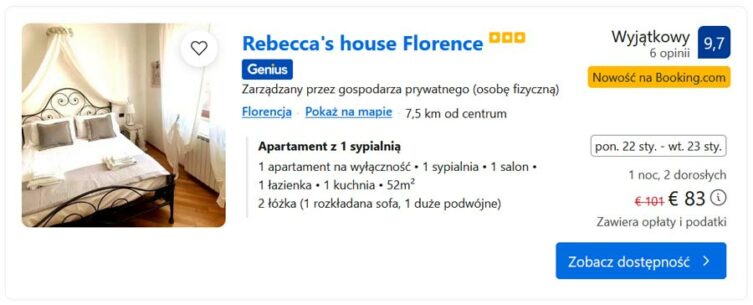
hotel: Rebecca's house Florence – [click]
Parking lots available to all tourists (outside the ZTL zone):
P1 – Underground parking lot: Parcheggio Beccaria, GPS coordinates:
43°46’10.7″N 11°16’15.3″E
43.769627, 11.270909 - click and route
P2 – Multi-story parking lot: Firenze Parcheggi – Parterre, GPS coordinates:
43°47’07.9″N 11°15’44.7″E
43.785527, 11.262414 - click and route
P3 – Outdoor parking: Parcheggio Vittorio Veneto, GPS coordinates:
43°46’31.7″N 11°14’09.8″E
43.775473, 11.236048 - click and route
P4 – parking lot at the Florence viewpoint: Parcheggio Viale Michelangiolo, GPS coordinates:
43°45’45.6″N 11°15’53.0″E
43.762671, 11.264726 - click and route
P5 – underground parking lot: Parcheggio Sant'Ambrogio Firenze, GPS coordinates:
43°46’12.9″N 11°16’06.7″E
43.770246, 11.268524 - click and route
the street leading to this parking lot does not belong to the ZTL, but everything beyond the access street is already a ZTL zone
P6 – underground parking lot: Parcheggio Stazione Fortezza Fiera, GPS coordinates:
43°46’57.6″N 11°14’44.9″E
43.782656, 11.245808 - click and route
2. Vinci

Vinci is a small town located somewhere among the Tuscan hills. This is where Leonardo was born. A man who, like few others, influenced the history of the world, science and technology. According to the once common rule, when the name of the town from which he came was added to a person's name (e.g. Zbyszko from Bogdaniec), Leonardo born here was called Leonardo da Vinci (i.e. Leonardo of Vinci).
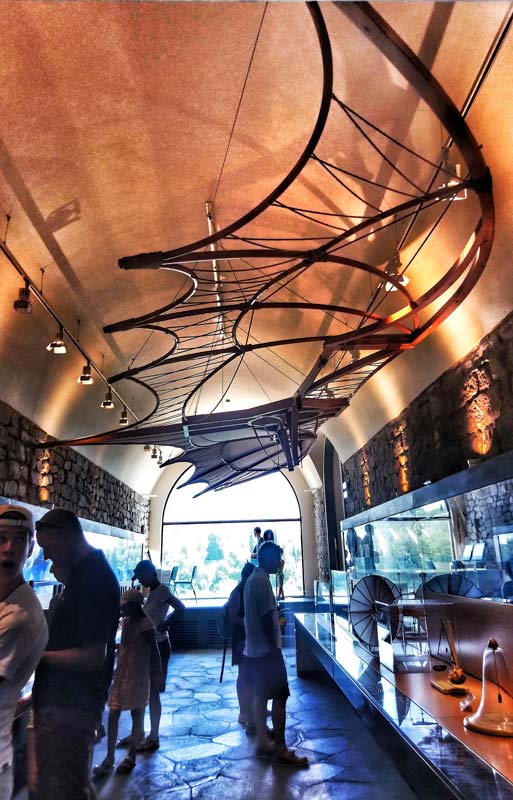
If you are interested in Leonardo da Vinci, be sure to visit Vinci. There is a very interesting museum here, where you can see working machines and other inventions made strictly according to Leonardo's designs. You will also see copies of the painter's most famous frescoes and paintings. In my opinion, this is the best Leonardo da Vinci museum I have ever been to.
Less than three kilometers from the museum, you can visit the house where Leonardo lived since he was a child, still standing here. The exhibition here is very modest (interesting are holographic, three-dimensional projections of figures, including Leonardo himself, which tell the history of the place). For me, the mere fact of visiting Leonardo's house was enough.
check out: accommodation Vinci – [click]
Leonardo da Vinci Museum (ticket counter and museum entrance), GPS coordinates:
43°47’14.1″N 10°55’35.6″E
43.787241, 10.926567 - click and route
Parking lot at Leonardo da Vinci's house, GPS coordinates:
43°47’59.7″N 10°56’20.8″E
43.799923, 10.939100 - click and route
Leonardo da Vinci's house, GPS coordinates;
43°47’57.0″N 10°56’17.3″E
43.799177, 10.938125 - click and route
my hotel recommendation:
While traveling in Tuscany, we liked it hotel Monti – [click] in the town of San Baronto. It has everything we need, and the price has always been attractive.
3. Lucca
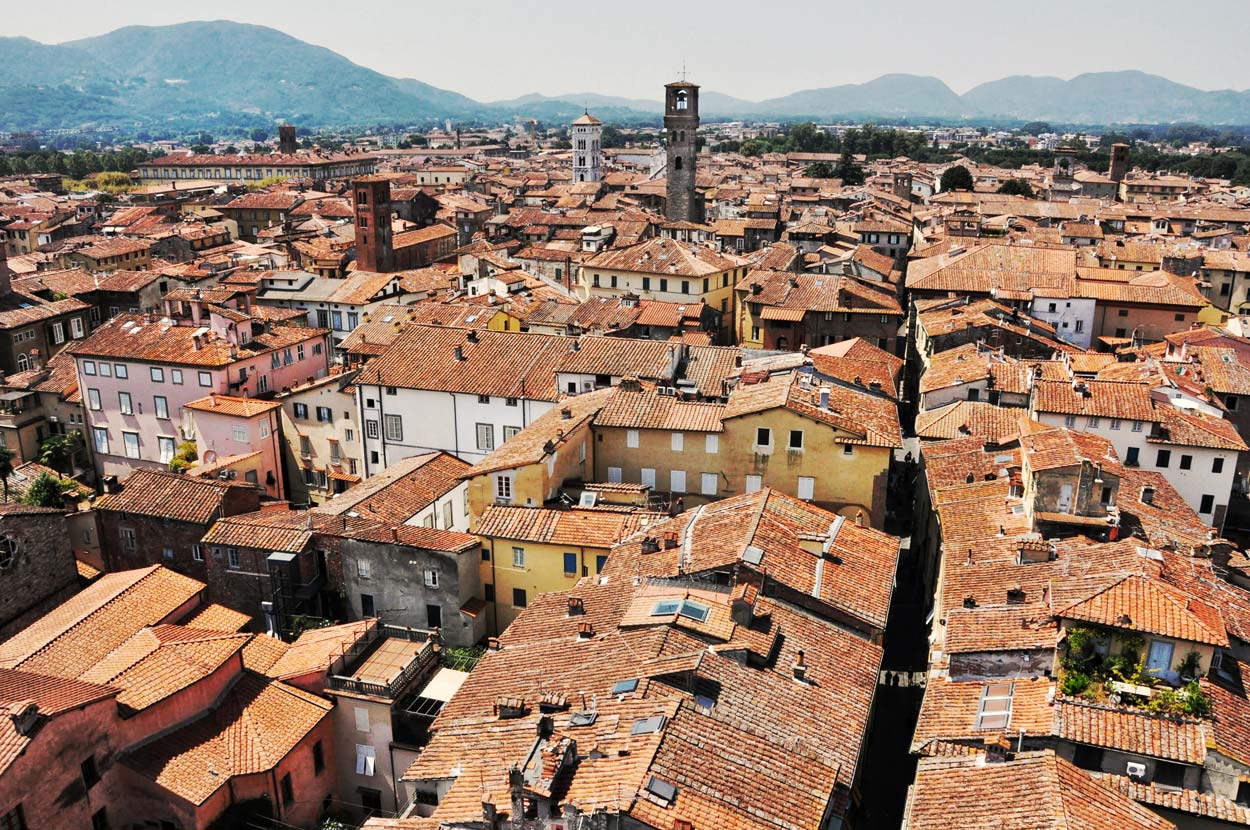
You must not miss Lucca. The city is really beautiful. It has largely preserved the architectural layout of the Roman city from the XNUMXst century BC and is entirely surrounded by a defensive wall. The compact nature of the city makes it very pleasant to visit. Narrow streets mean that even on hot and sunny days, you can always find some shade.
The key points are the oval Piazza dell Amfiteatro square, built on the site of a former Roman amphitheater (hence the shape and name), the beautiful Piazza San Michele square, where the characteristic church of San Michele stands, and the Cathedral of San Martino. It is also worth climbing to the top of the characteristic Guinigi Tower. You can easily recognize it because there are trees growing on its top :) Going to the top guarantees fantastic views of the city and the surrounding Tuscan lands.
Parking in a convenient place may be a minor problem. I definitely recommend using the paid, underground parking lot at Parcheggio Mazzini. The very fact that it is paid (although not expensive) makes it easier to get a place there. If there is no space in the indicated parking lot, you should look for a place near one of the entrance gates to the city. There are squares of various sizes next to them, with designated paid parking spaces. One of the largest is Parcheggio di Via del Pallone, which does not mean that you will 100% be able to find a place here.
check out: accommodation Lucca – [click]
Underground multi-story parking lot, Parcheggio Mazzini, GPS coordinates:
43°50’46.3″N 10°30’49.3″E
43.846205, 10.513698 - click and route
Parking on the street, Parcheggio di Via del Pallone, GPS coordinates:
43°50’31.1″N 10°29’47.0″E
43.841983, 10.496380 - click and route
4. Pisa
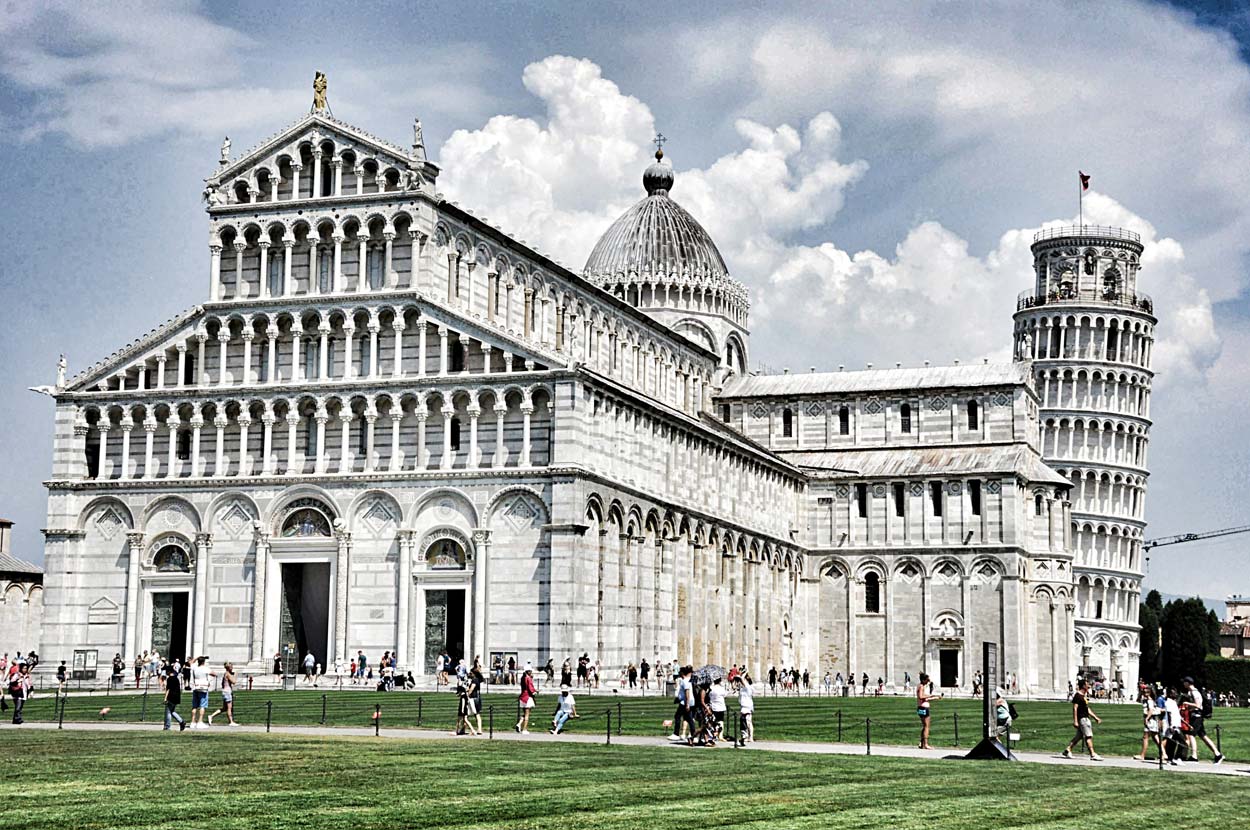
Everyone probably knows the symbol of Italy and the icon of Tuscany, the Leaning Tower of Pisa. I can't imagine exploring Tuscany without seeing the Leaning Tower with my own eyes. This is simply impossible.
The Leaning Tower of Pisa, located in the Square of Miracles, continues to enjoy great popularity and has become so popular that it has overshadowed other monuments in Pisa. So if you plan to come to Pisa, don't forget that in addition to the tower, there is a beautiful historical city center and the Arno riverfront surrounded by palaces.
From the Leaning Tower you will reach Piazza dei Cavalieri in 10 minutes (600 m), and the further walk to the bank of the Arno River near the Ponte di Mezzo will take another 6 minutes (450 m)
check out: accommodation Pisa – [click]
Huge parking lot near the Leaning Tower, GPS coordinates:
43°43’25.7″N 10°23’28.6″E
43.723802, 10.391283 - click and route
Leaning Tower of Pisa, GPS coordinates:
43°43’22.7″N 10°23’47.6″E
43.722978, 10.396557 - click and route
Piazza dei Cavalieri square in the center of Pisa, GPS coordinates:
43°43’09.8″N 10°24’00.5″E
43.719396, 10.400149 - click and route
The banks of the Arno River near the Ponte di Mezzo, GPS coordinates:
43°42’58.6″N 10°24’07.8″E
43.716266, 10.402164 - click and route
5. Calafuria
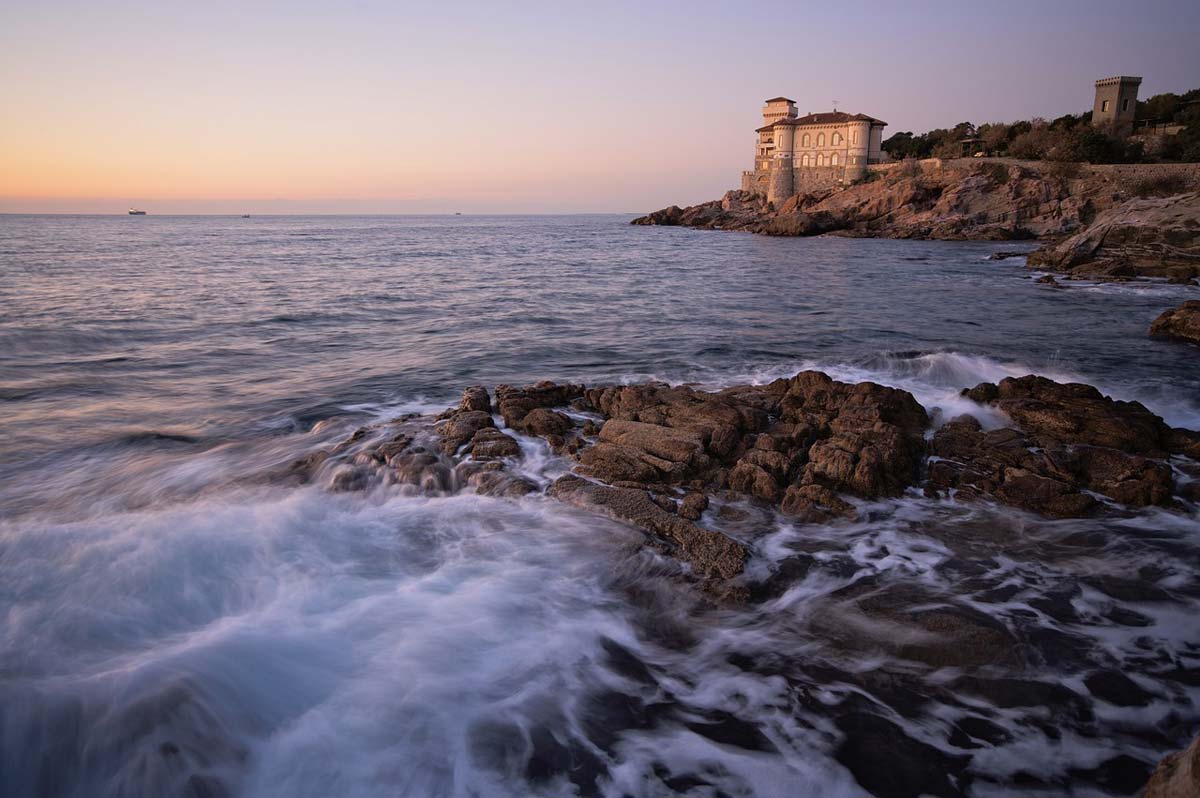
An interesting part of the Tuscan coast (especially for those interested in short walks) is located between the towns of Calafuria and Quercianella. On this part, the coast is high, rocky and precipitous. Of course, it is not suitable for comfortable sunbathing, but it offers nice views and the possibility of a very short but pleasant walk. During the walk, you should be careful, because there is no properly prepared path here, only wildly trodden paths.
check out: accommodation Calafuria and Quercianella – [click]
One of the places in the central part of the coast where you can stop and walk on the rocks, GPS coordinates:
43°28’10.3″N 10°20’11.3″E
43.469535, 10.336479 - click and route
6. Volterra
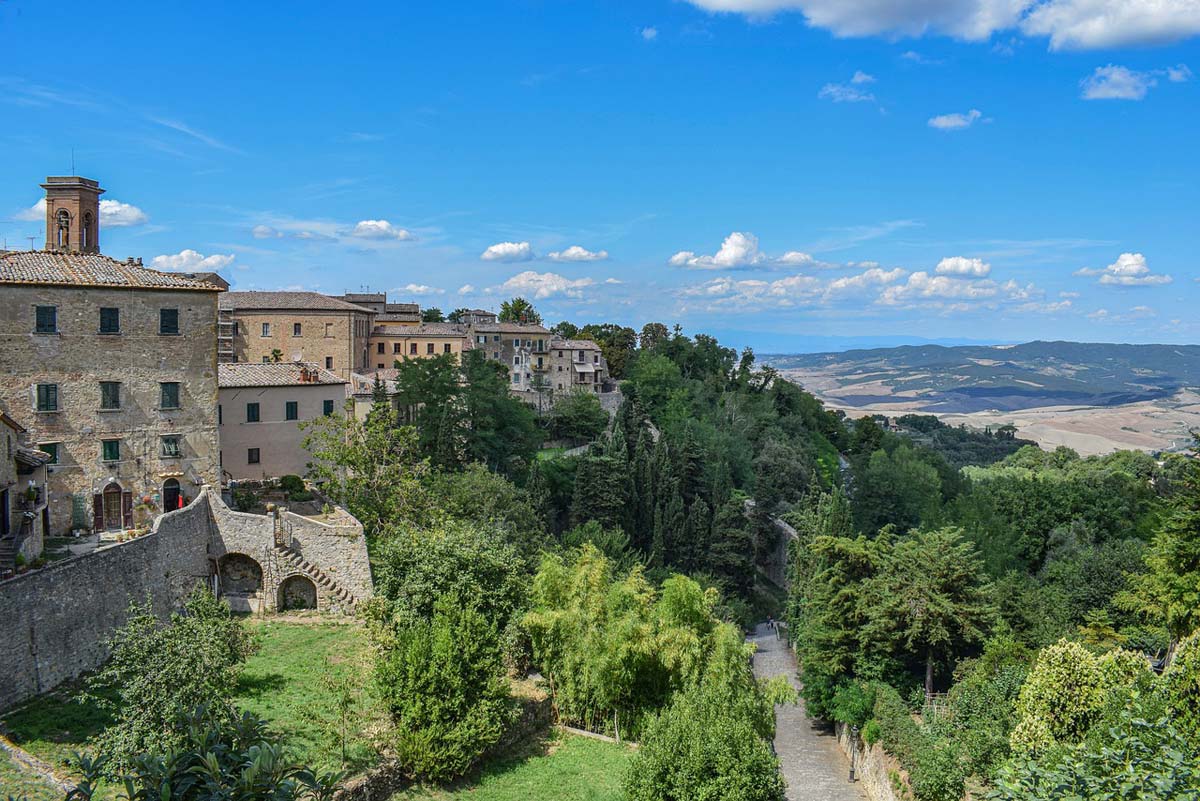
Volterra is a town that can easily be classified as small, medieval and beautiful :)
This is one of those towns where you can basically walk around without a guide, because for some reason you will find all the most interesting places on your own: the main square Piazza dei Priori and the town hall Palazzo dei Priori standing next to it, the ruins of the Roman theater, the castle, countless shops selling products. made of alabaster, a triumphal arch and a few other attractions. You will see all this by walking freely and looking here and there. There is probably no chance of losing your way.
check out: accommodation Volterra – [click]
Underground parking near the historic center of Volterra, GPS coordinates:
43°24’02.1″N 10°51’33.8″E
43.400578, 10.859388 - click and route
Depending on the direction from which you arrive in Volterra, on the way you may pass a parking lot conveniently located near the ruins of the Roman theater, marked Parcheggio per RESIDENTI. Although large and comfortable, it is intended only for residents (as the name suggests). Tourists are not allowed to park there.
7. San Gimignano
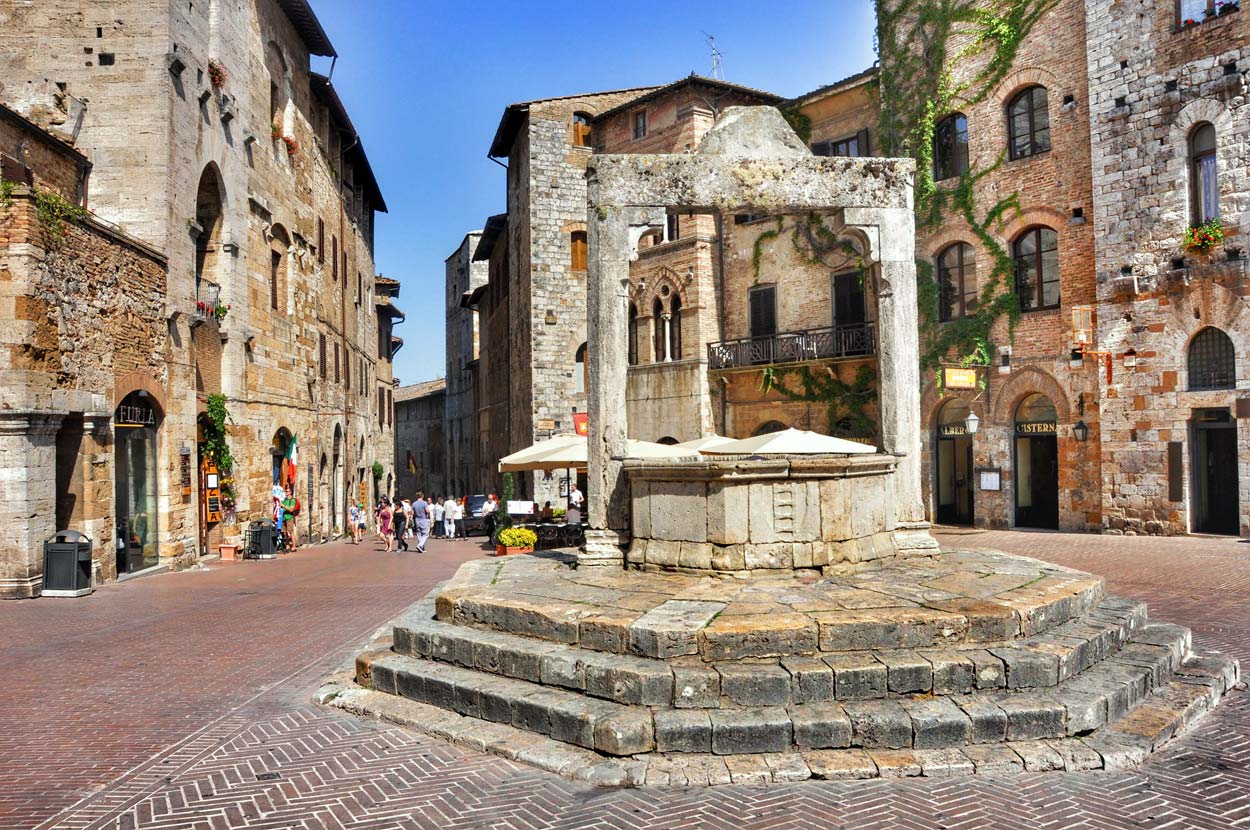
San Gimignano belongs to the same category of towns as Volterra (i.e.: small, medieval and beautiful), although many people will certainly say that it is even more beautiful. It is certainly equally easy and pleasant to visit.
By the way, I would like to add that San Gimignano is one of those places to which I can return endlessly. I just love this town and I love the commute to it. There are typical Tuscan, narrow roads leading here among rolling hills, and San Gimignano, thanks to its tall, medieval towers, is visible from afar. With each kilometer the towers seem to get higher and higher and we see more and more of them, as if the town consisted only of brick skyscrapers. This combination of the thoroughly modern shape of the city seen from a distance (as if it consisted of skyscrapers) with the actual medieval brick origin of the buildings makes a huge impression.
When visiting San Gimignano, it is worth considering additional time for standing in line. What for? For ice cream!
For some reason, right here, on the main square and on the main street of the city, there are ice cream parlors that constantly compete with each other. The competition is so intense that it has led to several ice cream parlors (probably three) winning the titles of world ice cream champions in different years! You will recognize them by the fact that there are queues in front of them. Each ice cream parlor has its fans who like their products and support them in the next championships.
I recommend! The best ice cream in the world, eaten on the steps of a medieval well on the main square (Piazza della Cisterna) in San Gimignano, tastes delicious!
Below are the directions to three parking lots. In my opinion, the most conveniently located parking lot is P2 (at the main gate to the city - Saint John's Gate - and at the beginning of the main walking street - Saint John Street). The next most convenient is P3, and I would choose P1 in third place. From the P1 parking lot, you need to walk approximately 500 m (7 minutes) to the city gate.
check out: accommodation San Gimignano – [click]
Montemaggio parking lot (P2) for tourists, GPS coordinates:
43°27’52.6″N 11°02’29.1″E
43.464613, 11.041418 - click and route
Bagnaia Superiore parking lot (P3) for tourists, GPS coordinates:
43°28’15.7″N 11°02’41.4″E
43.471020, 11.044830 - click and route
Giubileo parking lot (P1) for tourists, GPS coordinates:
43°27’40.2″N 11°02’21.7″E
43.461156, 11.039360 - click and route
8. Monteriggioni
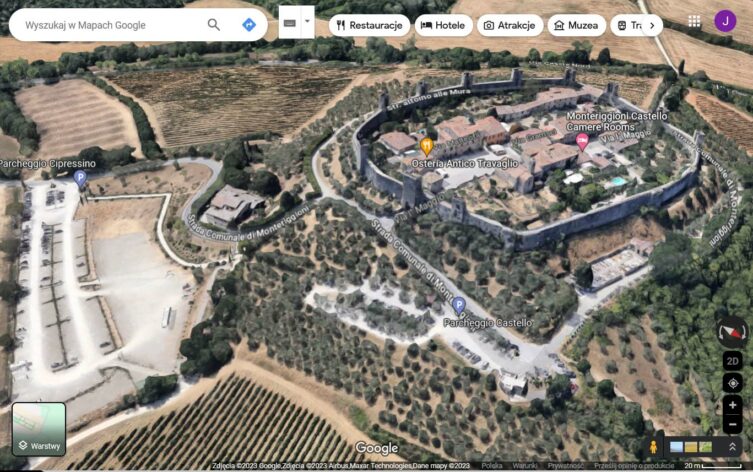
Monteriggioni is a small, almost pocket town. It is situated on the top of one of the gentle Tuscan hills and surrounded on all sides by greenery, vineyards and olive groves. It is so small that the wall surrounding it has a total length of just over 500 m. Every math enthusiast will immediately calculate the diameter of the city (I suggest: diameter d = Circumference / Pi). For those who don't like to count, I'll tell you straight away: the diameter is very small :)
Visiting Monteriggioni will take you little time and a stop here is worth treating mainly as a curiosity and an opportunity to stretch your legs for a few minutes.
check out: accommodation Monteriggioni – [click]
Parking for tourists in Monteriggioni, GPS coordinates:
43°23’17.2″N 11°13’29.7″E
43.388101, 11.224928 - click and route
9. Sienna
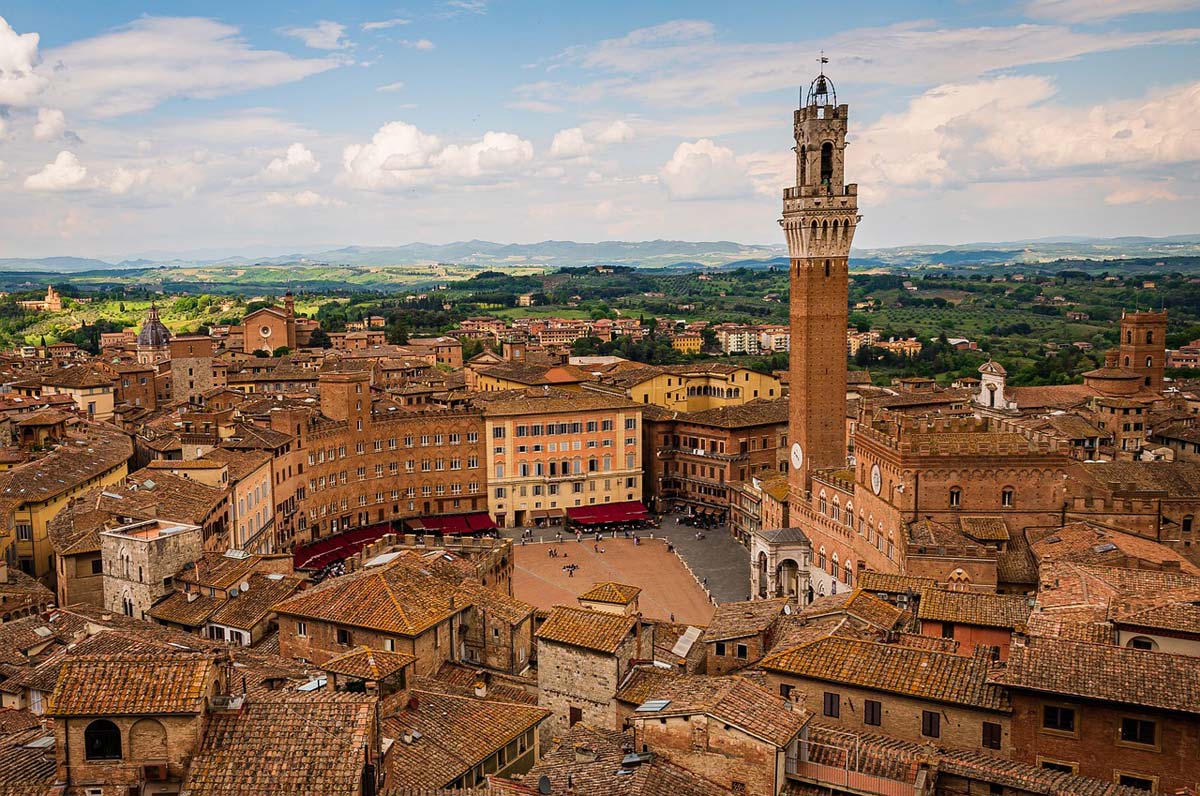
To put it briefly: Siena stole my heart. I spent a lot more time here than I originally expected. And it's not that I planned the tour wrong. On the contrary. Everything was well thought out and I didn't have to rush anywhere. I saw everything I wanted, and then... then I just felt the need to stay here longer. So I did. I stayed longer, but I was still sad to leave Siena. I promised myself that I would come back here as many times as possible. So I may be biased in my assessment of Siena, but on the other hand it is difficult to overestimate this city.
Siena, like other cities, is located on a quite steep hill and most of it is connected to this hill. It extends widely beyond the relatively gentle peak of the hill, which means that a large part of the city climbs sharply uphill or falls down at breakneck speed. So we have a lot of narrow and very steep streets and countless stairs. The city flattens out a bit towards the most important city squares, but nowhere is it completely flat. I think I will include more about Siena in a separate description and guide to this city.
There are two pieces of information that are most important in this entry. The first is the parking lot, and the second is how to get to the center. Siena's shape and tight buildings make it virtually impossible to drive around the city. It is very difficult and very limited even for residents. Tourists are banned from entering the city. Therefore, you should leave your car in a parking lot outside the center of Siena and walk to the center.
What may be a little scary is the fact that from the parking lot to the historic center, i.e. Piazza del Campo and Piazza del Duomo, it's a really steep uphill climb! Don't worry though! The city authorities thought about it. On the way from the parking lot, after passing the city gate, look for signs leading to the escalators. Yes! You can take several sections of escalators almost from the city gate to the very top of the hill! Beautiful, right?
Unless you feel like doing some physical exercise? You can climb through the streets and regular stairs. Siena is waiting and inviting you!
check out: accommodation Siena – [click]
Entrance to the parking lot in front of the city gate in Siena, GPS coordinates:
43°19’02.1″N 11°19’26.7″E
43.317241, 11.324073 - click and route
Direction to the escalator to the center of Siena, GPS coordinates:
43°19’06.0″N 11°19’37.0″E
43.318334, 11.326939 - click and route
Square in front of Siena Cathedral (Piazza del Duomo), GPS coordinates;
43°19’02.4″N 11°19’43.0″E
43.317323, 11.328596 - click and route
Square in front of Siena's town hall (Piazza del Campo), GPS coordinates:
43°19’06.3″N 11°19’54.2″E
43.318424, 11.331720 - click and route
10. Arezzo
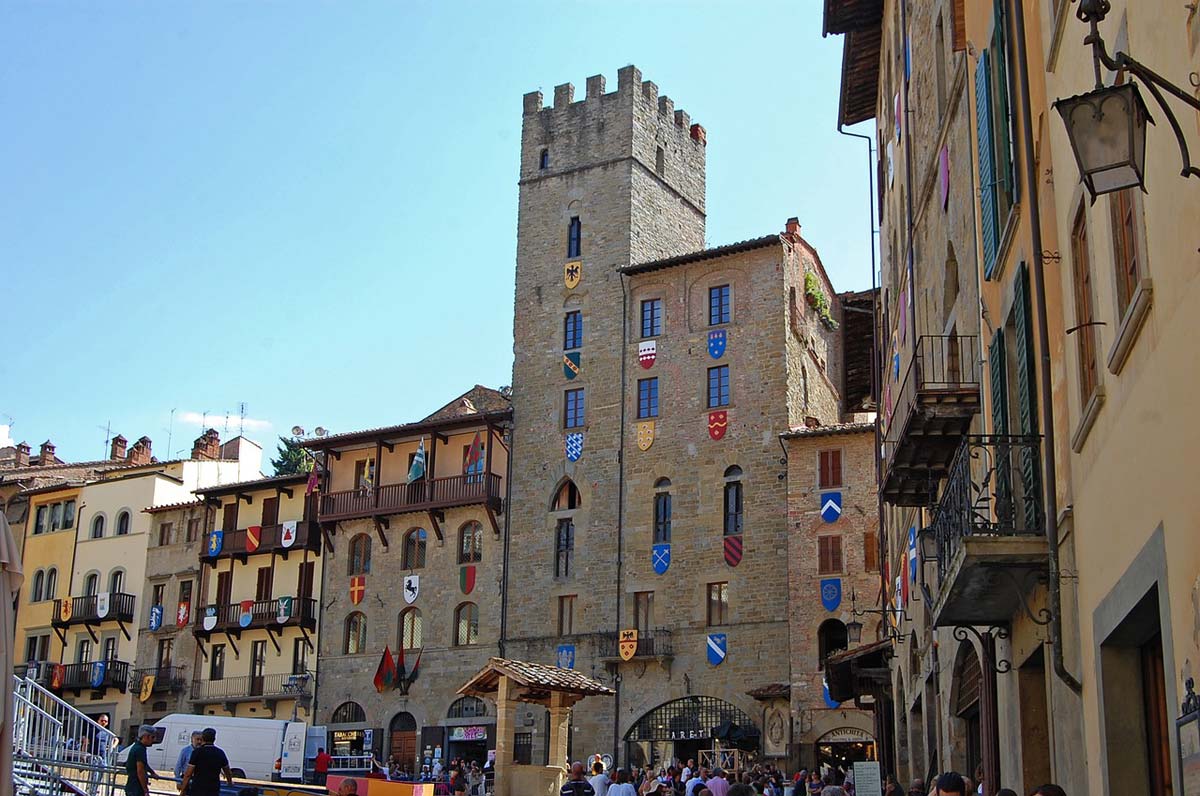
Arezzo is a bit off the beaten track in our itinerary. It is a city whose size definitely exceeds the small towns we have become accustomed to in Tuscany. Its biggest attractions (e.g. Santa Maria della Pieve, Palazzo Pretorio, Cathedral of St. Peter and St. Donatus) are located close to the main square, Piazza Grande, and people come to the city mainly for these monuments.
Generally, Arezzo is located off the main tourist route in Tuscany and if you are looking for a place where the tourist traffic is much lower, this may be an interesting proposition (lower hotel and gastronomy prices).
check out: Arezzo accommodation – [click]
Large parking lot near Piazza Grande in Arezzo, GPS coordinates:
43°28’10.2″N 11°53’03.7″E
43.469500, 11.884351 - click and route
The main square (Piazza Grande) in Arezzo, GPS coordinates:
43°27’53.2″N 11°53’03.4″E
43.464788, 11.884288 - click and route
11. Val d'Orcia and Crete Senesi
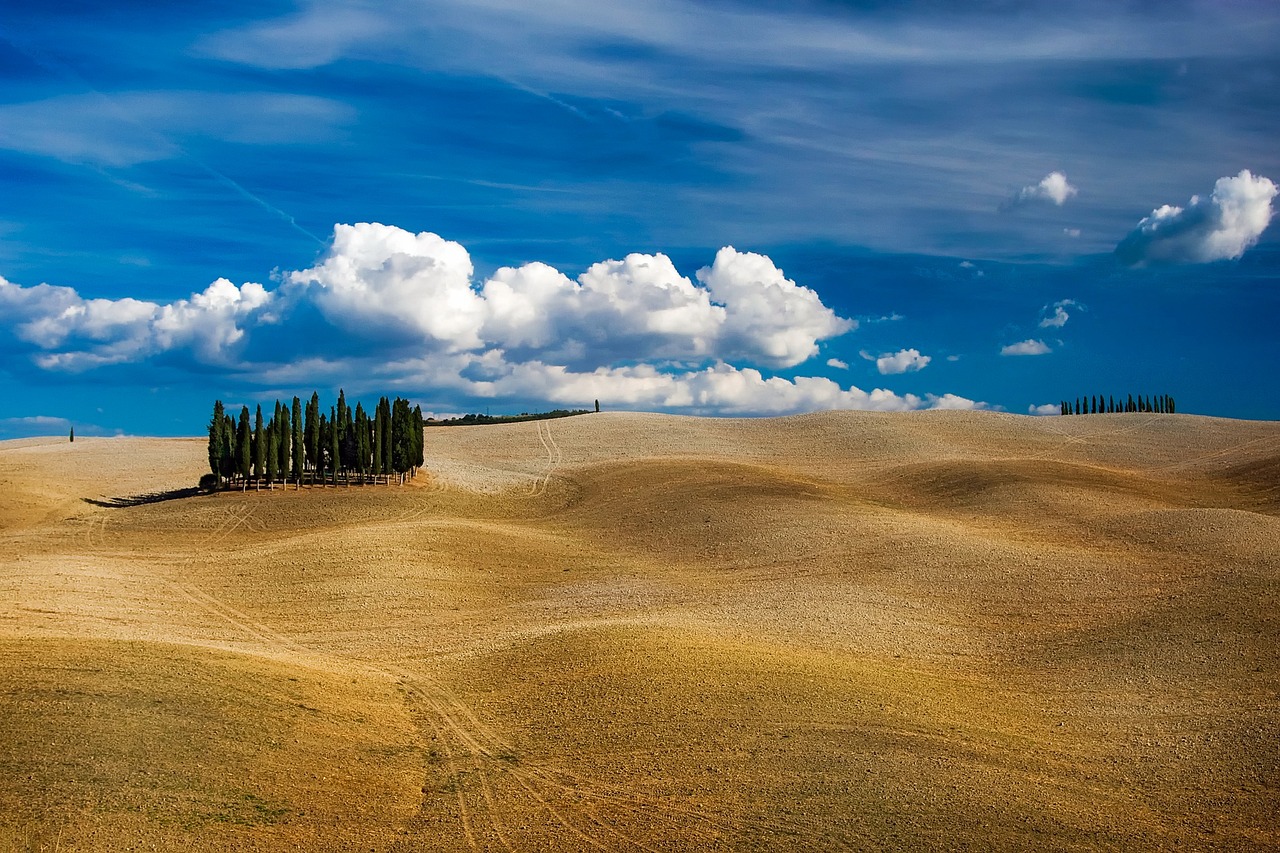
Val d'Orcia and Crete Senesi are not specific points. These two names cover two separate areas. Each of these areas covers a large part of Tuscany. My marking these two areas on the map (Val d'Orcia and Crete Senesi) under one number can be considered a bit of an abuse, and in fact it is. However, I did it on purpose.
In practice, they cannot be visited separately because they are partially intertwined. The communes that are located on the border between the areas practically belong to both of them. Moreover, even though they cover a significant area of Tuscany, when traveling by car we have to cover distances that pose a great challenge. Without excessive effort, they can be overcome in one day (or by bike or on foot).
However, the most important argument is that many of the photos that attract tourists to these areas, even though they are taken in Crete Senesi, for example, are described as having been taken in Val d'Orcia (the opposite is rarely the case). Such inaccuracy may be misleading, but fortunately it will not prevent us in any way. You just need to be prepared to wander around both areas in search of the best viewpoints.
As always, the best planning tool will be a map. I couldn't find a map on the Internet that would present the matter in a clear enough way, so I had to make such a map myself, based on a map base from openstreetmap.org. Of course, it does not reflect the precise course of administrative borders, but it very well reflects the scope and location of the areas we are interested in.
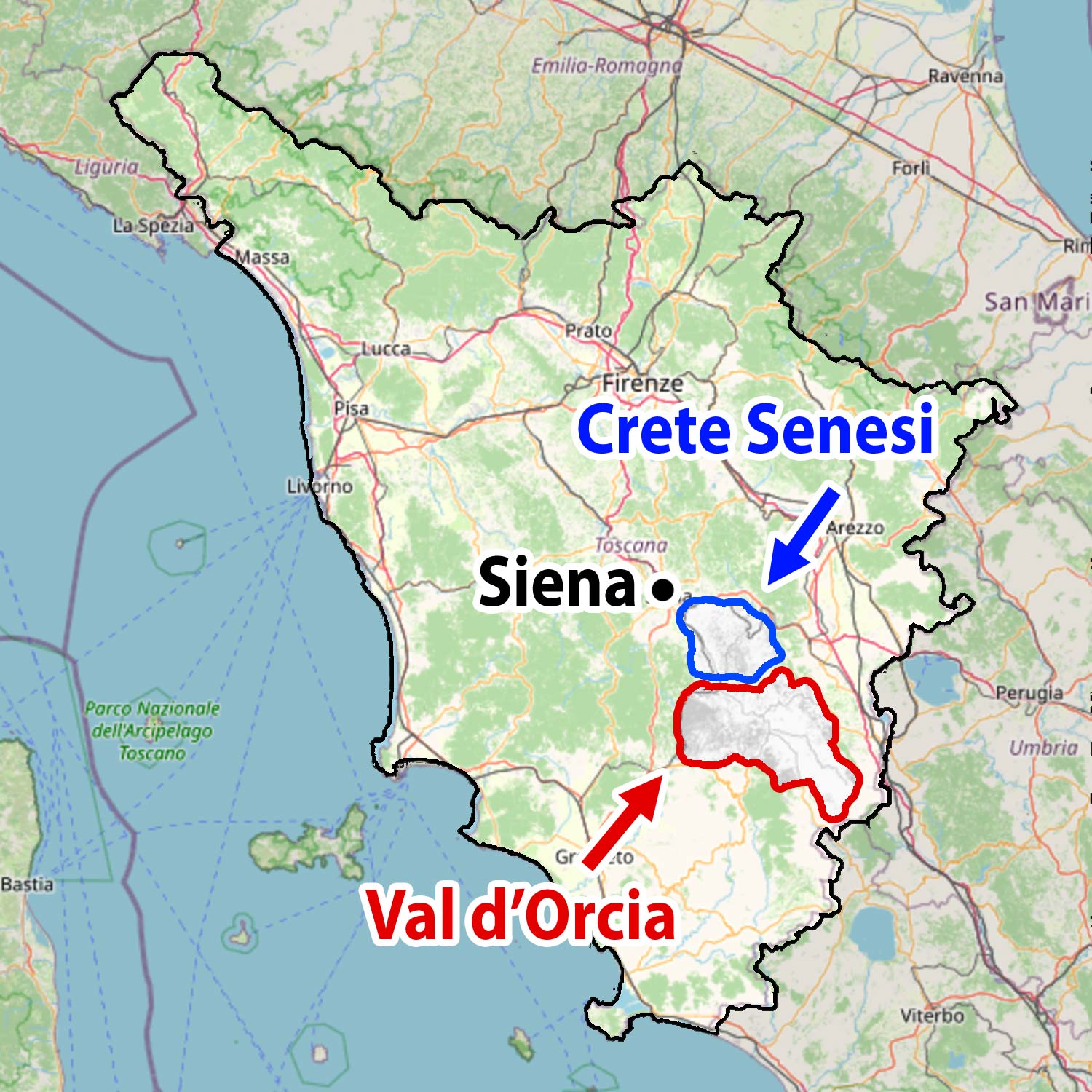
The map above shows the area of Tuscany that you already know. I marked the location of Siena on it. South of Siena begins the Crete Senesi area surrounded by the blue line, and going even further south we will reach the Orcia river valley, called Val d'Orcia in Italian.
For those who will plan their own outdoor trips in search of the most beautiful scenery in Tuscany, I have prepared a separate entry with descriptions and detailed GPS coordinates of several of the most famous viewpoints: Val d'Orcia (map) – the most beautiful viewpoints in Tuscany. It is so extensive and there is so much information in it that I decided to separate it from this entry and post it in a separate text.
12. Montepulciano
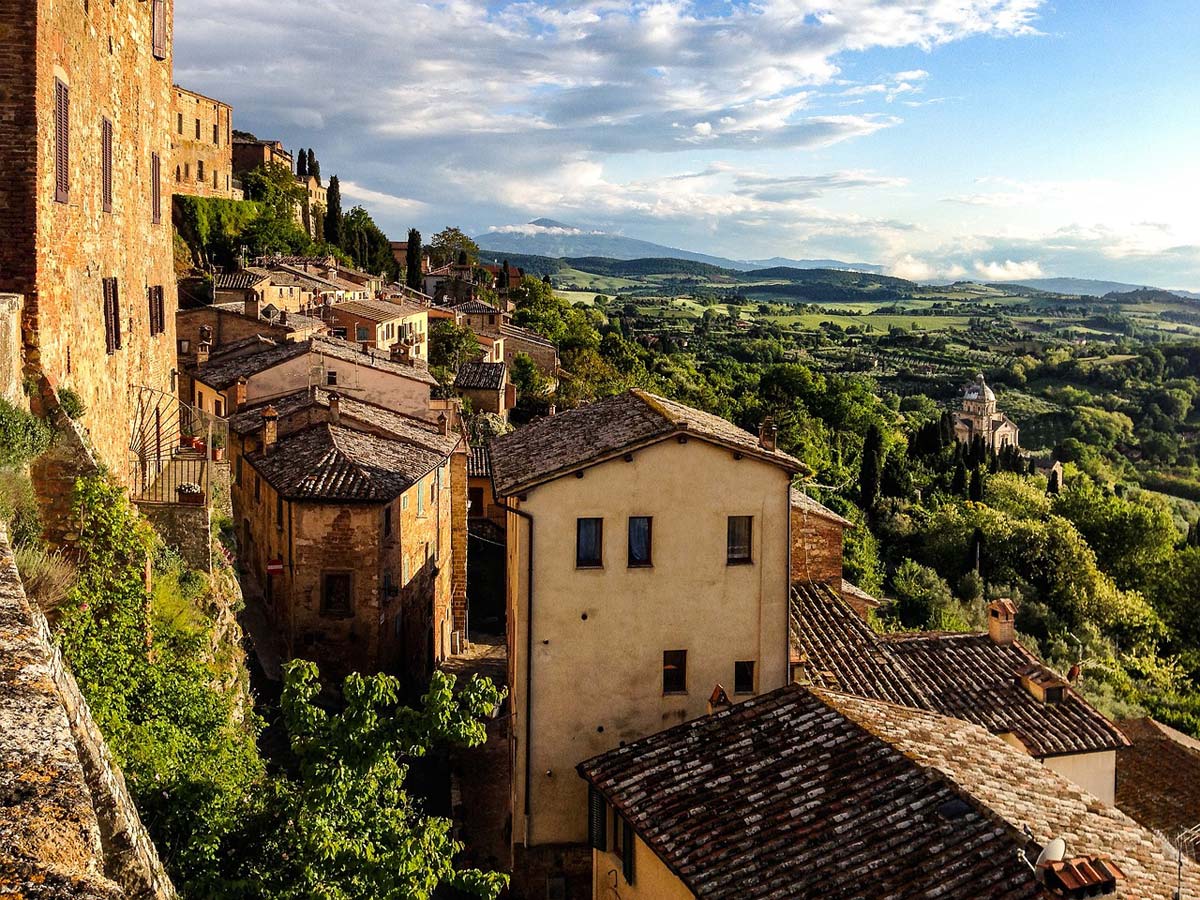
Montepulciano is a postcard place. Situated on a hill, with the typical, tight, medieval character of pleasant streets. The perfectly preserved nature of the buildings (in Montepulciano it has long been strictly forbidden to modify anything yourself) means that some people treat the town as exemplary in every respect.
Visiting Montepulciano is not overly complicated because the town is quite small. It is worth taking a typical walk: the main and side streets, the main square and the cathedral. Basically, you will get everywhere by following your intuition. It is worth noting the viewpoints over the Val d'Orcia valley (GPS coordinates below), because due to its relatively high location, Montepulciano offers one of the most beautiful and very extensive panoramas of this valley.
The city has prepared 10 parking lots for tourists (all paid), but most of them are really small parking lots or just a row of spaces on the street. On most of them, there may be a problem with free seats. So I suggest starting with the parking lot P1, located near the entrance gate to the city. If you don't make it there, you can try at the parking lot located a few hundred steps away P5. It is the largest of all and the chances of parking here are also the highest.
check out: accommodation Montepulciano – [click]
Parking lot P1 in Montepulciano, GPS coordinates:
43°05’52.3″N 11°47’06.0″E
43.097864, 11.784992 - click and route
Parking lot P5 in Montepulciano, GPS coordinates:
43°05’45.3″N 11°47’14.4″E
43.095907, 11.787322 - click and route
Viewpoint over the Val d'Orcia valley, GPS coordinates:
43°05’39.9″N 11°46’51.0″E
43.094427, 11.780833 - click and route
13. Pienza
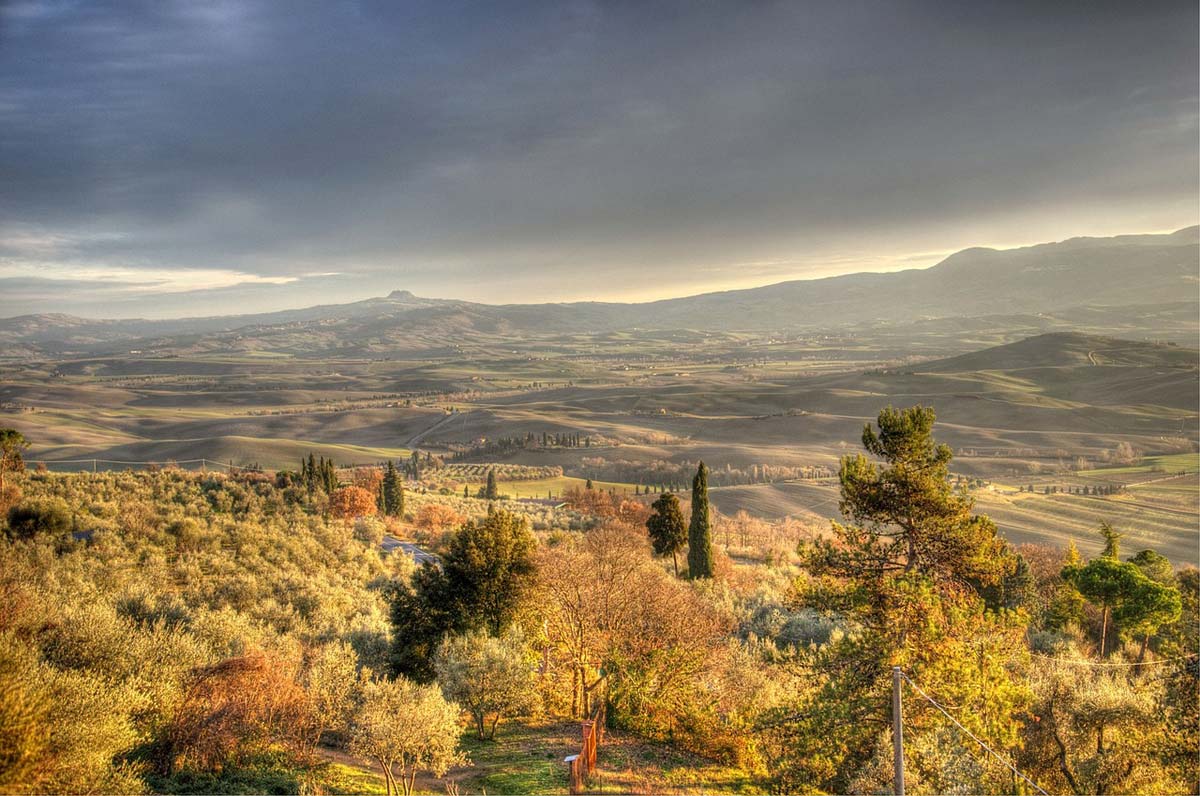
Pienza is located in the Val d'Orcia valley, which, as you can easily guess, guarantees beautiful views from the town to the valley. Just climb the walls surrounding the city and take a walk around them. Everyone will find the most beautiful viewpoint here. That's for sure.
The historic center of Pienza is truly pocket-sized, so don't expect a long walk. Instead, focus on a quiet walk and spend some time enjoying the views of the picturesque Val d'Orcia valley. Sit down, drink coffee, eat something, take your time. One main street, several short side streets, main square, cathedral, city walls. Tight and nice 🙂
check out: accommodation Pienza – [click]
Parking near the historic center of Pienza, GPS coordinates:
43°04’41.6″N 11°40’49.5″E
43.078207, 11.680414 - click and route
14. Bagni San Filippo
In Tuscany you can find many thermal springs, creating natural pools, hot streams and watercourses. The mineral-rich water has created picturesque, colorful mineral structures in many places, which attract not only bathing enthusiasts, but also lovers of natural wonders.
Bagni San Filippo has become a popular swimming spot over time (which has generally not been a good thing for this place), but it still attracts many people with its extremely interesting mineral dripstone structures.
The area is not large, so it quickly fills with people. It is best to come here outside the summer season. However, if you cannot choose such a date and you will be here in the summer, I suggest arriving outside the weekend and possibly early in the morning.
check out: accommodation Bagni San Filippo – [click]
Bagni San Filippo, picturesque dripstone mineral structures, GPS coordinates:
42°55’44.7″N 11°42’11.3″E
42.929085, 11.703145 - click and route
Parking lane on the road to Bagni San Filippo, GPS coordinates:
42°55’43.2″N 11°42’09.7″E
42.928671, 11.7027025 - click and route
The parking lane ends at approximately the location indicated by the GPS coordinates I provided. So try to park before you get to this point.
15. Pitigliano
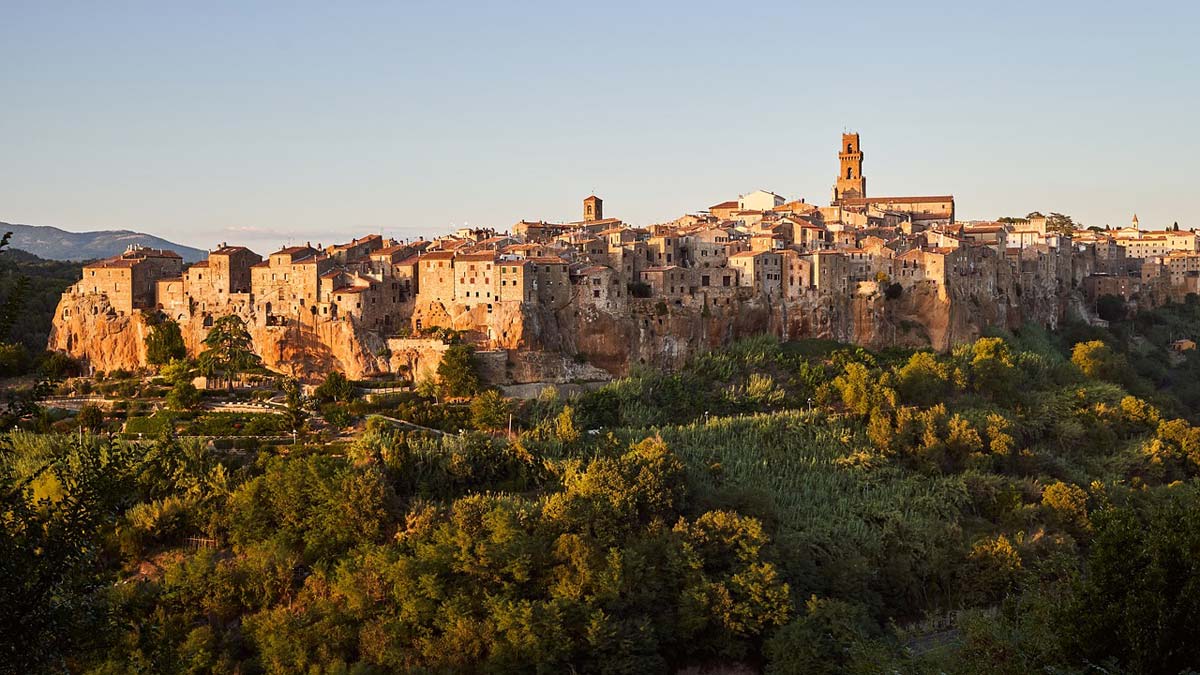
Thanks to its location, Pitigliano quickly became a widely recognizable place. The city was built from a rock identical to the one on which it stands. The buildings therefore seem to grow straight out of the bedrock as if they were still part of the rugged hill on which they are located. The impression is amazing, especially when the front of the mountain and the facades of the buildings connected to it are bathed in the warm light of the gentle morning sun. So if you want to see Pitigliano in its most beautiful version, you have to arrive at the viewpoint at sunrise.
It's worth starting your visit to the old part of Pitigliano by… finding a parking space. The old part of the city does not offer parking at all and you have to look for a place somewhere else. I suggest starting your visit by visiting a viewing point overlooking the hill and the old town. There is a parking lane along the access road to the viewing point. If you're lucky, you'll find a place here. If not, continue slowly towards the next parking space I mentioned (in Piazza del Mercato). The parking lane will run along your route, so use the first available space. If there is nothing free on the way, your last hope is in Piazza del Mercato, where you should find something.
Pitigliano is visited intuitively. Two parallel streets run along the entire length of the hill (Via Roma and Via Zuccarelli). You follow one of them to the end and then go back with the other one. Along the way, the streets first split up and then merge together at the end.
The further into the town you go, the tighter and more interesting it becomes. It's worth looking everywhere. A picturesque alley may be lurking around every corner. Here is the entire sightseeing plan :)
check out: accommodation Pitigliano – [click]
Viewpoint of the old part of Pitigliano and parking spaces along the street, GPS coordinates:
42°38’00.1″N 11°40’15.0″E
42.633360, 11.670823 - click and route
A little more parking space in Piazza del Mercato, GPS coordinates:
42°38’01.0″N 11°40’26.6″E
42.633602, 11.674041 - click and route
16. Terme di Saturnia
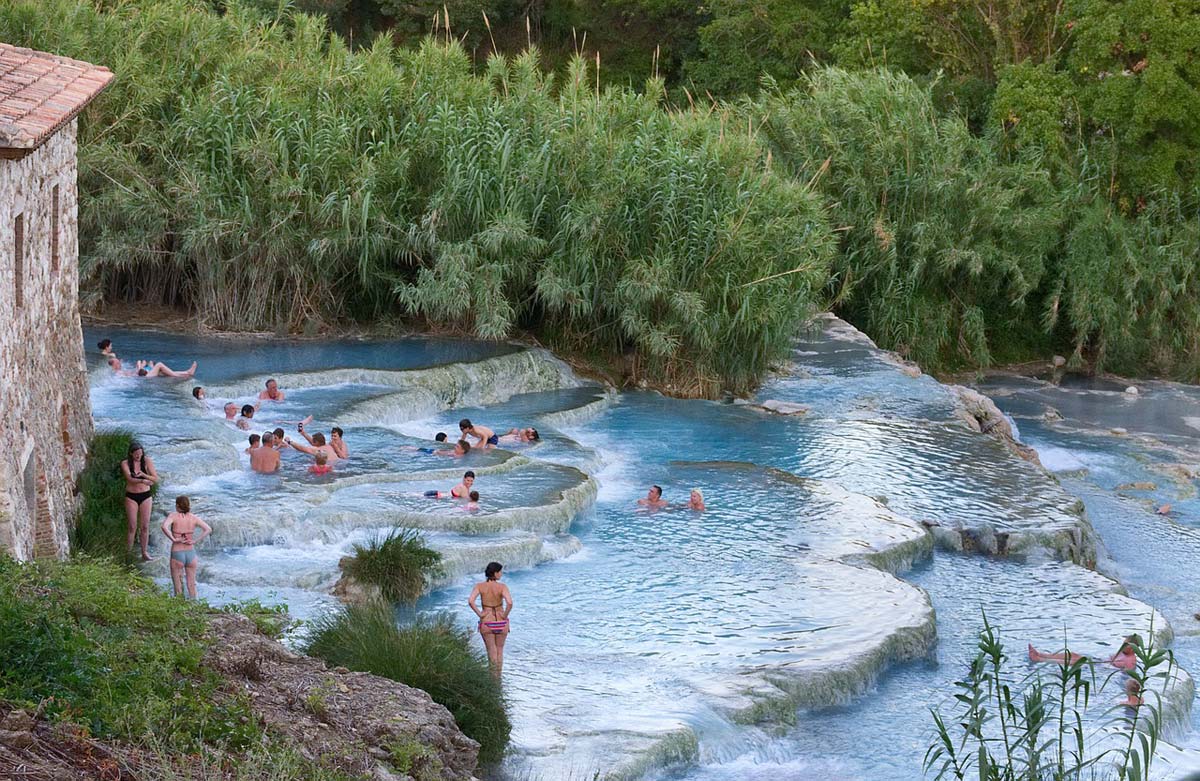
In the case of Terme di Saturnia, you may be interested in two locations. The first of them is Cascate del Mulino di Saturnia, i.e. exceptionally photogenic, cascading limestone pools in the open air, from which warm thermal water flows. The second is the Terme di Saturnia hotel with thermal springs and additional swimming pool infrastructure. It was built directly on these sources and offers a wide range of treatments, baths and SPA services.
If you are looking for relaxation and rest in good (but not necessarily cheap) conditions, this may be a good option for a short break in your journey.
Below are the locations of both places.
check out: accommodation Saturnia – [click]
Terme di Saturnia (hotel with SPA at a thermal spring), GPS coordinates:
42°39’25.6″N 11°30’57.9″E
42.657110, 11.516078 - click and route
Cascate del Mulino di Saturnia (natural thermal pools), GPS coordinates:
42°38’53.4″N 11°30’45.5″E
42.648152, 11.512651 - click and route
Parking near Cascate del Mulino di Saturnia, GPS coordinates:
42°39’05.5″N 11°30’40.9″E
42.651517, 11.511354 - click and route
A viewpoint overlooking Cascatelle del Mulino, located by the road, GPS coordinates:
42°38’44.5″N 11°30’45.2″E
42.645682, 11.512561 - click and route
17. Argentario Peninsula
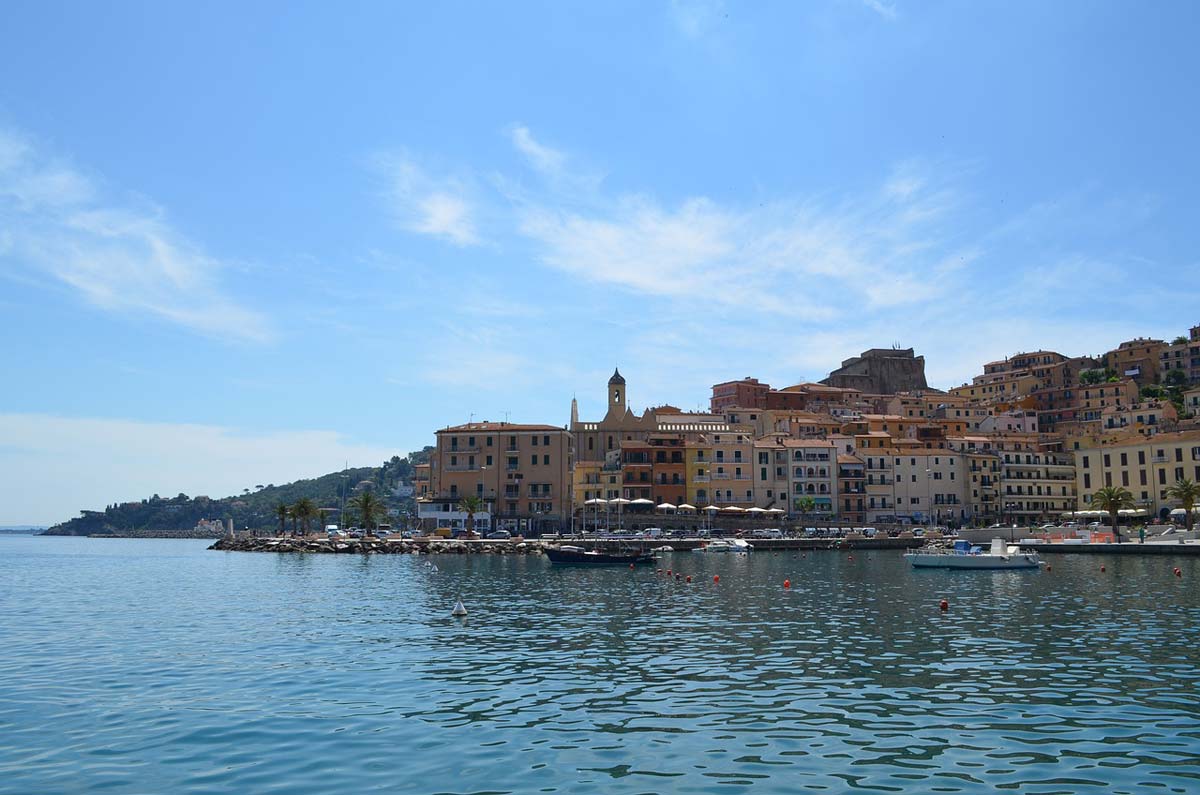
Most guides to Tuscany do not offer suggestions for visiting the Argentario peninsula. Honestly, I wonder why? When it comes to the coastal part of Tuscany, the Argentario peninsula is definitely an attraction worth especially recommending. Perfect, crystal clear sea, fantastic beaches, cypress valleys, green hills, picturesque sea bays, excellent food (including amazing seafood). It's all here! So why would we be missing?
What is not? There are no typical Tuscan vineyards and olive groves. But after many days of staying among endless vineyards and olive groves, won't such a change be pleasant? Of course it will! Pleasant and refreshing.
The Argentario Peninsula used to be an island, but it was artificially connected to the mainland, which significantly improved access to it. You can get here easily (via an artificial causeway) by car.
An attraction that has always delighted and still delights tourists on the Argentario Peninsula is the opportunity to sail independently in a small motor boat along the shore of the peninsula, from bay to bay. This does not require any special permissions or skills. The boats are safe (usually for 2-4 people), and the engines installed in them have limited power (for safety). You rent a boat for the whole day and during that time you sail among picturesque bays, getting to know the island from the water in your own way.
The adventure is great and when time runs out, it's a pity to go back.
Two main towns on the island are best for accommodation and a base:
– smaller and more intimate: Porto Ercole - check accommodation prices [click]
– a bit larger and a bit more noisy: Porto Santo Stefano - check accommodation prices [click]
Parking near the marina in Porto Ercole, GPS coordinates:
42°24’10.2″N 11°12’15.7″E
42.402819, 11.204364 - click and route
Parking near the marina in Porto Santo Stefano, GPS coordinates:
42°26’01.6″N 11°07’25.7″E
42.433781, 11.123793 - click and route
18. Populonia and the Gulf of Baratti
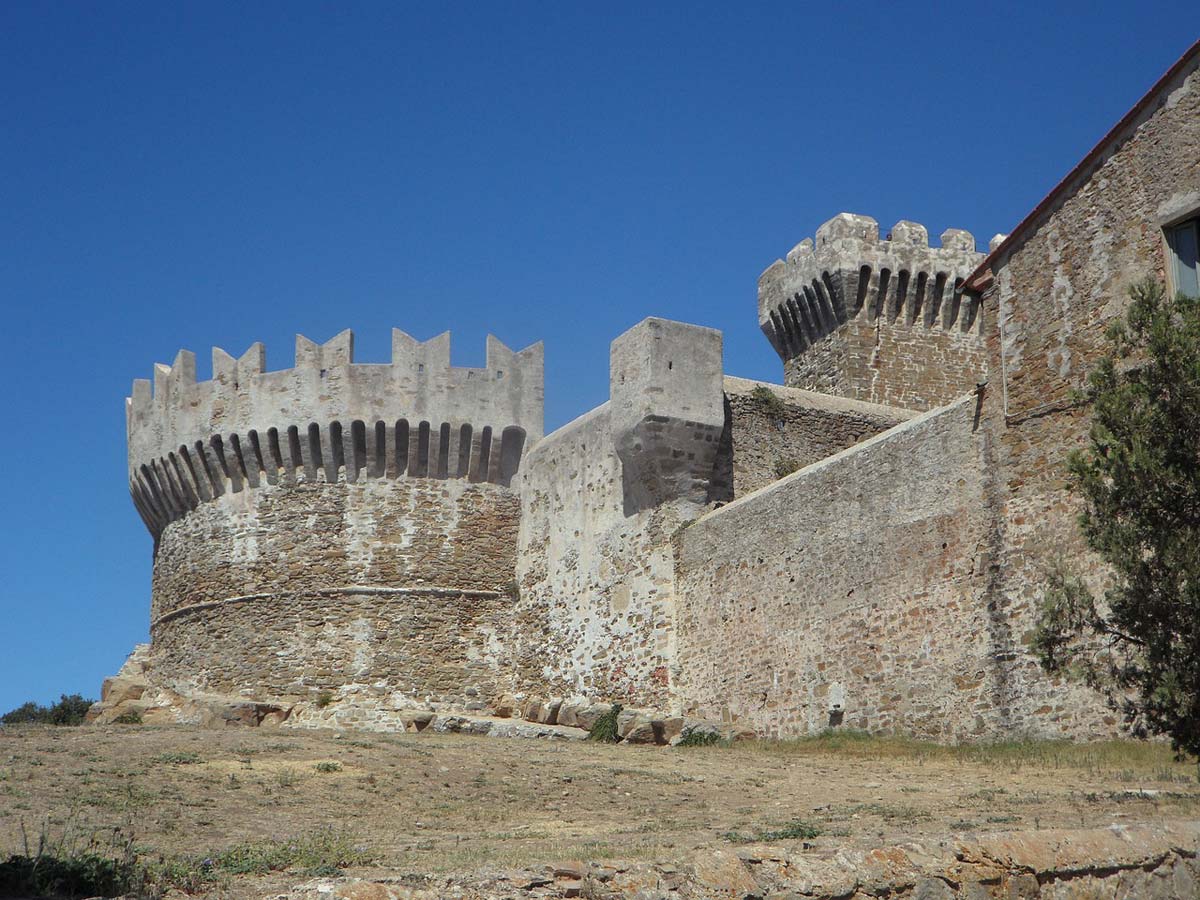
This point of the program is a classic combination of pleasure and usefulness. We have a beautiful beach here in the Baratti Bay, which begs to laze on for a while, but right next to it (only 1,5 km in a straight line), it looks at us from the top of a coastal hill. Populonia: the oldest Italian port! In ancient times, it was one of the largest and most important cities on the Mediterranean Sea and a copper smelting center (the city had the status of an episcopal capital already in the XNUMXth century). It is estimated that in the Iron Age Populonia could have numbered even 40 inhabitants (Rome reached this size about 300 years later than Populonia).
After almost 1000 years of operation, Populonia lost its importance and was abandoned. In 2009, officially... 17 people lived here. Today, Populonia is mainly a tourist destination. I recommend visiting Populonia as a break from the beach!
check out: accommodation Baratti Bay – [click]
Parking lot in front of the city gate in Populonia, GPS coordinates:
42°59’20.9″N 10°29’25.1″E
42.989147, 10.490296 - click and route
Parking lot no. 1 near the beach in the Gulf of Baratti, GPS coordinates:
42°59’46.0″N 10°31’06.3″E
42.996101, 10.518411 - click and route
Parking lot no. 2 near the beach in the Gulf of Baratti, GPS coordinates:
42°59’37.3″N 10°30’51.8″E
42.993694, 10.514380 - click and route
Parking lot no. 3 near the beach in the Gulf of Baratti, GPS coordinates:
42°59’27.9″N 10°30’40.8″E
42.991072, 10.511323 - click and route
19. Marina di Castagneto Carducci
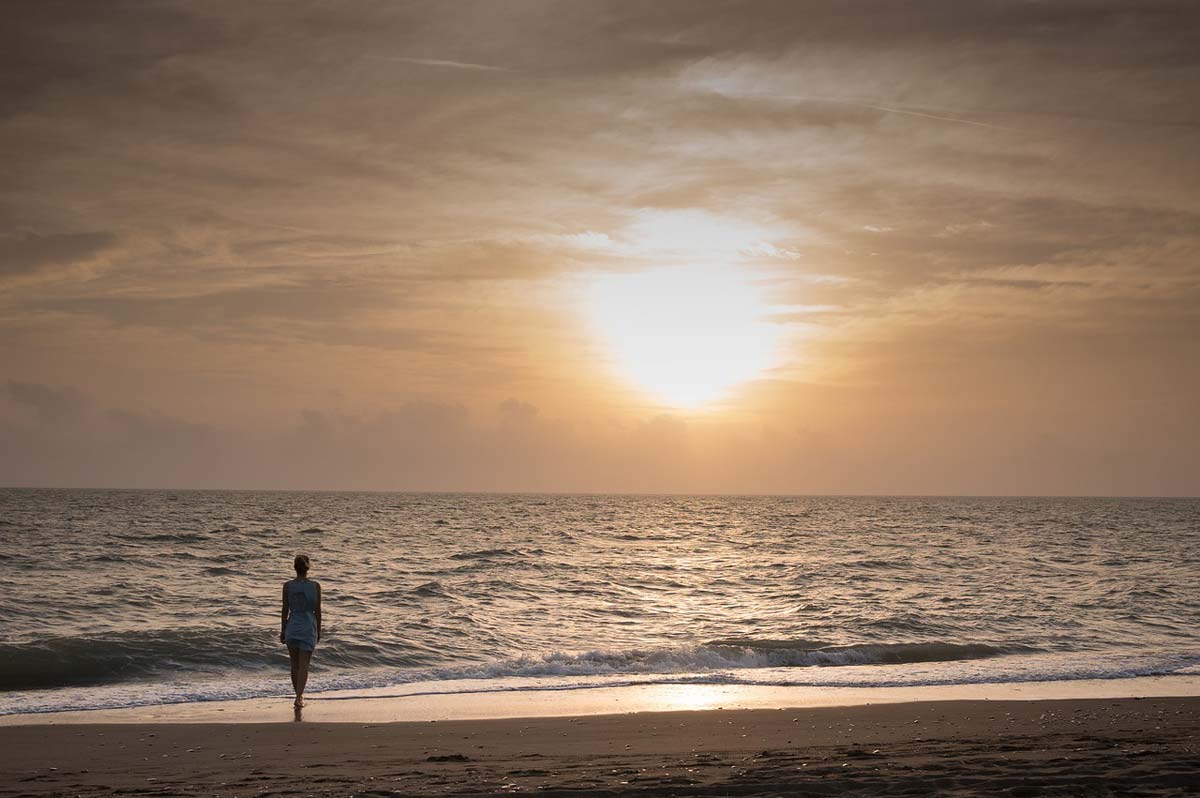
There aren't many beach-related suggestions in my guide. However, the ones that are available were selected based on a strong selection process. I didn't want to suggest many similar places. I decided to choose and propose only the most interesting ones.
Marina of Castagneto Carducci has many advantages. First of all, it's not crowded yet and probably won't be for a long time. The beach here is long and wide, and the village next to it is small. The village, in turn, is divided into two parts: the tourist part with low hotel buildings and the second part, a little more distant from the beach and inhabited by permanent residents. This division makes the tourist and beach part live its own holiday life, and that's cool.
In addition, it is enough to add that the beach and sea water are kept in a high class of cleanliness and ... we have a recipe for a successful holiday in a quiet - for Italian conditions - place!
check out: accommodation Marina di Castagneto Carducci – [click]
Parking by the beach in Marina di Castagneto Carducci, GPS coordinates:
43°10’51.2″N 10°32’18.8″E
43.180898, 10.538546 - click and route
20. Marina di Cecina
This time something for lovers of slightly larger tourist resorts. Marina di Cecina it has everything that such a resort should have. The right size to create an atmosphere of evening and nightlife and to guarantee a wide catering and hotel offer.
check out: accommodation prices in Marina di Cecina – [click]
There are various types of restaurants, bars, ice cream parlors, and shops with everything you need while on vacation. There are paid beaches with umbrellas and free beaches, playgrounds for children, carousels, a lively promenade, open-air concerts, street shows and a nice marina... to choose from.
Whoever likes it will be pleased!
Small parking lot near the beach in Marina di Cecina, GPS coordinates:
43°18’03.0″N 10°29’29.3″E
43.300824, 10.491480 - click and route
21. Abbazia di San Galgano (Abbey of San Galgano)

Imagine a monumental Gothic cathedral, its vaulted ceiling a lavish blue of Tuscany and its floor a meticulously manicured lawn. The Abbey of San Galgano, located about 35 kilometers southwest of Siena, is one of the most photogenic and simultaneously most enigmatic places in Italy. Here, the story of the knight who abandoned the sword for the cross intertwines with the architectural mastery of the Cistercians, creating a setting that seems almost unreal.
It all began with Galgano Guidotti, a local knight with a rather fiery nature. Legend has it that after a series of visions of St. Michael the Archangel, Galgano decided to break away from his violent lifestyle. In 1180, as a sign of his final dedication to God, he plunged his heavy sword into a crevice in a rock on Montesiepi Hill. To the surprise of witnesses, the hard rock gave way, and the weapon sank into the rock, leaving only a fragment of the blade and hilt visible above the surface, forming the shape of a cross. Galgano died a year later as a hermit and was canonized shortly thereafter. It was around his hermitage that the Cistercians first built a rotunda (Rotonda di Montesiepi), and then, in the valley below, a massive abbey that would become one of the most important spiritual and economic centers in the region.
Construction of the main church lasted from 1218 to 1288. San Galgano's architecture is pure, austere Cistercian Gothic, eschewing unnecessary ornamentation in favor of harmony and proportion. For decades, the abbey flourished, managing vast estates, but its glory days were interrupted by plague epidemics and mercenary raids. A key moment in its decline was the introduction of the commenda system (management by persons outside the order), which led to the plundering of the property. In the 16th century, one of the abbots even decided to sell the lead roofing, sealing the building's fate. In 1786, after a lightning strike, the bell tower collapsed, burying the remains of the vault beneath the rubble. Since then, the cathedral has remained "open-air," which paradoxically gave it a unique, almost mystical character, attracting artists and travelers from around the world.
Interesting facts
The sword embedded in the rock at Montesiepi is absolutely authentic. Metallurgical tests have confirmed that it dates from the 12th century, and the style of its construction corresponds to the Galgano era.
The extraordinary aura of the roofless ruins has made San Galgano a backdrop for major cinema. Anthony Minghella used these walls in the film "The English Patient" (the film won nine Oscars).
The lack of a roof doesn't spoil the acoustics at all. Quite the opposite! In the summer, opera and symphony concerts are held within the abbey walls, as sound carries exceptionally clearly through the ruins.
Opening hours and tickets
The abbey is open to visitors every day of the year, but opening hours vary depending on the season:
November – March: 9:00 a.m. – 17:30 p.m.
April, May, October: 9:00 a.m. – 18:00 p.m.
June – September: 9:00 – 20:00
Admission to the Rotonda di Montesiepi is free, but entry to the main nave of the abbey requires the purchase of a ticket.
Some practical tips
The best time for photosFor spectacular shots, visit the abbey just after opening or an hour before closing. This is when the sun shines at a low angle through the empty window openings, creating geometric patterns of light and shadow on the grass.
A walk up the hillAfter visiting the main building, be sure to take the uphill path (about a 10-minute walk) to the Rotonda di Montesiepi. This is where the famous sword in the rock is located – no visit would be complete without seeing it.
OutfitRemember that despite the lack of a roof, this is a sacred space (especially the rotunda). It's a good idea to bring something to cover your shoulders if you plan to enter the chapel.
filter link: accommodation near Abbazia di San Galgano – [show accommodation]
Abbazia di San Galgano Cathedral, GPS coordinates:
43°08’58.1″N 11°09’17.9″E
43.149469, 11.154969 - click and route
Chapel with a sword stuck in the rock (Cappella di San Galgano), GPS coordinates:
43°09’09.0″N 11°09’19.7″E
43.152488, 11.155459 - click and route
Parking (large) for tourists, GPS coordinates:
43°09’09.1″N 11°09’05.8″E
43.152535, 11.151599 - click and route
22. Cortona

filter link: accommodation in Cortona and the surrounding area – [show accommodation]
Cortona is a town that proves that in Tuscany, vertical and horizontal are relative concepts. Perched on the steep slope of Mount Sant'Egidio, it overlooks the fertile Val di Chiana and, on a clear day, allows you to glimpse the glint of Lake Trasimeno. Although Cortona's worldwide fame exploded following the publication of Frances Mayes's book "Under the Tuscan Sun" and the subsequent film adaptation starring Diane Lane, the town offers much more than just cinematic nostalgia. It is one of the oldest cities in Italy, with roots dating back to Etruscan times, and legends claim it is "the mother of Troy and the grandmother of Rome."
A stroll through Cortona is a solid workout for your calves. The streets are rarely flat; most climb or drop sharply, creating a maze of stone passageways over which laundry and pots of geraniums hang. The heart of the town is Piazza della Repubblica, where tourists and locals sit on the monumental steps of the 13th-century Palazzo Comunale (town hall) to simply observe life. Right next door is Piazza Signorelli (named after the famous painter Luca Signorelli, who was born here). It's in these squares that you can feel the spirit of old Tuscany, even though it can be bustling in the summer. For years, Cortona was nicknamed "Città del silenzio" (City of Silence), and although today the silence is disturbed by cameras, all you have to do is wander down one of the side streets to experience that ancient, peaceful rhythm.
Cortona's history is as thick as its red wine. The Etruscans made it one of their twelve mighty capitals (lucumoni), a fact recalled by its massive defensive walls, the lower layers of which are composed of gigantic, mortarless blocks dating back 2500 years. According to local beliefs, Dardanos, the mythical founder of Troy, is said to have originated from here. But Cortona is also a sacred place. The highest point of the city is dominated by the Basilica of St. Margaret, the city's patron saint. Her story is a classic Tuscan motif: Margaret was a beautiful woman who, after a turbulent life and the tragic death of her lover, found peace in a convent and devoted herself to the sick. Today, her mummified body rests in a glass sarcophagus, a sight that many visitors find both fascinating and somewhat macabre.
Before the sun sets over Val di Chiana, it's worth taking a look at Bramasole (Frances Mayes's famous villa). It's located slightly outside the city center, on the picturesque Via Case Sparse. Although the property has undergone a complete renovation and looks different from the one on screen, it still attracts literary fans seeking their "Tuscan dream."
Cortona, however, is no open-air museum. It's a vibrant city where artisans still forge copper objects, and the aroma of bistecca alla fiorentina (a huge Chianina beef steak) wafts from the restaurant kitchens, reminding us that in Tuscany, a feast for the soul always goes hand in hand with a feast for the body.
Interesting facts
The Lost FountainMany people search for the fountain in the center of Cortona, where Katherine jumped in the movie "Under the Tuscan Sun." In reality, the fountain was merely a film prop placed in Piazza Signorelli and was removed after filming.
Etruscan chandelierThe local MAEC museum houses one of the most important monuments in the world (a bronze Etruscan chandelier from the 5th century BC). Decorated with figures of satyrs and sirens, among other things, the precision of its craftsmanship continues to amaze historians.
Traces of HannibalNear Cortona, on Lake Trasimeno, one of the greatest battles of antiquity took place, in which Hannibal defeated the Roman legions. The village of Ossaia (derived from the word ossa, meaning bones) owes its name to the mass graves of soldiers discovered in the area.
Opening hours
MAEC Museum (Etruscan)
From April to October, open daily 10:00 – 19:00.
During the winter season (November – March) 10:00 – 17:00 (often closed on Mondays).
MAEC Museum, GPS coordinates:
43°16’31.5″N 11°59’05.5″E
43.275429, 11.984859 - click and route
Basilica of St. Margaret
Usually available daily from 8:00 a.m. to 12:00 p.m. and from 15:00 p.m. to 19:00 p.m. (shorter in winter).
Parking in front of St. Margaret's Basilica, GPS coordinates:
43°16’36.5″N 11°59’30.8″E
43.276806, 11.991881 - click and route
Girifalco Fortress
Open mainly from spring to autumn (April–October) from 10:00 a.m. to 19:00 p.m. It's worth checking before visiting, as it hosts numerous temporary exhibitions.
If you want to visit the fortress, you can go there by car (you can park near the Basilica of St. Margaret).
The walk from Cortona Market Square will take approximately 30 minutes each way.
Girifalco Fortress, GPS coordinates:
43°16’36.5″N 11°59’37.3″E
43.276796, 11.993691 - click and route
Some practical tips
Chianina tastingCortona is one of the best places to sample Chianina beef. If you're here around mid-August, don't miss the Sagra della bistecca, a major steak festival held in the city park.
Le Celle MonasteryAbout 4 km from the city lies the hermitage of Le Celle, founded by St. Francis of Assisi. It's an incredibly peaceful place, nestled in a deep ravine, perfect for a respite from the hustle and bustle of tourism.
Parking at Le Celle, GPS coordinates:
43°17’35.6″N 12°00’04.0″E
43.293218, 12.001097 - click and route
Cortona's main square (Piazza della Repubblica), GPS coordinates:
43°16’30.2″N 11°59’07.5″E
43.275045, 11.985428 - click and route
Viewpoint at Piazza Garibaldi, GPS coordinates:
43°16’26.2″N 11°59’16.3″E
43.273930, 11.987847 - click and route
Large parking lot under the city walls (Parcheggio dello Spirito Santo), GPS coordinates:
43°16’23.6″N 11°59’13.3″E
43.273226, 11.987028 - click and route
There's no way to park outside the city walls. There's no point in even trying. Park in front of the walls (preferably in this lot), then head to the viewpoint at Piazza Garibaldi, and then towards the main square, Piazza della Repubblica. After that, everything will become clear, and you won't need a guide to explore.
Second large parking lot at Piazzale del Mercato (if there are no places in the first one), GPS coordinates:
43°16’24.4″N 11°59’00.6″E
43.273433, 11.983497 - click and route
If you park here, first go to Piazza della Repubblica and then to the viewpoint at Piazza Garibaldi.
23. Sorano

filter link: accommodation in Sorano and the surrounding area – [show accommodation]
Sorano is a town that seems to have sprung directly from the volcanic rock, and the line between natural and man-made architecture is almost imperceptible. Located in southern Tuscany, in the province of Grosseto, Sorano, along with neighboring Pitigliano and Sovana, forms the so-called triptych of "tuff towns" (Citta del Tufo). This is a region of Maremma that differs significantly from the picture-perfect, rolling hills of Siena and Pienza. Here, the landscape is rugged, wild, and imbued with the scent of damp earth and a history dating back to Etruscan times.
When you look at Sorano from a distance, from one of the roadside viewpoints, you might get the impression that the houses are simply extensions of the steep cliff. The city was built on a high tufa promontory, surrounded on three sides by deep gorges through which the Lente River flows. This location was no accident. For centuries, Sorano served as an impregnable fortress. Its history is inextricably linked to the powerful Aldobrandeschi family, and later to the Orsini family. It was during the reign of the latter that the city became one of the most well-fortified locations in all of Italy. It is no wonder that while neighboring powers fell to the forces of Siena and Florence's Medici, Sorano remained independent for an exceptionally long time. A symbol of this power is the Fortezza Orsini, a gigantic fortress that dominates the city and is an impressive example of Renaissance military architecture.
However, Sorano's charm lies not only in its defensive walls, but above all in its labyrinth of narrow streets, which have remained virtually unchanged since the Middle Ages. Walking here, you feel an authenticity sometimes lacking in the more commercial corners of Tuscany. By the 50s, the town was almost completely deserted. Residents moved to newer buildings for fear of landslides from the unstable tufa rock. For decades, Sorano was a "ghost town," which paradoxically saved it from modern reconstruction. Today, thanks to careful revitalization, the old houses are once again bustling with life, and in the former cellars carved into the rock (called cantines), local producers season their cheeses and wines. One of the most distinctive landmarks in the city's skyline is Masso Leopoldino (a huge, flat rock platform with a bell tower), which was fortified by Grand Duke Leopold I. From its summit, the view reveals why the Etruscans, and later the Romans and medieval knights, loved this place so much. From here, one can also see the entrances to the mysterious Vie Caves (ancient paths carved into the rock to a depth of several meters), which wrap the city like a spider's web.
Parking (and viewpoint) before entering Sorano, GPS coordinates:
42°40’51.6″N 11°42’38.7″E
42.681000, 11.710750 - click and route
It's best to park here and take the short (500-meter) walk to the historic center. From the parking lot, head towards Masso Leopoldino (coordinates above).
Interesting facts
Wine maturing in tombs. Many of the wine cellars in Sorano today are former Etruscan tombs. The specific properties of the tuff allow for a constant temperature and humidity inside, ideal for food storage.
Thermal baths nearby. Just a few kilometers from the center are the Terme di Sorano. This is a lesser-known, more tranquil alternative to the famous Saturnia, with water at a temperature of 37,5 degrees Celsius (99.6 degrees Fahrenheit) that has been bubbling from the earth for thousands of years.
Handprint. On one of the walls in Via San Marco, a mysterious handprint carved into the stone can be found. According to legend, it belongs to a traitor who tried to open the city gates to his enemies but was captured and punished in that very spot.
Opening hours
Orsini Fortress (Museum of the Middle Ages and the Renaissance)
From April to October, it is usually open from 10:00 a.m. to 13:00 p.m. and from 15:00 p.m. to 19:00 p.m. During the winter season, the museum is open mainly on weekends and public holidays.
Città del Tufo Archaeological Park (Vie Cave and necropolises)
12 km from Sorano.
Open daily from 10:00 a.m. to sunset.
Tickets can be purchased at the ticket office at the fortress or directly at the entrances to the trails (e.g. in Sovan).
Parking at Parco Archeologico Citta del Tufo, GPS coordinates:
42°39’29.3″N 11°38’07.7″E
42.658148, 11.635480 - click and route
Fortifications of Masso Leopoldino
Access to the observation deck is usually free during the day, although entry to the tower itself may be time-limited.
It is worth looking for passages and squeezing through narrow streets, sometimes surprising views open up "around the corner".
Observation terrace on Masso Leopoldino, GPS coordinates:
42°41’02.8″N 11°42’50.9″E
42.684097, 11.714143 - click and route
Practical tips
Footwear is essentialSorano is a city of steps and steep climbs. Forget flip-flops or elegant shoes with slippery soles. The medieval cobblestones can be treacherous.
FoodSorano is famous for its wild boar (cinghiale) dishes. Be sure to try pici con sugo di cinghiale (thick pasta with game sauce) at one of the small restaurants hidden in the backstreets. Portions in this part of Tuscany are usually very generous.
Vie Cave (prepare for mud)If you're planning to walk Etruscan roads (e.g., Via Cave di San Rocco), keep in mind that the bottom of these rock passages is often damp and muddy, even in hot weather. It's worth bringing a flashlight, as some sections are very shaded.
Ground parking at the beginning of the Etruscan trails, GPS coordinates:
42°41’05.3″N 11°42’32.6″E
42.684809, 11.709060 - click and route
see: panorama from one of the viewpoints along the Etruscan paths
24. Ponte della Maddalena (Devil's Bridge)

If there's a structure in Tuscany that seems to defy the laws of physics and logic, it's undoubtedly the Ponte della Maddalena, better known as the Devil's Bridge (Ponte del Diavolo). Spanning the Serchio River in Borgo a Mozzano (about 20 km north of Lucca), it captivates the eye with its unnaturally asymmetrical silhouette. Its highest arch shoots upwards so dramatically that, viewed from the side, it's hard to believe the structure has survived virtually unchanged for nearly a thousand years. It's a classic example of medieval "donkey's back" (schiena d'asino) engineering.
The bridge's history dates back to the 11th century, and its foundation is attributed to the powerful Margravine Matilda of Canossa, one of the most important women in medieval Europe. The bridge was intended to facilitate communication on the Via Francigena, which thousands of pilgrims traveled from France to Rome. In the 14th century, the structure was significantly rebuilt by Castruccio Castracani, an ambitious general and lord of Lucca.
Why Devil's Bridge?
According to local legend, the bridge builder (often identified as St. Julian) despaired when he realized he couldn't finish the work on time. Then the devil appeared to him, offering to help him complete the project overnight. The price was standard for such a transaction: the soul of the first being to cross the finished bridge. The builder, racked with guilt but also fearful of reneging on the agreement, sought the advice of a local priest. Together, they devised a cunning plan. When the bridge was ready in the morning, they chased a dog (other versions of the legend refer to a pig or goat) across with a piece of bread. Enraged by his deception, the devil threw himself into the Serchio River and (according to local beliefs) never returned to the area. Although some claim that in autumn, when mists envelop the river, the shadow of the dog can still be seen under the largest arch, searching for its lost soul.
From an architectural perspective, the bridge is a masterpiece. It consists of a single, gigantic arch spanning 38 meters and three smaller arches, giving it its characteristic "humpback" shape. Remarkably, the bridge has survived the numerous floods that have destroyed more modern structures in the Serchio River valley over the centuries. Its foundations, resting on natural rock formations in the riverbed, proved unshakable even during the catastrophic flood of 1836. Today, the bridge is closed to traffic.
Interesting facts
In the early 20th century, to accommodate the construction of a railway line along the river, it was necessary to add another, smaller arch to the right of the bridge. This was skillfully constructed, so that the new section blends almost perfectly with the historic structure.
The bridge survived World War II almost miraculously. Retreating German troops were ordered to blow up all crossings on the Serchio River, but commanders, recognizing the site's unique historical value, spared Ponte della Maddalena, destroying only the surrounding access roads.
Practical tips
The best photos of the bridge are taken from the riverbank, just below the parking lot. From here, you can see the full asymmetry of the largest arch. At low water levels in the Serchio, you can descend almost to the riverbed to capture the bridge's perfect reflection in the water (the so-called circle effect).
If you have time, after visiting the bridge, drive 5 km further to Bagni di Lucca. This charming spa town was a favorite retreat for Lord Byron and Shelley in the 19th century. It's a great place for coffee in a more aristocratic setting.
filter link: accommodation in Borgo a Mozzano and the surrounding area – [show accommodation]
Parking by the bridge, GPS coordinates:
43°59’06.5″N 10°33’09.6″E
43.985126, 10.552674 - click and route
25. Anghiari

photo: Mattana on the rules CC BY-SA 3.0
source: wikipedia
filter link: accommodation in Anghiari and the surrounding area – [show accommodation]
Instead of the classic, winding streets, Anghiari opted for architectural bravura. The town's most distinctive feature is Corso Giacomo Matteotti (a perfectly straight road), which, like an arrow, cuts through the old town and runs for kilometers through the Val Tiberina. This urban layout is unique in the hilly Tuscan landscape, making the Anghiari panorama more memorable than any other.
The city gained immortality thanks to the 1440 battle, when Florentine troops defeated the Milanese army, sealing the Medici's dominance in the region. This battle became legendary thanks to Leonardo da Vinci. He was commissioned to paint a fresco commemorating the event in Florence's Palazzo Vecchio. This work remains one of the greatest mysteries in art history. Leonardo abandoned the work due to technical problems with the paints, and the fresco was lost. Debates persist to this day as to whether the painting was destroyed or whether Giorgio Vasari, while painting a new wall, deliberately concealed Leonardo's work underneath to preserve it.
Walking through Anghiari, you'll quickly notice that the town isn't just an open-air museum. Since the mid-19th century, the heart of Tuscan textile craftsmanship has been beating here. Busatti looms still whirr in the basements of the palaces, and the scent of natural linen and cotton mingles with the aroma of coffee from the local bars. Anghiari, surrounded by massive defensive walls, has avoided mass tourism, thus retaining its austere, medieval character, where every stone seems to tell a story of knights, weavers, and great art.
Interesting facts
A small inscription reading "Cerca trova" ("Seek and you will find") was found on a Vasari fresco in Florence, which supposedly represents Leonardo's "Battle of Anghiari." Many scholars consider this a clue from Vasari.
Anghiari's medieval walls are among the best-preserved in this part of Italy. You can walk almost all the way around the city, admiring views of the Tiber Valley.
Practical tips
View from the end of Corso Giacomo MatteottiBe sure to stand at the top of the straight path inside the walls and look down. The perspective, where the path seems endless, is an ideal photo opportunity.
Viewpoint at the end of Corso Giacomo Matteotti, GPS coordinates:
43°32’24.5″N 12°03’07.8″E
43.540126, 12.052153 - click and route
RestaurantsLook for places serving bringoli. This thick, handmade pasta (similar to Tuscan pici) is the culinary pride of Anghiari, most often served with a mushroom or meat sauce.
A landmark in the heart of Anghiari's old town, GPS coordinates:
43°32’26.8″N 12°03’25.9″E
43.540789, 12.057200 - click and route
Public parking near the old town, GPS coordinates:
43°32’30.1″N 12°03’24.4″E
43.541700, 12.056764 - click and route
From the parking lot, first head to the viewpoint at the end of Corso Giacomo Matteotti and then towards the landmark in the old town. The rest will take care of itself.
26. Massa Marittima

photo: Mongolo1984 on the principles CC BY-SA 4.0
source: wikipedia
filter link: accommodation in Massa Marittima and the surrounding area – [show accommodation]
Massa Marittima is a town that defies classic Tuscan symmetry. Although its name suggests proximity to the sea (marittima means "seaside"), the town sits on a hill about 20 kilometers from the coast. One of Tuscany's most underrated cities, Massa Marittima was a powerful, independent republic in the Middle Ages, prospering from copper and silver mining. This "metallic" past (hence the ancient name Massa Metallorum) allowed for the construction of architecture that continues to astonish art historians today.
The heart of the city is Piazza Garibaldi, considered one of the most beautiful squares in Italy. It is here that an architectural phenomenon unfolds: the monumental Cathedral of San Cerbonne (Duomo) does not stand parallel to the square's frontage, but is set at an angle, giving the entire space a unique dynamic. The cathedral itself is a hybrid of Romanesque and Pisan Gothic styles. Its façade is filled with sculptures of mythical creatures and details, best viewed at sunset, when the stone takes on a honey-colored hue. The city is divided into "Citta Vecchia" (the old, lower city) and "Citta Nuova" (the new, upper city), which was built after the Sienese conquest. A symbol of Sienese dominance is the massive arch connecting the defensive walls with the Torre del Candeliere (a tower offering views as far as the Isle of Elba).
The real magnet for the curious, however, is the Fonti dell'Abbondanza (Springs of Abundance). Beneath the arcades of the former public water intake stands the fresco "Tree of Fertility." There would be nothing unusual about it, were it not for the fact that, instead of fruit, male limbs hang from the branches, over which women painted below fight. This extraordinary 12th-century work, discovered only recently (in 1999), is one of the few surviving examples of secular, provocative medieval art, intended to symbolize the city's abundance and prosperity.
Fonti dell'Abbondanza, GPS coordinates:
43°02’59.5″N 10°53’20.3″E
43.049866, 10.888977 - click and route
Interesting facts
Mines museumsMassa Marittima was such an important mining center that in 1310, the Codice Minerario was compiled here—one of the world's first collections of laws regulating mining operations. Today, you can visit the Museo della Miniera, 700 meters of underground passages carved into the tufa.
Entrance to the Museo della Miniera, GPS coordinates:
43°02’52.6″N 10°53’21.1″E
43.047954, 10.889190 - click and route
Stairway to HeavenThe climb from the lower square to the upper part of the city is steep. It's worth taking the steps on Via Moncini to experience the physical boundary between the former free republic and the part controlled by Siena.
Stairs on Via Moncini, GPS coordinates:
43°03’03.8″N 10°53’21.9″E
43.051053, 10.889417 - click and route
Hint
While in Massa Marittima, be sure to sample the local Monteregio di Massa Marittima DOC wine. This Sangiovese-based red wine is the pride of the Maremma region.
Paid parking (blue lines on the asphalt) close to the historic part of the city (Parcheggio di Piazza Garibaldi), GPS coordinates:
43°02’57.8″N 10°53’19.4″E
43.049382, 10.888728 - click and route
PLEASE NOTE! The town has a restricted traffic zone (ZTL) in place, which tourists are not allowed to enter. The zone is strictly enforced and monitored, and fines are high. The parking lot I mentioned is located (as of 2025) at the edge of this zone, on the side still accessible to tourists.
27. Montefioralle

If you're looking for a place that epitomizes Tuscan tranquility, Montefioralle should be at the top of your list. This tiny, pocket-sized hamlet, located a stone's throw from bustling Greve in Chianti, regularly features in rankings of Italy's most beautiful towns (Borghi più belli d'Italia). Although today it's primarily associated with idyllic surroundings and wine, its history is much more rugged – Montefioralle is actually a former castle (castello), whose defensive walls and towers were later converted into residential homes. The entire structure has retained its unique, elliptical layout, and the only road leading through the center of the village is a narrow labyrinth where time seems to flow at a different pace.
The town's greatest pride lies in its connection to the great history of the world. It is here that the family of the great traveler and explorer, Amerigo Vespucci, has its roots. In the very center of the village, you can find a house that once belonged to his family. You'll recognize it by the distinctive coat of arms carved above the lintel, depicting the letter "V" and a wasp (Vespa in Italian), a direct reference to the family name. A stroll through Montefioralle doesn't take long. Walking around the entire village takes just a few minutes, but the abundance of details, flower-filled balconies, and stone arches make every minute spent within these walls suffuse with authenticity. Instead of noisy cafes, you'll find silence, the scent of old wood, and views of the vineyards that produce some of the world's finest wines.
Although the settlement is small, it exudes a certain aristocratic pride. For centuries, Montefioralle was a strategically important point on the route between Florence and Siena, as evidenced by the solid construction of its buildings. Today, it's a prime example of Tuscany's ability to preserve its heritage, not turning it into a plastic amusement park, but allowing it to remain virtually unchanged since the 14th century.
Interesting facts
The town was originally called Monteficalle, derived from the word fica (fig). Legend has it that fig trees grew everywhere. The name was changed to the more elegant Montefioralle only in the 18th century.
Every March, around the feast of St. Joseph, the town hosts a major fried rice doughnut festival (Sagra delle Frittelle). It's a local tradition that attracts people from all over Chianti.
There are several tasting rooms (enotecas) in the town. It's worth sampling the local Chianti Classico, which often comes from vineyards visible just outside the village walls.
filter link: accommodation in Montefioralle and the surrounding area – [show accommodation]
Paid public parking in Montefioralle, GPS coordinates:
43°34’51.6″N 11°18’13.8″E
43.580986, 11.303837 - click and route
28. Isola d'Elba (Elba Island)

filter link: accommodation on Elba near Portoferraio – [show accommodation]
Elba, the largest island in the Tuscan Archipelago, is a place where mountains literally meet the sea, and the history of iron mining intertwines with the luxury of Medici residences. Although most of the world associates it almost exclusively with Napoleon Bonaparte's ten-month exile, for Italians it is primarily the "Island of Iron." The ancient Greeks called it Aethalia (Smoke Island), a reference to the perpetual clouds of smoke rising from Etruscan blast furnaces. Elba is not your typical, flat island. It is a rugged, granite massif, with its highest peak, Monte Capanne (1019 m), offering views as far as Corsica.
A key point on the map is Portoferraio, the island's capital, whose present appearance is due to the vision of Cosimo I de' Medici. It was he who, in the 16th century, decided to create "Cosmopoli" here – an ideal city and impregnable fortress intended to protect the Tuscan coast from pirates. The massive defensive walls and forts (Stella, Falcone) still dominate the harbor, creating one of the most spectacular fortification systems in the Mediterranean. Napoleon, in turn, despite his short stay, modernized the island by building roads and reforming agriculture. His two residences, the urban Villa dei Mulini and the summer Villa San Martino, are now must-sees, offering a glimpse into the private life of the leader who transformed from the lord of Europe into the administrator of the tiny island.
Elba, however, is primarily characterized by the diversity of its coastline. In the north, you'll find white, pebble beaches (like the famous Sansone). In the south, wide, sandy bays. Exploring the island takes time. Each of its seven municipalities has a distinct dialect, a different cuisine, and a completely different landscape, from the mining settlements in the east to the granite villages on the western edge.
Interesting facts
Napoleon's BeesThe flag of Elba features three golden bees. Napoleon chose them as a symbol of the industriousness and unity of its inhabitants, although some argue that it was simply a way to distinguish the island's fleet from pirate ships.
Elba produces a unique sweet red wine, Aleatico dell'Elba DOCG. The grapes are sun-dried before pressing, giving the wine a deep, almost jammy aroma.
The eastern part of the island (around Rio Marina) is a geological treasure trove. The beaches sparkle with hematite and pyrite particles, and in local mining parks, you can legally "hunt" for crystals with a hammer.
Information about opening hours
Napoleonic Museums (Villa dei Mulini and San Martino):
Usually open from 8:30 a.m. to 19:30 p.m. (on Sundays often only until 13:30 p.m.).
It is worth buying a combined ticket for both facilities.
Fortresses in Portoferraio
Open to visitors from April to October from 10:00 a.m. to 19:00 p.m.
In winter, hours are very limited.
Monte Capanne Cable Car
Runs from Easter to the end of October (approx. 10:00 – 17:30).
It is worth checking the wind forecast, because in case of strong gusts the cable car is closed.
Practical tips
Elba is reached by ferry. Most connections depart from the port of Piombino. The journey takes about an hour. Booking a car ticket during the summer season (July-August) is absolutely essential, preferably several weeks in advance.
You can make a reservation online at Direct Ferries – [click]The website is available in many languages (including Polish).
Once you have entered the website, enter the ports: Piombino (on the continent) and Portoferraio (on the island). Then enter the make of car you are traveling in and select the number of people.
At the time of writing, a round trip for two people with a car (Volkswagen Polo) cost a total of €154.

Piombino car port from where ferries to Elba depart (towards Portoferraio), GPS coordinates:
42°55’44.3″N 10°32’43.3″E
42.928979, 10.545365 - click and route
Car or scooterElba is large and mountainous. If you plan to explore the various beaches, a car is essential. A scooter is great if you're based in one place (e.g., Portoferraio) and want to avoid parking problems at the beaches.
Beach time and the windA key rule on Elba: the wind direction determines which beach you go to. When the wind is from the south (Scirocco), choose beaches in the north – the water will be crystal clear. When the wind is from the north (Tramontana), head south.
Drinking waterThere are many public drinking water sources (often labeled "fonte") on the island. The most famous is Fonte Napoleone near Poggio – the emperor drank from it daily, believing in its healing properties.
29. Bagno Vignoni

filter link: accommodation in Bagno Vignoni and the surrounding area – [show accommodation]
Bagno Vignoni is a unique phenomenon on a global scale. In the heart of this tiny village in the Val d'Orcia valley, instead of a classic cobblestone square, lies a gigantic Renaissance thermal pool (Piazza delle Sorgenti). Here, from a depth of a thousand meters, volcanic water at a temperature of 49°C erupts, giving this place an almost dreamlike atmosphere for centuries. Especially in autumn and winter, when thick clouds of steam rise above the water, Bagno Vignoni looks like a scene from the border between dream and reality.
The village has always been a strategic point for pilgrims traveling the Via Francigena to Rome. Weary travelers found solace for aching muscles here, and the fame of its waters attracted the most prominent figures of the era. The 14th-century loggias surrounding the reservoir were frequented by Lorenzo the Magnificent of the Medici family, seeking treatment for his gout, and by Pope Pius II, who transformed nearby Pienza into an ideal city. Although swimming is strictly prohibited in the main pool today, the settlement remains vibrant, offering a luxurious spa and free paths down the slope, where the hot water carves spectacular troughs and waterfalls into the limestone rock.
Interesting facts
Mills that never froze. Below the village lies the Parco dei Mulini (Park of the Mills). Thanks to the constant, high temperature of the thermal water, the mills here could operate year-round, even in the coldest winters, providing the settlement with a huge economic advantage.
Roman roots. Although the square's current buildings date back to the 16th century, the pool was built directly on the foundations of ancient Roman baths, which were already popular during the reign of Emperor Hadrian.
Practical tips
Bathing is prohibited in the squarePlease note that the water in the main pool in the square is for viewing purposes only. Attempting to get your feet wet could result in a hefty fine. For a free swim, take the path down to Parco dei Mulini. At the very bottom, at the foot of the slope, there's a natural pool of water (though the water is much cooler there).
Antiche Terme Romane Libere This is a depression with water at the foot of the slope. You can get there by following a path leading from the viewpoint, the coordinates of which are provided below.
43°01’34.4″N 11°37’10.9″E
43.026216, 11.619690 - click and route
If you're feeling adventurous, head (or drive) to Vignoni Alto, a nearly abandoned stone fortress towering over the spa town. The view of the Val d'Orcia is unrivaled.
Parking at Vignoni Alto, GPS coordinates:
43°02’11.7″N 11°36’29.6″E
43.036575, 11.608234 - click and route
The town square in the form of a thermal pool, GPS coordinates:
43°01’41.9″N 11°37’04.7″E
43.028318, 11.617964 - click and route
Viewpoint on the hill, along which the waters of hot springs flow, GPS coordinates:
43°01’36.2″N 11°37’08.5″E
43.026726, 11.619029 - click and route
Paid public parking, GPS coordinates:
43°01’41.6″N 11°37’10.5″E
43.028215, 11.619569 - click and route
Bagno Vignoni is a restricted traffic zone (ZTL), so do not attempt to drive right up to the square.
Free underground parking located 400 m from the town center, GPS coordinates:
43°01’47.4″N 11°37’13.5″E
43.029822, 11.620416 - click and route
30. Cava di Marmo (marble quarries)

filter link: accommodation in Carrara and the surrounding area – [show accommodation]
The Carrara quarries are a place where the line between natural landscape and man-made creation blurs completely. Looking at the slopes of the Apuan Alps from a distance, one might get the impression they are perpetually covered in snow. In reality, it's white marble, gleaming in the sun, continuously mined here since Roman times. This is where the raw material from which the Roman Pantheon, Trajan's Column, and countless Renaissance palaces come from. Carrara is not just a mine; it's also the world's largest sculptural "archive," from which the most distinguished masters of the art have drawn.
The most famous "client" of the local quarries was Michelangelo. The artist personally visited the Fantiscritti quarry basin, spending months searching for perfect, flawless blocks. He believed that the sculpture already existed within the stone, and his task was merely to discard the unnecessary fragments. For centuries, marble was transported down the slopes using the punishing lizzatura method (huge blocks were slid down on greased wooden runners), a process that required superhuman precision and often ended tragically. Today, traditional wedges have been replaced by diamond ropes, which cut the mountain with surgical precision, creating monumental, geometric terraces reminiscent of the interiors of futuristic cathedrals.
Information about opening hours
Quarries (mining areas)
Most mines are privately owned and open during business hours (usually 8:00 a.m.–17:00 p.m.). They are best explored on organized 4x4 tours.
Cava Museo Fantiscritti (Open-air Museum):
Open daily from April to October (10:00 a.m. – 18:00 p.m.). In winter, hours are shorter and weather dependent.
A quarry inside the mountain (Cava in Galleria Ravaccione):
Only accessible with a guide during specific hours (usually several entries per day between 10:00 and 16:00).
check out: prices and available dates for tours of the Carrara quarries – [click]
If you don't want to take advantage of the organized tours (although I highly recommend them), just head to the museum located in the quarry and use the entrance (paid) to MarmoTour Fantiscritti.
Entrance to MarmoTour Fantiscritti, GPS coordinates:
44°05’26.5″N 10°08’01.3″E
44.090695, 10.133685 - click and route
Parking – if there is no place near MarmoTour Fantiscritti, try here (you will have to walk about 250 meters), GPS coordinates:
44°05’22.8″N 10°07’59.9″E
44.089664, 10.133313 - click and route
An absolutely cosmic viewpoint to the quarries (Belvedere di Campocecina), GPS coordinates:
44°06’53.2″N 10°07’22.9″E
44.114788, 10.123020 - click and route
The journey from Carrara to this place is approximately 37 km and takes approximately 1 hour.
Is it worth it? YES! It's worth it!
If you're asking me if it's possible to continue on this road, I'd say yes, it is, but it quickly becomes even more congested, and the road surface deteriorates. The road ahead is so dangerous that it's only suitable for experienced, calm, and composed drivers, especially since the views will be distracting, as they will remain stunning.
Interesting facts
Lardo di Colonnata is the most famous quarry delicacy. The lard is aged for many months in special marble troughs lined with garlic and herbs. It was the traditional, high-calorie meal of the mine workers (called cavatori).
Statuary Marble is the rarest and most expensive variety of Carrara marble. It has an almost pure, milky white color without the characteristic gray veins and is reserved exclusively for the highest quality sculptures.
In the very center of Carrara, marble is ubiquitous – not only the cathedral's façade, but even the curbs, benches, and street signs are made of it.
The incredible, winding quarry roads served as the backdrop for a spectacular chase in the 007 film "Quantum of Solace." These scenes were filmed in the Fantiscritti mine area.
Practical tips
Sunglasses are a mustThe white marble is blinding in full sunlight. Without good filtering glasses, exploring the mine will be physically painful for the eyes.
4×4 toursTo truly experience the vastness of the quarries, it's worth taking a jeep tour. A regular passenger car won't allow you to access the steep technical roads that offer the best views of the mining operations.
FootwearForget sandals. Even at tourist hotspots, the ground is covered with white dust and small rock fragments. Comfortable, closed-toe athletic shoes are an absolute must.
31. Montalcino

photo: Thomas Fabian on the principles CC BY-SA 2.0
source: wikipedia
Montalcino is a town that proudly puffs its chest above the rolling Val d'Orcia valley. From a distance, its silhouette is defined by the imposing, four-sided Fortezza (fortress), a reminder of its turbulent past. Although today Montalcino is primarily associated with elegance and some of the world's most expensive wines, for centuries it was an impregnable defensive bastion. The most heroic moment in its history occurred in 1555, when, following the fall of Siena, a group of 650 families fled to this very spot, establishing the "Republic of Siena in Montalcino." For the next four years, the town resisted the might of Florence and Spain, becoming the last enclave of freedom in the region.
A stroll through Montalcino is a journey along steep, stone alleyways that always lead to one destination: wine. It was here, in the mid-19th century, that Ferruccio Biondi-Santi selected the Sangiovese Grosso grape variety, giving birth to the legendary Brunello di Montalcino. The city lives to the rhythm of the grape harvest, and almost every cellar within the walls houses oak barrels in which the wine must mature for at least five years before reaching the tables. But Montalcino is not just about vineyards. It also boasts the austere charm of the Palazzo dei Priori, with its distinctive, slender clock tower, and squares where time passes more slowly than the maturing wine.
Interesting facts
Before Brunello became a global hit, Montalcino was famous for its honey (miele). To this day, rare varieties of lavender and chestnut honey can be purchased here, and the town itself hosts prestigious beekeeping fairs.
Inside the main Fortezza is one of the most atmospheric wineries in Tuscany. Here, you can sample Brunello wines in the ancient courtyard surrounded by defensive walls.
Like Pisa, Montalcino has its own "leaning tower." This refers to the town hall tower in Piazza del Popolo, which is noticeably off-center due to subsidence.
filter link: accommodation in Montalcino and the surrounding area – [show accommodation]
Tourist parking at Fortezza di Montalcino, GPS coordinates:
43°03’22.1″N 11°29’18.0″E
43.056146, 11.488320 - click and route
The city center is a restricted traffic zone (ZTL). Don't try to drive deeper into the city (unless you're staying at a hotel there, in which case contact the hotel before arrival and ask for instructions on how to behave upon arrival).
Practical tips
A walk on the wallsIf you're not afraid of heights, buy a ticket to the fortress walls. The views of the Val d'Orcia valley from there make you understand why no one has been able to take this city by force.
Abbey of Sant'AntimoWhile in Montalcino, be sure to drive the 10 km (6.2 miles) further to the Abbazia di Sant'Antimo. It's one of the most beautiful Romanesque abbeys in Italy. If you're lucky, you might even hear the monks singing Gregorian chants (check service times).
Brunello tastingRemember that Brunello is a heavy and expensive wine. If you want to try something lighter and more affordable, look for Rosso di Montalcino on the menu – it's Brunello's "little brother" that doesn't require as much aging and often tastes just as outstanding.
32. Collodi

photo: Pescia1977 on the principles CC BY-SA 4.0
source: wikipedia
filter link: accommodation in Collodi and the surrounding area – [show accommodation]
Collodi is a place that proves that a literary pseudonym can bring a town greater fame than big politics. It was here that Carlo Lorenzini, author of "The Adventures of Pinocchio," spent his childhood, adopting the surname Carlo Collodi out of fondness for his mother's hometown. The town is divided into two completely different parts: a fairytale park at the foot of the mountain, and Collodi Castello, a medieval settlement that seems to cascade stone houses down the steep slope. This "waterfall town" has retained its austere layout, where narrow passages and steps replace streets, creating a setting almost identical to that described by Lorenzini in the 19th century.
The biggest tourist draw is Villa Garzoni, with its monumental garden. It's one of the most beautiful examples of Baroque landscape architecture in Italy, where geometric flowerbeds, intricate fountain systems, and hedge mazes create a theater of nature. Right next door is Pinocchio Park, which, contrary to appearances, isn't a classic amusement park. It's an open-air museum of contemporary art where renowned sculptors and architects (including Emilio Greco and Giovanni Michelucci) have reimagined the adventures of the wooden puppet. A stroll through the park's paths is a journey through scenes from the book, from an encounter with the Talking Cricket to entering the belly of a giant whale. Collodi is the perfect place to remind yourself that the story of Pinocchio, in its original version, was much darker and more enlightening than its Disney adaptations.
Interesting facts
The world's tallest wooden statue of Pinocchio stands on the access road to the town. At 16 meters tall, it has become the unofficial symbol of the region.
Within the Garzoni Gardens lies Casa delle Farfalle, a tropical greenhouse where hundreds of giant, exotic butterflies fly freely. It's one of the best-maintained butterfly conservatories in Europe.
Information about opening hours
Pinocchio Park and Garzoni Garden
Open daily from 10:00 a.m. to sunset (usually until 17:00 p.m. in winter and 19:00–20:00 p.m. in summer).
Butterfly House
Opening hours coincide with the garden's opening hours, but butterflies are most active on sunny days between 11:00 and 15:00.
Tickets
You can buy a combined ticket for all three attractions (Park, Garden, Butterfly House), which is much more advantageous than separate tickets.
check out: available combined entry ticket options at Collodi – [click]
Entrance to Pinocchio Park, GPS coordinates:
43°53’59.9″N 10°39’07.4″E
43.899965, 10.652065 - click and route
Entrance to the gardens of Villa Garzoni (there is a Butterfly House in the garden), GPS coordinates:
43°53’59.4″N 10°39’13.3″E
43.899829, 10.653702 - click and route
Paid public parking near attractions in Collodi, GPS coordinates:
43°53’57.6″N 10°39’07.3″E
43.899329, 10.652037 - click and route
Important to me!
Give the article a good rating (5 stars welcome 😀)!It's free, a for me it is very important! The blog lives on visits and thus has a chance to develop. Please do it and ... thank you in advance!
If you like my guides, you will certainly find the one I created useful guide catalog - [click]. There you will find ready-made ideas for your next trips, descriptions of other tourist destinations and an alphabetical list of guides divided into countries, cities, islands and geographical regions.
I also post link to Facebook profile - [click]. Come in and press "Follow"then you will not miss new, inspiring posts.
Unless you prefer Instagram. I'm not a social media demon, but you can always count on something nice to look at on my instagram profile - [click]. The profile will gladly accept any follower who likes it.
I read ALL the comments (and many times). Under each of them I could write that Thank you very much, because you are real fantastic. I often come back to comments because they give me motivation and energy. For me this is invaluable a treasure trove of good emotions!
Thank you for this here (I don't want to clutter the comments with repeated thanks). Know that by leaving a kind word here, you are doing a really good job for me!
I make the content I create available free of charge with copyright, and the blog survives from advertising and affiliate cooperation. So, automatic ads will be displayed in the content of the articles, and some links are affiliate links. This has no effect on the final price of the service or product, but I may earn a commission for displaying ads or following certain links. I only recommend services and products that I find good and helpful. Since the beginning of the blog's existence, I have not published any sponsored article.
Some of the readers who found the information here very helpful, sometimes ask me how you can support the blog? I do not run fundraisers or support programs (type: patronite, zrzutka or "buy coffee"). The best way is to use links. It costs you nothing, and support for the blog is self-generating.
Pozdrawiam



Great guide. Seriously. I am planning to go to Tuscany by car in 2024 and I will torture your guide cruelly. Thank you very much!
You can ride and ride.
Thanks, I'm following your route and I don't need anything else. Kind regards,
An incredibly interesting and accessible description of a trip to Tuscany. We haven't been there yet, it inspired us and we're starting to plan.
Thank you.
according to your guide we visited Madrid 👍
Awesome guide👍👍👍 as usual🤩
Hello
I rated the guide and thanked you for it a few days ago because it was a fantastic job.
I am currently at the stage of practical use of it and I confirm it.
I only have one comment. Everything is fine in the large article about Florence, but in the short article in Tuscany, the link to the parking lot marked as No. 5 in Florence is the link to the parking lot under the fortress.
My wife and I had to run a bit because the guide was waiting under Neptune.
Luckily it was morning.
It doesn't change the fact, it's still 5 stars
pozdrawiam
Tomasz
Good morning,
Thank you for the information and for your understanding. Everything is now corrected and in its place! Good thing there were no additional complications.
Best wishes!
Jacek
Puno HVALA. Idemo za koji dan, Navedeno malo di je spomenuto za posjetiti. Evo sve zabilježeno i nadam se da ćemo imati divna sjećanja. HVALA
I've already been to Tuscany, but your guide makes me want to go back there soon. J
This website is great!!! I traveled all over Tuscany following this guide and I think that all the advice is very practical and super reliable. Thanks a lot! Thanks to you, I saved a lot of time searching for information on my own. Hats off to the heron 😀
Fantastic guide. Thank you for the work you put into it!
Great! Väga palju head infot. Tänan väga!! Sellest oli suur abi oma Toscana reisi planeerimisex.
Great guide. My (still) Fiance and I are browsing your site and planning our honeymoon in Tuscany using your recommendations. Great job! 🙂 Warmest regards
Great guide! That's what I wanted, a given route of sightseeing, parking, accommodation. A lot of saved time and nerves on the spot 🙂 The most practical I've ever come across! Absolutely 5 stars.
thanks, I read it and I'm going with my camper and bike along your route, just specifics without unnecessary texts, I'll write more after I get back
Today I came across your website.
I haven't gone to the places you recommend yet, but I am very impressed by your professionalism, detail, reliability, ease of writing, the way you present the places you visit, and the precision you take care of every little detail with a pharmacist's eye.
I already feel relaxed, comfortable and calm today, because I have access to your site, I can only pack my suitcase, break the piggy bank and follow your path
Very useful guide, interestingly described, contains a lot of valuable information. Great job, we're going on the trail in August. Best regards
A wonderful, readable and very valuable blog.
We were in Tuscany and used only your blog! Thanks to these guides I consider the trip the best in my life. Warmest regards and we supported in every possible way!
Great guide! I'd like to go to Tuscany in early November, and I'm most interested in the Gladiator road near Sienna and the warm thermal baths. What kind of weather can we expect then? If we're going to the coast, swimming is probably out of the question?
Beginning of November
Air: usually 15–18 °C during the day, 7–11 °C at night on the coast (Livorno/Viareggio). In Livorno, the daily average drops from around 18 °C to 13 °C in November; similarly in Viareggio.
Rain and cloudsNovember is the rainiest month on this coast—around 9–10 days of precipitation per month, and cloud cover can exceed 50% of the time. Rainfall totals at the beginning of the month in the Grosseto area are ~80 mm (average, with significant fluctuations).
Temperature of water: at the beginning of November usually ~19–20 °C, with a tendency to decrease to ~17–18 °C towards the end. For example: Marina di Pisa avg. 18.1 °C (range 15.7–20.9 °C), Elba ~18.8–20 °C; for Viareggio in the first decade ~19.3 °C.
Great guide, we just used it and it's very well laid out, with details about every place, descriptions, and directions to every place. There's just something wonderful about this guide. I'm already looking at it for other trips and I'll only use this one because it's great. Thank you so much for this guide!
Big WOW!!!
I'm currently traveling through Tuscany with a friend. This guide is fantastic. Everything is served up on a silver platter. Parking is available! There are links to specific towns and attractions. Clicking the links takes you to the navigation! I'll be back for more guides on other trips. Thank you so much 🩵