
Apulia (Puglia): attractions, MAP and sightseeing plan [2026] What to see?

Puglia on your own: where to start planning?
Looking for a road trip of a lifetime? Puglia is a region best explored from the window of a car, weaving between olive groves and the azure coasts of the Adriatic and Ionian Seas. This guide will take you through the most interesting corners of southern Italy: from vibrant Bari, through magical Alberobello, to the "Florence of the South," Lecce. You'll find ready-made routes, maps, and practical tips to help you plan the perfect vacation in one of Italy's most diverse regions.
The sheer number and quality of attractions that make up the itinerary are so impressive that it's hard to believe they all actually exist in such a small area. It's simply mind-blowing!
And I will present such a plan to you below!
When going to Apulia expect all the best.
Before you set off, check out our detailed guides to key destinations in Puglia:
Bari – ready-made sightseeing plan and map of attractions.
Monopoli – where to sleep and what to see in the popular city.
Polignano a Mare – the most beautiful viewpoints and beaches.
Interactive Map of Puglia (PDF) – download and have all points on your phone with links to GPS navigation.
Date of departure, weather and climate in Apulia
We visited Puglia in February (of course, this was the first, main trip, the one that formed the basis of this guide). We chose this date deliberately. We had several things in mind:
So that it is not too hot
The south of Italy can be visited all year round, but in winter and spring the weather is probably the best. We were in the middle of winter (February 10-17). There were 6 sunny days and one rainy day. On sunny days, the air temperature remained in the range of 17-22 degrees Celsius (a wonderful temperature, it made you want to live). On a rainy day, the air temperature dropped to about 15-16 degrees.
During a rainy day, rainfall was periodically heavy, but for a large part of the day it did not rain at all and we managed to complete the entire sightseeing plan without getting wet. The photos from that day are said to be the most atmospheric.
On a sunny day, it is pleasant to sit on the beach (we had an hour for it, for example in Vieste and sometimes we sat in different places for a while), but lying on a deckchair in a swimsuit is not an option.
In summer, temperatures here can reach 40 degrees, and in early autumn, they often exceed 30 degrees Celsius. Of course, I can't talk about sightseeing in such temperatures!
So if you want to visit Apulia, choose winter or spring.
So that there is no crowding
Two birds with one stone: not only is the weather perfect for sightseeing, but also the absolute lack of crowds. It can't be better 🙂
Someone will say that Apulia is not as popular with tourists as Rome or Venice and even in high season it is hard to expect crowds here. I will not agree. In the most interesting tourist places, which we usually care about the most, the summer season is crowded. Big enough to disturb the rest and sightseeing. The villages are tiny and a few tour coaches make them overloaded quickly. I choose silence, peace and the possibility of taking photos freely, beautiful streets not covered with crowds of tourists.
Prices, prices… it's cheap!
So the third roast with one stone. There is a huge gap between summer and winter prices. A huge gulf. Example?
car for a week with full insurance for PLN 479 (in the season PLN 1000 would be a great bargain)
Plane ticket to Bari (price for a return ticket): 150 PLN. Out of range during the season.
hotele, e.g. for three nights in Bari for 2 people: PLN 450, or PLN 75 per person per night !!!
As if that was not enough, the price of the hotel also included a fee for leaving the car in a guarded car park, near the hotel. It was a shock to me. When I asked how much I was paying for the parking and found out nothing: I was speechless ...
I was leaving the parking lot very, very slowly, so that the staff (in case they were wrong) had time to stop me to pay the fee. Nothing like that happened. I came to the conclusion that maybe the hotel will settle it on my own credit card for which the reservation was made, but nothing like that happened either. All I got from the hotel was thanks for a nice stay with them and that's it… It's impossible in high season!
parking at tourist attractions and on the streets of towns, they are free off-season (even those marked with blue lines on the asphalt). We did not spend even 1 EUR on parking lots throughout the trip. Thread. Absolutely nothing. Tourist car parks were open, public and free. In the season, for each parking you would have to pay from a few (parking lots at attractions) to a dozen or so EUR (parking for the night).
There are road signs with information about the parking fee at the parking lots in the streets of the towns. For example, in Vieste, these characters look like the photo below.

According to the information on the sign, the parking fee is from May 15 to October 15, from 8.00 to 24.00. Charges are EUR 2 per hour or EUR 10 per night. The photo shows that the information on the sign has been changed (stuck) several times, so during the visit, you need to check the current rules and fees on the signs.
Puglia – how to get here?
We have cheap and convenient air connections from Poland to Bari and Brindisi. Both directions are good. You can go ahead and choose the one that fits your plan better or is simply more convenient for you (you can rent a car just as easily in both cities).
I once described the way how to cleverly and quickly search for really cheap air tickets in the post: Cheap flights. How to search for cheap flights and cheap flights? [GUIDE]
Cheap flights
Below, you'll find a tool I created that looks like a regular search engine, but is actually really fast and clever. It allows you to instantly check flight prices to your destination.One click on the "OK" button without entering anything, you can check the current prices of airline tickets from all airports in the country (Poland is entered by default). The form works in real time and immediately generates current call prices! If you want to check connections from another country (or city), simply enter its name in the box. Later (if the list proves interesting), you can modify the search parameters on the landing page (starting city, dates, currency, language, etc.). The search engine works on all devices (phone, computer, tablet) and automatically adjusts functionality to the device type and screen size.
The landing page is probably the world's largest airline ticket comparison and search engine: Skyscanner
The website works in 24 languages and if it opens in a language other than your preferred one, simply switch it (in the menu or the globe icon in the upper right corner).
What is the most convenient way to explore Apulia
Definitely a car. It is most convenient by car, despite the fact that Apulia is really well connected by other means of transport (train, buses).
However, if you don't want to actively explore various less accessible places or travel, but just want to get to one specific location, getting anywhere from the airport shouldn't be a problem. The entrance to the train station is located right next to the airport terminal, and buses depart from the terminal in various directions.
You can check railway connections and buy tickets at the same price as in the window at the station via the Internet, on the website Omio – [click]. The website works in Polish.
However, if you intend to explore and travel a lot in Puglia, a car will be a more comfortable, better, faster and cheaper solution.
I decided to rent a car from one of the local Italian rental companies.
Car rental in Italy
Renting a car seems simple on the surface, but anyone who has tried to do it at least once knows how the welding becomes complicated when you start getting into the booking details. Collaterals, deposits, insurance coverage, accepted credit and debit payments, etc. ...
The amount of information related to the description of safe and cheap car rental is so large that including it in this post does not make sense. A separate entry was made for this circumstance: Bari: car rental without credit card or deposit.
This is probably the most detailed and specific guide you'll find online. Step-by-step, with copies of documents: from booking, through rental, and finally, return and settlement. Everything you need to know about safely renting a car.
Travel Insurance (Is It Necessary?)
I don't want to spend too much time on this topic, so I'll be really specific. I'll be brief: I never leave home on a trip alone without insurance. On a trip we are constantly moving to new places, our heads are occupied with delights and other pleasures. We are more relaxed and it is not difficult to have an adventure. Lack of insurance is asking for serious trouble.It is also worth remembering that the so-called EHIC, i.e. the insurance that we have as citizens of the European Union, does not reimburse everything. It only reimburses what is reimbursed in a given country (e.g. in France, 35% of the costs of state rescue services are paid out of pocket). We could go into details for a long time, but doing so is pointless, because a solid weekly insurance for one person in Europe, compared to the cost of the entire trip it's surprisingly cheap. You can easily find really good deals for around 10-15 EUR total for the whole week (!!!), which is the equivalent of two or three beers.
I usually look for the best deals in this area offer comparison - [click] (in this case it's Rankomat) and I buy them online. You can do it really quickly and cheaply.
Below is an example of a good and not at all the cheapest offer from a price comparison site (for an entire week in 2025).

Two parameters are key in the offers:
- goat goat (KL) - the minimum amount is PLN 250 (EUR 000)
- Civil protection (OC) - the minimum amount is PLN 250 (EUR 000)
it is worth paying attention to two additional parameters:
- Consequences of Accidents (NNW) - at your discretion
- travel luggage insurance - at your discretion
Apulia hotels
We mostly made hotel reservations several months in advance. It was the cheapest, with one exception: Matera. We noticed that in low season, the closer to the day of arrival in Matera, the lower the prices. So we booked the hotel in Materze at the last minute, being away in Italy, about 3 days before the planned accommodation. And it was actually the cheapest.
The accommodation base in Puglia is large, so the choice of accommodation outside the summer season is quite large. In the case of the summer season, theoretically, a large accommodation base is not so large, because there are several times more people willing. So if you are planning a trip around summer and want to have a choice, book a few months in advance. There will be nothing to choose from later. The most expensive and not necessarily the best offers will remain, which will eventually sell out.
I'll include helpful links next to the attraction descriptions to make your search easier . I've prepared the links so they include filters that present offers from the location you're interested in and block offers you're not interested in, such as those from far-flung destinations. It's worth starting your search with these links. They save a lot of time.
If you find a link to a specific hotel in the descriptions, do not treat it as a suggestion of a selected accommodation that I recommend. In this way, I only use the search engine mechanism, which, in addition to a specific hotel, always offers other, similar offers, often more attractively priced. This is also a way to avoid constantly filling in search forms. After one click, you get a ready list of interesting hotels from this specific location.
Hotels we stayed in
Below I will provide a list of the nights we slept in at the time of departure, along with links to their booking sites, so that you can check the current room rate yourself. I will write more about the facilities themselves when creating separate entries about the towns where the hotels were located. I only post short comments here.
Accommodation in Bari : Interno2 Bari Centrale (guesthouse) – the price we managed to snag this accommodation was jaw-dropping. We paid 75 PLN per person per night. This price (!!!) even included underground, secure parking for our car, just a few steps from the guesthouse. The price was a SHOCK, in a positive way. The room conditions were exactly as in the photos on Booking.com – [click].
Accommodation in Vieste : Dream & Relax (guesthouse) – pleasantly located, close to the city center, which of course makes parking difficult. It took a bit of a detour to find a spot. The room was spotlessly clean. Someone really puts a lot of effort into keeping everything sparkling clean. Breakfast is served in a café in the adjacent building. More information about this hotel, along with actual photos from my stay, can be found in a separate post about Vieste – [click].
Lecce Accommodation : B&B Corte Dei Romiti (guesthouse) – huge (we had a five-room apartment), comfortable, and clean. Located in the historic center, 100 meters from the cathedral, in the heart of Lecce. Access by car is only possible with a sat-nav with up-to-date maps (preferably Google Navigation), as the one-way street layout has recently undergone significant changes. Old maps won't work. Breakfast is brought to your room in the morning. No need to go anywhere.
Accommodation in Matera : Fra I Sassi Residence (guesthouse) – located in the historic center of the city. The rooms are extravagantly arranged in historic, original caves carved into the rock. All rooms have access to a terrace overlooking the city panorama, which is especially breathtaking after dark. In the morning, it was hard to leave, so we lingered until the last minute, sunk in armchairs on the terrace, admiring the view of Matera. The experience was priceless.
Apulia - itinerary by car
We decided to plan a trip for 7 days. This is statistically the most frequently chosen length of a holiday trip by Poles ... so we behaved quite statistically (in practice, it was a bit longer: 8 days).
Eight days. That long?
After all, it's just one small region of Italy.
Or maybe: that's all?
After driving the entire route, I can say with full confidence: that's all.
The sheer number and quality of attractions Puglia has to offer is so incredible that eight days fly by in the blink of an eye. Like a snap of the fingers. Every day there was something to do, and every day we gasped for breath… Every evening over dinner, there were so many reasons to share our emotions and impressions that there wasn't time to discuss everything. Every day we looked through photos and nodded in disbelief that we had the privilege of seeing it all in person. A fantastic journey, from which we have an unimaginable number of beautiful memories. By presenting the following itinerary, I want to invite you on such a journey. A unique, colorful, sunny, and unforgettable one!
Leaving emotions aside, I must add that the plan does not include everything worth seeing in Puglia. It just can't be crammed into 8 days. When creating the plan, we were forced to consciously give up several places. We wanted the plan to include a variety of places to make the trip interesting and engaging. The plan therefore includes small and larger towns, beaches, viewpoints, nature reserves, landscape parks… in other words, what is unique, created by man and by nature.
We have implemented the plan below exactly as you can see it. Nothing more and nothing less. We set off every day around 10 am, and we checked in around 18.00 p.m. at the place of accommodation. The pace of sightseeing was rather moderate. We were in no rush and we didn't have to chase the time. There was enough of it to sit for an hour in the sun on the beach, or for a quiet coffee or a meal in a restaurant. Despite the moderate pace, we were satisfactorily tired every day. Looking back, I think that this time we managed to choose the intensity of the visit.
As I updated this plan, I decided to add a few additional places to the map that couldn't be crammed into these eight days. Their presence on the map and detailed descriptions give you additional freedom to modify my plan to suit your own preferences and interests. You can leave something out, add something else, and freely change the day division and the length of your trip. This makes the plan and the map that supports it very flexible.
Points on the map (you can find the map a little lower in the text) indicating additional attractions are colored purple.
Apulia - map

As you can see in the picture above, Apulia is long and skinny. Therefore, it is worth planning a few nights, so as not to drive unnecessarily back and forth along the same roads, driving unnecessary kilometers. It is worth planning an overnight stay in the very north (Gargano peninsula), more or less in the middle (Bari or Brindisi) and in the lower part (Lecce area). Such a distribution of accommodation allows you to minimize the amount of time you spend in the car in favor of the time you can spend on sightseeing and leisure.
This is exactly how we organized our trip. The approximate course of the entire route is shown in the picture below.
In the following, I will present more detailed maps of journeys for each day separately.
WARNING!
Marked on the Map Matera Technically, it doesn't belong to Puglia, as it's already within Basilicata. However, I don't see a problem with visiting Matera while exploring Puglia, as it's only a short drive away. That's why I marked it on the Puglia map, but please remember that legally, it's already part of Basilicata.
Tip:
If you lose your map, don't worry! You don't have to remember any pages!
Type in Google: gancarczyk Apulia
I'll show up first! It always works!
(for other fields as well)

Are you using my logistics data, GPS coordinates or NaviG PDF maps for your trip?
Read this MUST!
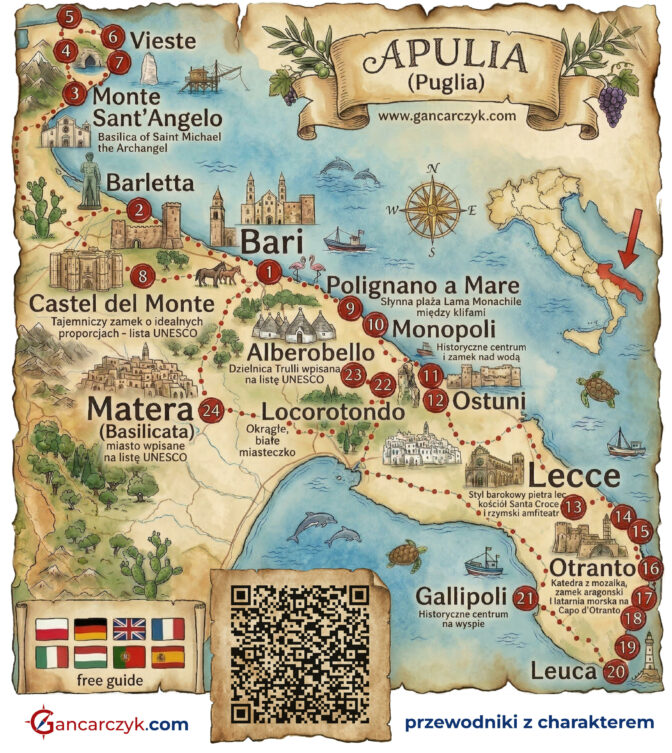
If you enjoy having a map in your hands that perfectly sets the tone for your trip, I've also prepared a high-quality illustrated map of Puglia. It's an exact replica of the previous map, but has a completely different feel. It works perfectly with this guidebook, and the numbering of attractions is identical, so feel free to use it instead of a traditional map!
I also know that some of you have printed out my regular maps as part of your travel journal. An illustrated map is even better for this purpose. If you're planning to create a souvenir photo book, what better way could there be to illustrate your trip?
If you want to print the map in the best quality or include it in a photo book, download the illustrated map of Apulia in high resolution – [click]
See: more free resources for hotels, guesthouses and car rental companies
Apulia - detailed sightseeing plan, maps and tours
I have divided the sightseeing plan description into separate days. I will try to very briefly describe each day in terms of intensity, important sightseeing points, time and length of trips. If necessary, I will provide additional information that may be useful during the tour. Over time, separate, detailed entries will appear for all places included in this plan, thanks to which you will learn more about each place.
Next to each of the listed destinations, you will find the GPS coordinates of the car parks where you can park your car best and conveniently.
day 1 - arrival in Bari (1)
On the first day, I usually do not plan any sightseeing. You will most likely arrive here by plane in the afternoon. Afterwards, you will be picked up by the rental car, then driven from the airport to the city center and checked into your hotel. You will probably not have enough time or energy for sightseeing. If, however, you have some desire, a short exploration of the city and a little grocery shopping in the local store will be very advisable. Breakfasts in Italy are modest and very light. You will get hungry one hundred percent quickly after them. A few groceries like bread and bakery items, or bananas, wafers or whatever you like, will surely come in handy when exploring the next day. It is worth remembering that in Puglia, restaurants usually open in the afternoon only from 20.00. Before that, they are open between 12.00 and 15.00. It is practically impossible to eat anything between 15.00pm and 20.00pm in an Italian restaurant. Only fast food remains, which is very rare in Apulia. A bun, a sandwich, a wafer or a banana in a moment of hunger that will catch you sooner or later are priceless.
1. Baric
The city where the relics of St. Nicholas rest. Yes! The one we associate with Christmas gifts. The city of Queen Bona. From here she came to Poland and died prematurely (poisoned). A beautiful, unique, and (still) tourist-free city. A city to which one gladly returns again and again. Learn more about Bari in the post: Bari – sightseeing, map, attractions, hotels, accommodation. Guide.
filter link: accommodation in Bari – [show accommodation]
Underground garage in the city center, close to the historical center, GPS coordinates:
41°07’11.4″N 16°52’04.2″E
41.119835, 16.867819 - click and route

day 2 Barletta (2) - Monte Sant'Angelo (3) - Umbra Forest (4) - Peschici (5) - Vieste (6)
trip length: 224 km
time of travel: 4 hours 1 min. (does not include time to visit attractions)
accommodation: Vieste
route map: open on Google map - [click]

comments:
It is the most difficult day for the driver during the entire trip. Although it does not look dangerous in numbers, there will be a lot of work. The difficult route begins when you get to Monte Sant'Angelo. It leads steeply uphill and meanders in serpentine. You will travel along narrow, winding and steep roads from now until the end of the day. You have to be very careful at every turn, because drivers coming from the opposite direction often cut corners. Despite the low traffic, in winter we had a few dangerous situations on this route related to cutting corners by the drivers. Therefore, the following kilometers are very slow and you have to be very patient. Guaranteed to be very tired at the end of the day.
2. Barletta
Nice town with two beaches, a promenade and monuments ... and a shocking entrance to the city.
Detailed information about Barletta can be found in a separate entry: Barletta - city attractions, map, sightseeing, accommodation. A quick guide.
filter link: accommodation Barletta – [show accommodation]
Parking near the castle, GPS coordinates:
41°19’13.8″N 16°17’25.2″E
41.320499, 16.290328 - click and route

3. Monte Sant'Angelo
The town boasts picturesque, cascading architecture and a remarkably beautiful, steep access road with stunning views. A significant place of worship for the Catholic Church, a unique chapel, and much more…
Detailed information about Monte Sant'Angelo can be found in a separate entry: Monte Sant'Angelo - sightseeing, attractions, map, accommodation for holidays
filter link: accommodation in Monte Sant'Angelo – [show accommodation]
Public parking at the Torre dei Giganti tower and the Castello di Monte Sant'Angelo castle, GPS coordinates:
41°42’26.3″N 15°57’04.8″E
41.707302, 15.951329 - click and route
Note: This parking lot is the most convenient place to start exploring the town.

4. Foresta Umbra
A unique forest area and nature reserve for Italy, located in the central part of the peninsula and the Gargano National Park.
Detailed information about Foresta Umbra can be found in a separate entry: Foresta Umbra - Dark Woods in the heart of the Gargano National Park. Map of trails and walking paths
One of the car parks in the forest, close to the lake where animals come to drink, GPS coordinates:
41°49’07.4″N 15°59’54.4″E
41.818722, 15.998441 - click and route
Note: The forest covers a large area, so you'll pass many forest parking lots along the way (driving through it takes several dozen minutes). The parking lot above is just one of many you can stop at.
5. Peschici
You must not miss this town. A fantastically atmospheric, tiny town!
Detailed information about Peschici can be found in a separate entry: Peschici - sightseeing, attractions, map, recommended accommodation for a vacation.
filter link: accommodation in Peschici – [show accommodation]
Parking in the upper part of the town, GPS coordinates:
41°56’42.1″N 16°00’50.3″E
41.945034, 16.013961 - click and route
Note: The parking lot I chose is located just outside the historic center of town. Of course, you can try driving a little further, where there are street parking spaces, but it's quite tight. Then, a restricted access zone begins, where only authorized vehicles are allowed. A walk from my suggested spot toward the historic center and the Castello Medioevale, perched on a sheer cliff, allows you to see the most beautiful parts of the town.

6. Vieste
It is a tourist paradise. Huge sandy beaches, low-rise buildings devoid of hotel behemoths, a beautiful old town and countless restaurants and bars.
Detailed information on what to see, where to stay and how to spend time in Vieste can be found in a separate entry: Vieste - sightseeing, attractions, map, accommodation for holidays
filter link: accommodation in Vieste – [show accommodation]
Parking at Pizzomunno - a characteristic rock spire, GPS coordinates:
41°52’43.0″N 16°10’35.2″E
41.878616, 16.176451 - click and route

day 3 Vieste (6) - Tower of San Felice (7) - Castel del Monte (8) - Bari (1)
trip length: 202 km
time of travel: 3 hours 7 min. (does not include time to visit attractions)
accommodation: Bari
route map: open on Google map - [click]
comments: the second half of the day and evening are dedicated to exploring Bari. Allow sufficient time for this. It is worth going out to see Bari so that you can see it on the border of day and dusk, when the street lamps in the old part of the city start to light up. These are magical moments. The city is changing in the eyes, every now and then it changes colors, it surprises us.
This day is planned in such a way that being here in winter, when the day is the shortest (dusk is around 18:00 pm), we had no rush with everything. Even in the morning in Vieste we sat for an hour in the sun on the beach.
7. San Felice Tower
The coastal Tower of the Kingdom of Naples and a viewpoint of the Arco do San Felice rock formation. The best place to observe the arch and take souvenir photos. More information about the tower and the rock arch can be found in a separate post: Torre San Felice – a tower and viewpoint overlooking the Arco San Felice rock arch.
Parking lot at the defensive tower overlooking the famous rock arch of Arco San Felice, GPS coordinates:
41°49’39.0″N 16°11’38.9″E
41.827488, 16.194135 - click and route

8.Castel del Monte
A castle whose purpose remains unclear. Widely considered a masterpiece of military architecture (it is a UNESCO World Heritage Site ), it remains remarkably functional to this day. Discover its secrets in a separate entry: Castel del Monte – a medieval fortress of secrets, symbols, and unanswered questions.
filter link: accommodation near Castel del Monte – [show accommodation]
Tourist parking, GPS coordinates:
41°04’36.2″N 16°16’29.6″E
41.076726, 16.274878 - click and route
Note: From the tourist parking lot to the castle, you'll need to walk about 1500 meters, slightly uphill. The walk is very pleasant and is a good way to warm up after a car ride.

day 4 Polignano a Mare (9) - Monopoli (10) - Monumental Olive Trees (11) - Ostuni (12) - Lecce (13)
trip length: 164 km
time of travel: 2 hours 12 min. (does not include time to visit attractions)
accommodation: Lecce
route map: open on Google map - [click]
Notes: The route looks quite innocuous, with only a few kilometers and a short total travel time, but I suggest not adding anything extra. It's worth spending as much time as possible in Polignano a Mare and Ostuni. They're unique places, and there's no need to rush. Lecce has daytime sightseeing the following day, so you might arrive late. If you're feeling energetic, you can take a nighttime stroll around the city. Monopoli, however, was a disappointment. If it had been derailed, we wouldn't have missed much (though it looks quite good in the photos 🙂 ).
9. Polignano a Mare
The stunning scenery of this town, nestled above a rocky gorge and the sea, is heating up photographers' Instagram accounts. Photos from the beach in Polignano attract people from all over the world to Puglia. They all want to see it for themselves and leave satisfied. For information on exploring the town, read a separate post: Polignano a Mare – map, sightseeing, attractions, hotels, accommodations. Guide.
filter link: accommodation in Polignano a Mare – [show accommodation]
Parking at the viewpoint on the cliff, GPS coordinates:
40°59’49.2″N 17°13’03.1″E
40.997011, 17.217519 - click and route

10. Monopoly
I read a lot of good things about Monopoli before my trip. Perhaps too much… The euphoric reviews of this city whetted my appetite and set the bar high. Perhaps that's where the disappointment stemmed from? Regardless of my subjective impressions, I'm including a complete set of information, including maps, useful for exploring the city. I recommend reading the details in my dedicated post: Monopoli – map, sightseeing, attractions, hotels, accommodation. Guide.
filter link: accommodation in Monopoli – [show accommodation]
Parking near the port and the old town, GPS coordinates:
40°57’06.9″N 17°17’58.0″E
40.951916, 17.299432 - click and route

11. Area of monumental olive trees
Fantastic groves of olive trees that date back to 3000 years. Amazing impression. It is worth taking a ride among them, especially as they are on the way from Monopoli to Ostuni.
You can find more about this in the entry: Area of monumental olive trees - Apulia
One of the places where the photo below was taken, GPS coordinates:
40°46’34.0″N 17°32’57.8″E
40.776103, 17.549393 - click and route

12. Ostuni
Italy's flagship "white city." Situated on a hill, it creates a whimsical tangle of alleys, narrow streets, squares, and staircases wrapped around houses, some carved directly into the rock. It's a must-see!
Read more in a separate post: Ostuni - sightseeing, attractions, map, parking lots, hotels, accommodation. Guide.
filter link: accommodation in Ostuni – [show accommodation]
Parking at the historic center of the town, GPS coordinates:
40°43’57.9″N 17°34’51.2″E
40.732760, 17.580891 - click and route

13. Lecce
A surprisingly beautiful city. Unique, richly ornamented, baroque facades fill the entire old town. You can't miss it!
Details of visiting Lecce can be found in a separate entry: Lecce - attractions, sightseeing, map, restaurants, hotels, accommodation, parking lots. Guide.
filter link: accommodation in Lecce – [show accommodation]
City parking near the historic center, GPS coordinates:
40°21’19.3″N 18°10’00.3″E
40.355351, 18.166752 - click and route

day 5 Cave of Poetry (14) - Sant'Andrea (15) - Otranto (16) - Santa Cesarea Terme (17) - Cala dell'Acquaviva (18) - Lecce (13)
trip length: 123 km
time of travel: 2 hours 21 min. (does not include time to visit attractions)
accommodation: Lecce
route map: open on Google map - [click]
Note: Most of the attractions on this day don't require much walking or hiking (except Otranto), and the route is short and easy. This is a great advantage, as the second half of the day is dedicated to exploring Lecce.
14. Cave of Poetry
The cave (grotto) of poetry. A beautiful creation of nature, amazing colors.
More information about the Cave of Poetry can be found in the post: Cave of Poetry - one of the 10 most beautiful natural pools in the world
filter link: accommodation near Cave of Poetry – [show accommodation]
Parking a few steps from the entrance to the area where the cave is located, GPS coordinates:
40°17’05.0″N 18°25’34.6″E
40.284717, 18.426279 - click and route

15. Sant'Andrea
Probably the most beautiful part of this part of the coast. A jagged, rocky shore, insanely situated beaches pressed into the rocks, walking paths and a convenient, free parking lot at the viewpoint. You have to see it.
More about Sant'Andrea can be found in the post: Sant'Andrea - beaches, white cliffs and sun. How to get, where to park, what to see?
filter link: accommodation in Sant'Andrea – [show accommodation]
Coastal viewpoint.
Parking at the viewpoint, GPS coordinates:
40°15’20.3″N 18°26’39.8″E
40.255636, 18.444377 - click and route

16. Otranto
A small, beautiful, and popular summer resort with a dramatic history dating back over 500 years. Read more in a separate post: Otranto – attractions, sightseeing, map, beaches, hotels, accommodation. Guide.
filter link: accommodation in Otranto – [show accommodation]
Parking 200 from the castle, GPS coordinates:
40°08’34.1″N 18°29’42.8″E
40.142816, 18.495229 - click and route

17. Santa Cesarea Terme
A popular spa town with thermal pools. More details can be found in a separate post: Santa Cesarea Terme – Spa, Thermal Waters, and Spa Relaxation
filter link: accommodation in Santa Cesarea Terme – [show accommodation]
Parking lot overlooking the Palazzo Sticchi, GPS coordinates:
40°02’14.4″N 18°27’47.2″E
40.037339, 18.463103 - click and route

18. Cala dell'Acquaviva
One of the most picturesque bays and beaches in Apulia.
More information about Cala dell'Acquaviva can be found in the post: Cala dell'Acquaviva - a bay and a beach hidden in a small Ford in the south of Italy
filter link: accommodation near Cala dell'Acquaviva – [show accommodation]
Parking at the descent to the beach, GPS coordinates:
39°59’29.4″N 18°24’47.7″E
39.991500, 18.413254 - click and route

13. Lecce
More about Lecce: Lecce – attractions, sightseeing, map, restaurants, hotels, accommodation, parking. Guide.
filter link: accommodation in Lecce – [show accommodation]
City parking near the historic center, GPS coordinates:
40°21’19.3″N 18°10’00.3″E
40.355351, 18.166752 - click and route

day 6 Canal del Ciolo (19) - Leuca (20) - Gallipoli (21) - Lecce (13)
trip length: 166 km
time of travel: 2 hours 39 min. (does not include time to visit attractions)
accommodation: Lecce
route map: open on Google map - [click]
19. Canal del Ciolo
A beautiful gorge for a short walk, or two trekking routes with stunning views for a slightly longer hike. More information on exploring the canyon and a description of the hiking trails with photos can be found in a separate post: Canale del Ciolo and the trail to the Cipolliane Grotto.
filter link: accommodation near Canale del Ciolo – [show accommodation]
Parking at the descent to the gorge, GPS coordinates:
39°50’36.5″N 18°23’09.8″E
39.843479, 18.386058 - click and route

20. Leuca
Leuca lies at the very end of the heel of an Italian shoe. Here something ends but also something begins ... and certainly something has started that has been influencing all of us for two thousand years.
Read more about Leuca in a separate post: Leuca - attractions, sightseeing, map, hotels, accommodation. Guide.
filter link: accommodation in Leuca – [show accommodation]
Street parking at the end of the land, GPS coordinates:
39°47’28.8″N 18°20’41.7″E
39.791328, 18.344903 - click and route

21. Gallipolia
Gallipoli may be a tiny town, but its significance in world history is surprisingly significant. In a separate post, you'll learn why Gallipoli was once as important as London or Paris, and what it has to do with the London Stock Exchange, which shapes prices worldwide. Read the Gallipoli guide: Gallipoli – attractions, sightseeing, map, hotels, accommodation, parking. Guide.
filter link: accommodation in Gallipoli – [show accommodation]
Parking just in front of the headland and restricted area, GPS coordinates:
40°03’17.8″N 17°58’55.0″E
40.054940, 17.981953 - click and route

day 7 locorotondo (22) - Alberobello (23) - Matera (24)
trip length: 187 km
time of travel: 2 hours 38 min. (does not include time to visit attractions)
accommodation: Matera
route map: open on Google map - [click]
Notes: If after a week of traveling through Puglia you think nothing will surprise you, you'll be proven wrong several times that day. The plan involves visiting three absolutely stunning places. Get your jaw ready, because you'll be knocked out several times during the day. Ideally, you should dedicate not one, but two days to these three towns, with an overnight stay in Locorotondo or Alberobello. We visited Matera twice: on the evening of our arrival and from morning until afternoon the next day, as our flight wasn't until evening (Matera is close to Bari airport: about a 50-minute drive).
22. Locorotondo
Locorotondo is a decidedly underrated town… and that's a good thing! This absolutely fantastic place is free from the hustle and bustle of crowds. It's peaceful, pleasant, and incredibly beautiful. Don't miss it under any circumstances! Maybe you'll make it before the tours start pouring in, which will likely happen sooner or later. Read more about this place and see more photos in a separate post – [click].
filter link: accommodation in Locorotondo – [show accommodation]
Parking lot close to the historic center, GPS coordinates:
40°45’11.1″N 17°19’52.7″
40.753089, 17.331303 - click and route

23. Albertobello
Alerobello is a different, separate world. Suddenly, funny little houses spring up everywhere and you feel like someone has teleported you into the world of fairy tales.
A detailed guide to Alberobello can be found in the post: Alberobello - the land of trulli houses in sun-warmed Puglia. Sightseeing, hotels, accommodation.
filter link: accommodation in Alberobello – [show accommodation]
Parking in the immediate vicinity of the trulli cluster, GPS coordinates:
40°46’56.8″N 17°14’21.0″E lub
40.782440, 17.239156 - click and route

24. Material
To put it succinctly: Matera is jaw-dropping! It's a real knockout blow at the end of the trip. Read more about Matera in the post: Matera – attractions, sightseeing, map, hotels, restaurants, accommodation, parking. Guide.
filter link: Matera accommodation – [show accommodation]
Parking on the street in a parking zone allowed, GPS coordinates:
40°40’13.1″N 16°36’30.4″E
40.670309, 16.608430 - click and route

day 8 Matera (24) – departure from Bari (1)
As I wrote above, we used this day from the morning to visit Matera. The late hour of our return flight to Berlin allowed us to do so. So we had almost the entire additional day at our disposal. It was very useful. Without it, we wouldn't have had time to see even half of the city.
Transfer from Matera to the airport in Bari took less than an hour. The car's return to the rental company went very smoothly and it was done in a few minutes.
Puglia for the curious: additional and alternative attractions
The above itinerary captures the essence of Puglia, but the region has much more to offer. This section is designed for those who want to venture off the beaten track or are looking for alternatives to the most popular destinations.
You can freely modify my main plan by adding places from this list, or build your own unique route by combining both lists – the basic one and the one for the curious.
Additional attractions are additionally highlighted in purple on the map.
25. Galatina

photo: Fabrizio Garrisi on the principles CC0 1.0
source: wikipedia
Most tourists rush to Baroque Lecce, completely unaware they pass by one of the Salento Peninsula's most captivating cities. Galatina, however, doesn't need mainstream glamour to captivate visitors with its history. It was here, in the shadow of its austere walls, that the legend of tarantism (tarantismo: a cultural and social phenomenon associated with the alleged spider bite) was born, and the austere Romanesque facades conceal interiors rivaled only by the Basilica in Assisi in terms of polychrome richness.
The heart of the city and its absolute treasure is the Basilica of St. Catherine of Alexandria (Basilica di Santa Caterina d'Alessandria). Its construction was commissioned in the late 14th century by Raimondello Orsini del Balzo, a powerful feudal lord who, after returning from the Crusades, decided to build a church worthy of the relic of the saint's finger, which, according to legend, he had stolen from a monastery on Mount Sinai. The basilica's exterior displays a restrained Romanesque style with a beautiful rose window, but crossing its threshold is a moment of transition to another reality. The entire interior (every wall, pillar, and vault) is covered with frescoes from the turn of the 14th and 15th centuries, executed by masters of the Neapolitan and Sienese schools. Biblical cycles, scenes from the life of St. Catherine, and the terrifying yet fascinating visions of the Apocalypse create a coherent narrative that can be read like an open book. It is one of the few examples of Gothic art in a region dominated by the later Baroque.
Walking through the narrow streets of the historic center, you'll encounter numerous traditional houses with inner courtyards, testifying to the ancient communal life of its inhabitants. Galatina, however, has another side: it's a sacred theater for the battle against demons. In St. Peter's Square stands the Church of Saints Peter and Paul, in front of which healing rituals were held for centuries for those "bitten" by the mythical tarantula. Women called tarantates, intoxicated by the toxin or trauma, danced to a frenzied rhythm until they dropped, seeking refuge from Saint Paul. Nearby is a small chapel with a miraculous well, whose waters were said to heal the effects of the venom. Although today it's merely folklore, the spirit of this mystical dance, from which the popular pizzica (a traditional Salento dance) evolved, still vibrates in the city's hot air.
Interesting facts
Errors in the paintings: in the cycle of frescoes in the Basilica one can find figures in 15th-century costumes, which was a deliberate move to bring the biblical events closer to the faithful of that time.
Coat of Arms Spider: Galatina's old coat of arms featured a spider, a direct reference to the legends of tarantism and the patronage of St. Paul, who was supposed to protect the city from poisonous creatures.
Pasticciotto: In Galatina, in 1745, Nicola Ascalone accidentally created pasticciotto (a shortbread pastry filled with a thick pastry cream). Time stands still in the Ascalone family pastry shop, which remains in operation to this day. The interiors are scented with vanilla and tradition, and each visit is an encounter with the culinary heritage of the Puglia region.
Opening hours
Basilica of St. Catherine of Alexandria:
Summer season (April–October): 7:30–12:30 and 15:30–20:00.
Winter season (November–March): 7:30–12:30 and 15:30–18:30.
St. Paul's Chapel:
It is usually open in the morning (9:00–12:00), although it is often opened by local caretakers at the request of tourists.
Closed days: January 1, January 6 and December 25 (on these days, hours may be limited to morning masses).
Practical tips:
Entrance to St. Catherine's Basilica is free, but it's worth having small coins with you for the automatic lighting of the frescoes (without it, the details of the paintings remain in semi-darkness).
For a leisurely stroll through the old town and contemplation of the frescoes, reserve at least 3 hours.
Galatina is flat and easy to explore on foot.
filter link: accommodation in Galatina – [show accommodation]
Parking: most of the space is around Piazza Dante Alighieri, GPS coordinates:
40°10’29.9″N 18°10’08.1″E
40.174966, 18.168910 - click and route
The square is very close to the Basilica of St. Catherine of Alexandria. Parking is available at the square (marked with blue lines on the asphalt). If you can't find a spot at the square, look for one along the surrounding streets. As a reminder, white parking lines indicate free parking, while yellow spaces are reserved (do not park in them).
Basilica of Santa Caterina d'Alessandria, GPS coordinates:
40°10’21.8″N 18°10’19.7″E
40.172716, 18.172146 - click and route
26. Grottaglie

Grottaglie offers a journey into the depths of the earth and a craft that has remained unchanged for centuries. The town, whose name derives from the Latin Cryptae Aliae (numerous caves), literally rises from the soft limestone. It is here, in the deep gorges known as gravines (rocky ravines), that potters have carved their workshops directly into the rock since the Middle Ages. To this day, the heart of Grottaglie is the Quartiere delle Ceramiche (ceramics district), a unique complex of over 50 factories, many of which are still housed in natural caves.
The district is dominated by the monumental Castello Episcopio (Episcopal Castle), built in the 14th century as the summer residence of the bishops of Taranto. Its austere, defensive silhouette, with its massive Torre Maestra (main tower), houses the Ceramics Museum in the former stables. Strolling through the castle courtyard, it's worth noting the details of pietra leccese (soft, golden limestone), whose malleability allowed local craftsmen to create exquisite window frames and portals.
The most fascinating element of Grottaglie's identity, however, is the figure of the Pupa con i baffi (mustached doll). According to local legend, during the Spanish domination and the prevailing law of jus primae noctis (right of the first night), a young winemaker refused to hand over his beloved to the local feudal lord. He decided to disguise himself as a bride and, with a knife hidden under his dress, go to the castle. The plan was perfect, except for one detail: in his haste, he forgot to shave his thick, black mustache.
Interesting facts
The Symbolic Rooster: The distinctive blue-and-yellow rooster motif on dishes is known as galletto. Legend has it that during periods of great famine, artisans painted it on plates to "feel the eyes" with a colorful image when real food was scarce.
Ceramic Buds: You'll notice Pumo, ceramic figurines resembling flower buds or pine cones, everywhere. For locals, they're a symbol of fertility and good fortune; they're traditionally placed at the corners of balconies to protect the home from evil.
Giant vessels: workshops still produce huge, over-meter-long wine vessels which, due to their size, must be fired in special, huge kilns built inside caves.
Opening hours
Castello Episcopio and the Ceramics Museum:
July–August: 10:00–13:00 and 17:00–21:00 (Saturdays often until 23:00).
Wrzesień–Czerwiec: 10:00–13:00 oraz 15:30–19:30.
Workshops in the Quartiere delle Ceramiche: Most bottegas (workshops) are open from 9:00 a.m. to 13:00 p.m. and from 16:30 to 20:00 p.m. Some are also open to the public on Sundays.
Closed: January 1, January 6 and December 25.
Practical tips
When buying pottery, look for the artist's signature on the bottom of the vessel. Authentic Grottaglie pottery is surprisingly lightweight compared to mass-produced pottery from other regions, thanks to the specific porosity of the local clay.
Visiting time: plan about 3 hours for a walk around the workshops, a visit to the castle and a coffee in the centro storico.
filter link: accommodation in Grottaglie – [show accommodation]
The historic center of Grottaglie (landmark), GPS coordinates:
40°32’04.0″N 17°25’41.9″E
40.534453, 17.428294 - click and route
Bishop's Castle and the Ceramics Museum (Castello Episcopio), GPS coordinates:
40°32’02.1″N 17°25’53.5″E
40.533928, 17.431524 - click and route
Ceramics District (Quartiere delle Ceramiche), GPS coordinates:
40°32’01.5″N 17°25’57.1″E
40.533754, 17.432517 - click and route
There are pottery workshops along the street.
Public parking near the historic center, GPS coordinates:
40°31’59.2″N 17°25’39.5″E
40.533111, 17.427639 - click and route
27. Grotte di Castellana

photo: Marcok on the rules CC BY-SA 3.0
source: wikipedia
The Grotte di Castellana is no ordinary cave; it's a monumental system of passages and chambers, patiently carved by water into the chalk limestone (Calcarea cretacea) over 90 million years. It all begins with La Grave (the abyss), a gigantic natural pantheon into which, for centuries, no one has dared to descend.
The story of the caves' discovery reads like the plot of an adventure movie. Although the opening in the ground had always been known, local residents gave it a wide berth. They believed that the souls of the damned or demons emerged from the dark hole. However, this irrational fear had a prosaic basis. Carrion and waste were thrown into the abyss, which, combined with the humidity, created thick, foul-smelling vapors hovering above the entrance. Only on January 23, 1938, speleologist Franco Anelli, assisted by local assistant Vito Matarrese, dared to descend to the bottom of the chasm. What they saw there forever changed the tourist map of Italy and proved that a labyrinth over three kilometers long lay beneath the feet of the inhabitants of Castellana Grotte.
Walking through the halls, such as the Caverna dei Monumenti (Grotto of Monuments) or the Corridoio del Deserto (Desert Corridor), one might feel as if one is witnessing a spectacle of surrealism. Stalagmites and stalactites here take on forms that the human imagination readily interprets as the silhouette of a she-wolf, the figure of the Madonna, or gigantic Gothic towers. However, the absolute highlight, accessible only to those taking the longer route, is the Grotta Bianca (White Cave). It is one of the most sterile and dazzling places in the underworld. Its entire interior is covered in pure white alabaster, which gleams like millions of diamonds when exposed to light. This ecosystem is so fragile and precious that guides rigorously ensure that nothing is touched, and the whiteness of the formations stems from the almost complete absence of pollutants in the water that percolated through the rocks thousands of years ago.
Interesting facts
Record-breaking purity: Grotta Bianca is considered by speleologists to be the brightest stalactite cave in the world; its pristine whiteness is the result of calcite crystallization without any iron oxides or clay.
Underground Pantheon: La Grave Hall is so vast it could easily accommodate the Roman Pantheon; light streaming through an opening in the vault creates a natural light show.
The Explorer's Mistake: Franco Anelli initially believed the cave system ended much earlier. It was his young assistant, Vito Matarrese, who squeezed through an incredibly narrow opening and became the first man in history to reach the stunning White Cave.
Endemic inhabitants: unique species live in the darkness of Castellana, such as the rare Troglophilus andreinii grasshopper, which has adapted to life in complete darkness and humidity reaching 90%.
Opening hours
Summer season (April – September): entry to the full route usually from 9:00 to 18:00 (last entry).
Winter season (October – March): the schedule is limited, entries usually take place in the morning (approx. 10:00, 11:00, 12:00) and early afternoon.
Closed: December 25 and January 1. It's worth checking the dates in February, as the caves may be closed during the Putignano Carnival.
Practical tips
Online tickets are essential. The number of people in each group is strictly limited, and during the summer season, tickets for the full tour sell out well in advance.
Check: entrance tickets and tour of Grotte di Castellana – [click] (GetYourGuide)
Clothing: The temperature inside is a constant 16,5-18°C, regardless of the heat above ground. A sweatshirt or light jacket is essential for a comfortable two-hour stay underground.
Footwear: Stairs and paths are constantly wet and can be very slippery. Wear shoes with rubber soles and good grip.
Choosing a route: I highly recommend the complete route (itinerario completo), which takes about 2 hours and is 3 km long. The short route (50 minutes) skips the most beautiful part of the caves, the Grotta Bianca.
filter link: accommodation near Grotte di Castellana – [show accommodation]
Main entrance to the Grotte di Castellana area, GPS coordinates:
40°52’32.8″N 17°08’54.8″E
40.875768, 17.148562 - click and route
Parking P1 at Grotte di Castellana; GPS coordinates:
40°52’29.9″N 17°09’08.9″E
40.874983, 17.152470 - click and route
Parking P2 at Grotte di Castellana; GPS coordinates:
40°52’42.8″N 17°09’03.1″E
40.878553, 17.150860 - click and route
28. Gravina in Puglia

photo: Lorenzo Ciaccia on the principles CC BY-SA 4.0
source: wikipedia
If you thought only Matera could dazzle with the scale of its rocky architecture, Gravina in Puglia will dispel your suspicions. While its famous neighbor is bursting at the seams with tourists, Gravina remains an authentic, rugged town suspended above a precipice, where life unfolds in two dimensions: on the sunny surface and in the dark corridors carved into the limestone. The city gazes into the abyss of a deep gorge (gravina – a karst formation resembling a canyon) that has defined its architecture and character for millennia.
The city's symbol and most striking landmark is the Ponte Acquedotto (Aqueduct Bridge). This impressive 18th-century structure, supported by two-level arcades, was originally used to transport water from the nearby Sant'Angelo Spring to the city walls. For modern viewers, however, the bridge has a different face – it was here that Daniel Craig, playing James Bond in the film "No Time to Die," made his chilling leap into the canyon. Walking this narrow, stone path, which connects the old town with the archaeological park of Botromagno on the other side of the gorge, allows you to experience the power of nature and the skill of ancient engineers who had to tame the irregular terrain.
Gravina's architecture is a fascinating dialogue between Romanesque austerity and Baroque splendor, best exemplified by the Cathedral of Santa Maria Assunta. Built in the 11th century by the Normans, it was repeatedly destroyed by earthquakes and fires, ultimately emerging as an eclectic masterpiece. Inside, the eye-catching feature is the coffered ceiling, adorned with gold and the coats of arms of the Orsini family – one of Italy's most powerful aristocratic families, from which Pope Benedict XIII, born here, descended. It was the Orsinis' patronage that brought the city to prosperity, and their palace (Palazzo Ducale) still dominates the historic buildings today.
Gravina's true secret, however, lies underground. Gravina Sotterranea (Underground Gravina) is a system of hundreds of caves, cellars, granaries, and cisterns that create a second, mirror-like city. For centuries, residents extracted calcarenite (a soft limestone typical of the Murgia region) from here to build their homes, while also adapting the empty spaces into shelters, olive presses, and places of worship. An example of this latter is the rock church of San Michele delle Grotte, carved entirely into the rock. In the darkness, remnants of frescoes and hundreds of skulls arranged in niches can be seen, which, according to legend, commemorates the victims of the Saracen massacre in the 10th century.
Interesting facts
The Papal Cradle: Gravina is the only city in the region to have produced a successor to St. Peter. Pietro Francesco Orsini, later Benedict XIII, was born here in 1649, and his figure remains venerated to this day, evident in street names and monuments.
James Bond and the Effect of Scale: The filmmakers chose the bridge in Gravina not only because of its height (approximately 37 meters), but also because it perfectly matched the dark, dramatic atmosphere of the chase, which could not have been staged in the more polished Matera.
Cola Cola: This isn't a misspelling of the well-known brand. Cola Cola is a traditional, ceramic bird-shaped whistle, made in Gravina since ancient times. Its sound was once believed to ward off evil spirits and protect children from illness.
Medieval Granary: Beneath the main square lie gigantic rock-hewn grain silos that could hold enough food for the entire city in the event of a multi-year siege.
Opening hours
Cathedral of Santa Maria Assunta: Daily 8:00–12:30 and 16:00–19:30.
Gravina Underground (Gravina Sotterranea) guided tour:
Monday – Friday: 10:00, 11:30, 16:30, 18:00.
Saturdays and Sundays: admission every hour from 10:00 to 19:00.
Closed: December 25 and January 1 (Sunday opening hours apply on other holidays).
Practical tips
Online tickets: theoretically, it's worth booking a tour of the underground in advance online, as the groups are small and interest has increased dramatically since the Bond premiere, but in practice the booking system doesn't work, and the attraction doesn't yet have a partnership with any network that supports online ticket sales.
Currently (as I write this) on their website they suggest contacting them by email.
Check: entrance tickets and tours of Gravina in Puglia – [click]
Footwear: Gravina is a town of steps and slippery rocks. Skip sandals and wear shoes with good grip, especially if you plan to cross the bridge and climb Botromagno Hill.
Clothing: The temperature underground is constant at around 16-17°C, even when it's 40°C outside. A light sweatshirt will be a lifesaver.
Tour time: Plan at least 4-5 hours. The underground tour itself takes about 90 minutes, and the walk above the gorge and visit to the cathedral will take you about the same amount of time.
filter link: accommodation in Gravina in Puglia – [show accommodation]
Underground of Gravina Sotterranea, GPS coordinates:
40°49’01.0″N 16°24’54.6″E
40.816942, 16.415165 - click and route
One of the viewpoints overlooking the city, the bridge and the Gravina gorge, GPS coordinates:
40°49’07.8″N 16°24’48.6″E
40.818839, 16.413502 - click and route
Gravina Aqueduct, GPS coordinates:
40°49’12.0″N 16°24’49.0″E
40.820005, 16.413601 - click and route
A viewpoint from the other side of the gorge overlooking the city, GPS coordinates:
40°49’11.4″N 16°24’43.7″E
40.819838, 16.412133 - click and route
The most convenient way to park is along Corso Vittorio Emanuele (paid parking in the parking meter, blue parking lines), GPS coordinates:
40°48’59.2″N 16°25’00.7″E
40.816433, 16.416871 - click and route
From there you can reach the bridge and the old town in a 5-minute walk.
29. Trani

Trani doesn't need flashy neon signs to attract attention; it does so with the distinguished serenity and radiance of the Pietra di Trani, the local limestone, almost white in color, which, depending on the time of day, changes to shades of ivory or delicate pink. Trani is elegance in its purest form, where the history of the Crusades mingle with the aroma of fresh fish landing in the horseshoe-shaped port.
The main landmark and architectural landmark is the cathedral, completed in the 12th century. It is one of the finest examples of Romanico Pugliese (the Romanesque style typical of Apulia). Its location at the very edge of a promontory makes the austere façade seem to rise directly from the blue Adriatic Sea. The interior is striking in its two-story structure: beneath the main nave lies the lower church of St. Mary and the crypt of St. Leucius, where a stark, mystical coolness prevails, contrasting with the scorching sun outside. Note the replica of the massive bronze doors by Barisano da Trani (the original is inside), consisting of 32 intricately carved panels.
Just a stone's throw from the cathedral stands Castello Svevo (Swabian Castle). This four-sided fortress with massive corner towers was built in 1233 by order of Frederick II of Hohenstaufen. While the castle served defensive purposes, it was also the site of lavish celebrations, including the wedding of the emperor's son, Manfred, to Helena Angelos. Its walls, constructed from the same pale stone as the cathedral, create a cohesive, almost surreal architectural landscape, best admired from the harbor pier.
Walking inland, you will come to Giudecca (the historic Jewish quarter), the densest labyrinth of narrow streets.
An evening in Trani is best spent at the port, watching local fishermen mend their nets and the locals indulge in the ritual of the passeggiata (evening stroll), while sipping a glass of the famous Moscato di Trani (a sweet dessert wine).
Interesting facts
Maritime Code: It was in Trani in 1063 that the Ordinamenta Maris, the world's first medieval maritime code, was promulgated, regulating trade and navigation throughout the Mediterranean.
A builder's error? The cathedral's bell tower was built on a crossing arch, an extremely risky engineering decision in the 12th century; however, it has survived numerous earthquakes.
Opening hours
Trani Cathedral:
Summer season: 9:00–12:30 and 15:30–20:00 (visiting is limited during mass).
Winter season: 9:00–12:30 and 15:30–18:30.
Castello Svevo:
Daily 8:30–19:30 (last entry at 18:30).
Closed: January 1, January 6, December 25.
Practical tips:
Admission to the cathedral is free, but fees apply for entry to the bell tower and castle.
Sightseeing time: Allow yourself about 3-4 hours for a leisurely stroll around the port, a visit to the cathedral, castle and Jewish quarter.
filter link: accommodation in Trani – [show accommodation]
Castello Svevo in Trani, GPS coordinates:
41°16’54.8″N 16°24’56.2″E
41.281900, 16.415613 - click and route
Trani Cathedral, GPS coordinates:
41°16’56.0″N 16°25’05.5″E
41.282226, 16.418192 - click and route
A landmark in the Jewish Quarter, GPS coordinates:
41°16’46.2″N 16°25’04.7″E
41.279503, 16.417977 - click and route
Fortino Sant'Antonio viewpoint in the port, from which the most beautiful photos of the Cathedral of Trani are made, GPS coordinates:
41°16’50.2″N 16°25’19.4″E
41.280623, 16.422041 - click and route
Large parking lot (paid) next to the Swabian Castle in Trani, GPS coordinates:
41°16’53.9″N 16°24’58.9″E
41.281648, 16.416373 - click and route
30. Nardo

photo: Iosca photography on terms CC BY-SA 4.0
source: wikipedia
While most travelers consider Nardò merely a gateway to the wild beaches of Porto Selvaggio, this town is actually one of the most refined architectural scenes in all of Puglia. Forget the museum-like silence; here, Baroque isn't a dead style but a living, almost pulsating organism. The city's focal point, Piazza Salandra, has been called "the most beautiful salon in southern Italy," but a more accurate description would be the proscenio (that part of the stage in front of the curtain). Every building, balcony, and cornice here seems to be part of an endless spectacle.
The square is dominated by the Guglia dell'Immacolata (Spire of the Immaculate Conception). This nearly twelve-meter-high, lavishly decorated monument was erected in 1749 by the town's inhabitants as a votive offering for saving the city from a devastating earthquake. However, it is not the soaring spires, but the austere walls of the Cathedral of Santa Maria Assunta that hold Nardò's greatest emotional significance. The church was built on the foundations of a former Basilian abbey. It is here, in a side chapel, that the famous Crocifisso Nero (Black Crucifix) is located. This 13th-century cedar sculpture, dark, almost ebony in color, is the subject of a cult bordering on mysticism.
Nardò's history also has a dark, bloody side, personified by Giangirolamo II Acquaviva d'Aragona, known as the Cross-Eyed of Apulia. The tenth Duke of Nardò was a figure as brilliant as he was demonic. In 1647, as Naples burned in the flames of Masaniello's revolution, the Duke brutally crushed a revolt by local nobles and townspeople, turning the city into an arena of executions.
Walking through the historic center, it's worth noting the details of the façade of the Church of San Domenico. It's a veritable "stone lace," where sculptors pushed the limestone to its limits, creating garlands of flowers, putti, and fanciful beasts that seem to emerge from the masonry.
Interesting facts
Bull on the Coat of Arms: The city's coat of arms features a bull, which, according to legend, dug up a spring of water with its hoof, saving thirsty residents during the siege. To this day, a fountain commemorating this event stands in Piazza Salandra.
An architect's mistake? The circular structure at the entrance to the old town, known as Osanna, looks like an oriental gazebo. Built in the 17th century and used for the blessing of palms, it is a unique example of a votive structure with a shape unusual in this part of Europe.
The Artist Prince: The aforementioned tyrant, Il Guercio, despite his cruelty, was a great patron of the arts and… a painter. He reportedly designed some of the decorations in his estates himself, combining a love of beauty with ruthless power.
Opening hours
Cathedral of Santa Maria Assunta:
Daily 7:30 a.m.–12:00 p.m. and 16:00 p.m.–19:30 p.m. Visits are not permitted during religious ceremonies.
Castello Acquaviva (museum and courtyard):
Monday – Friday 8:00 a.m. – 14:00 p.m. (some sections also available in the afternoon during temporary exhibitions).
Closed: As in the entire region, the main monuments are closed to visitors on January 1.01, January 6.01 and December 25.12, except during mass hours in churches.
Practical tips
The old town is a ZTL (Limited Traffic Zone). It's best to leave your car in the large parking lot on Via Roma or near the castle and explore the maze of streets on foot.
Plan at least three hours for the city center itself. If you want to combine this with a visit to the nearby Porto Selvaggio Nature Reserve (which I highly recommend), set aside a full day.
Porto Selvaggio is one of the most unspoiled and picturesque corners of the Ionian coast. The entire area is protected within the Regional Natural Park of Porto Selvaggio and Palude del Capitano.
The most frequently visited is the Bay of Porto Selvaggio (Spiaggia di Porto Selvaggio). It's a small, pebbly beach surrounded by a dense pine forest. The water here is incredibly crystalline and turquoise, but cooler than in other parts of Salento due to the presence of underground freshwater springs flowing into the sea.
Parking: The main parking lots are located on SP286 (coordinates below). During the summer season, it's worth arriving early to avoid the crowds and find a parking space.
filter link: accommodation in Nardò – [show accommodation]
The central square of Nardò, or Piazza Salandra, GPS coordinates:
40°10’45.5″N 18°01’51.3″E
40.179312, 18.030905 - click and route
Facade of the church of San Domenico, GPS coordinates:
40°10’43.4″N 18°01’51.0″E
40.178723, 18.030844 - click and route
Cathedral of Santa Maria Assunta, GPS coordinates:
40°10’47.9″N 18°01’48.5″E
40.179965, 18.030150 - click and route
Acquaviva Castle, GPS coordinates:
40°10’34.5″N 18°01’52.4″E
40.176253, 18.031208 - click and route
Parking in Nardò near the historic center, GPS coordinates:
40°10’42.7″N 18°02’07.1″E
40.178522, 18.035317 - click and route
PLEASE NOTE! The Old Town is a ZTL (Limited Traffic Zone). When traveling within the city, do not enter this zone (heavy fines may apply)!
Parking spaces in Nardò (free – white lines) on Via XX Settembre near the historic center, GPS coordinates:
40°10’51.1″N 18°02’05.2″E
40.180873, 18.034769 - click and route
PLEASE NOTE! The Old Town is a ZTL (Limited Traffic Zone). When traveling within the city, do not enter this zone (heavy fines may apply)!
Parking near the Bay of Porto Selvaggio, GPS coordinates:
40°09’08.5″N 17°58’51.0″E
40.152348, 17.980821 - click and route
Porto Selvaggio bay and beach, GPS coordinates:
40°08’53.4″N 17°58’28.9″E
40.148169, 17.974696 - click and route
Apulia - package tours and travel agencies' offer
I searched the databases of travel agencies' offers to find out what their proposition was. I must say it is miserable. Travel agents have few offers and they are not necessarily attractive. It is clear that so far they are not doing a great job to propose and sell this destination. They are mainly limited to proposing accommodation and hotel offer without meals and with own transport.
Links to the offer of dozens of travel agencies collected in one place, in the price comparison engine, I place here: list of Apulia offers - [click]
Important to me!
Give the article a good rating (5 stars welcome 😀)!It's free, a for me it is very important! The blog lives on visits and thus has a chance to develop. Please do it and ... thank you in advance!
If you like my guides, you will certainly find the one I created useful guide catalog - [click]. There you will find ready-made ideas for your next trips, descriptions of other tourist destinations and an alphabetical list of guides divided into countries, cities, islands and geographical regions.
I also post link to Facebook profile - [click]. Come in and press "Follow"then you will not miss new, inspiring posts.
Unless you prefer Instagram. I'm not a social media demon, but you can always count on something nice to look at on my instagram profile - [click]. The profile will gladly accept any follower who likes it.
I read ALL the comments (and many times). Under each of them I could write that Thank you very much, because you are real fantastic. I often come back to comments because they give me motivation and energy. For me this is invaluable a treasure trove of good emotions!
Thank you for this here (I don't want to clutter the comments with repeated thanks). Know that by leaving a kind word here, you are doing a really good job for me!
I make the content I create available free of charge with copyright, and the blog survives from advertising and affiliate cooperation. So, automatic ads will be displayed in the content of the articles, and some links are affiliate links. This has no effect on the final price of the service or product, but I may earn a commission for displaying ads or following certain links. I only recommend services and products that I find good and helpful. Since the beginning of the blog's existence, I have not published any sponsored article.
Some of the readers who found the information here very helpful, sometimes ask me how you can support the blog? I do not run fundraisers or support programs (type: patronite, zrzutka or "buy coffee"). The best way is to use links. It costs you nothing, and support for the blog is self-generating.
Pozdrawiam

great reportage-guide and nice photos. Thanks a lot 🙂
What would we do without Mr. Jacek's information?
We would pay a few fines, wander around the towns like children in the fog and get lost in hundreds of guides :)
One blog solves all problems!
Thank you!!!
The best guide to Puglia
PRICELESS 🙂
️
Thank you! 😀
The best guide to the world.
Interesting descriptions, great photos and maps with GPS locations.
If the country I'm going to is available, I always choose Gancarczyk🙂
Thanks for a job well done.
Very well written, lots of useful information. But I have a request for Mr. Jacek. I would like to ask you about your impressions of driving in Italian cities. If you could reply to my email, I would be grateful.
There's not much to write about, just a few words: chaos and eyes in the back of your head . You can read a bit more about this in the description from Sicily – [click]
Thanks for the post. This is a ready-made guide. I have a technical question. Is it possible to visit it in 4 days? Or should I split the trip into 2 dates?
no chance in 4 days
Another wonderfully detailed tour – thank you so much!!
super blog, thank you very much, it's not the first time it's helped me plan a trip. Can I ask for information whether the route from Bari to Locorotondo by car is demanding? I mean, is it rather flat, gentle bends, wide lane, or are there a lot of serpentines, sharp bends, narrow and a "precipice" down from the route? I'm a good big city driver but unfortunately I give up on such routes... and there will be no substitute
Nothing difficult. Easy way.
what rental company did you get your car from? it's hard to find anything in Bari with full insurance
everything is here: car rental in Bari – [click]
Well done, everything you need before a trip to this area, you should edit travel guides :)
Thanks a lot, I will definitely use your advice.
Lots of valuable advice!
Excellent guide. I want to "like" in Facebook, but can't find your link
Great article, very helpful in laying out your plan for Puglia. I will travel through this wonderful region using your knowledge. Thanks a lot 🙂
It will undoubtedly be a successful trip.
Have fun traveling!
Awesome!!!!! Great information presented clearly and concisely. Thank you!
Great material for creating your own sightseeing plan, very useful and professionally made, congratulations
A very useful article.
Way to go! For sensitivity and competence! I am going for the second time and I confirm my resolve with your stories. And I'm learning topographical details that make my journey easier. Grazie mille!
I must admit that I am drawn here again 🙂
thank you for the kind words!
Hello, with best regards and likes the wonderful reports and tips, I'm quietly asking if you would like to advise me about Apulli?
Mainly in sensible planning of accommodation so as not to travel senselessly. Arrival in Bari, we want to divide our trip into a tour north of Bari - 4 days, then overnight stay in Monopoly/sentiment/ and 4 days in the southern part of Bari,
Somehow I can't cope with planning good places to stay, and I took it upon myself for 4 people. I would be grateful for some short tips.
Ola
Lots of interesting information, links to parking lots great! Thank you very much for the entire article, better than many guides and very well laid out with useful links.
Great guide, we use the tips throughout the trip. Greetings Mr. Jacek
Inspirational Guide!
I just bought a plane ticket to Bari, I hope this information will be helpful, thank you.
Well, I am waiting for impressions after my return 🙂
Oh my ! What a gigantic guide!
I am shocked and full of admiration that someone wanted so much.
I haven't read everything yet, but I will definitely do it because I plan to visit Apulia on my own next year.
I've always driven my car, but it's quite a long way and now I want to go by plane and rent a car there.
Therefore, thank you in advance for all the information.
Regards Elżbieta
No worries. I'll be driving from Warsaw to Vieste-Bari in September. Two nights en route.
Sensational description. I intend to use it soon. Thank you very much
I'm just going to this region for 5 days and I'm looking for information. I am impressed with the descriptions !!! Unfortunately, I have to change places a bit because of the shorter time. Please tell me if the tour schedule was tight?
Yes. The plan I proposed was quite tight, but the days were shorter as we were winter. We started around 8.00 am and around 17.00 - 18.00 pm we were at the hotel.
Great description. We are just organizing a trip to Puglia with friends. We will like it very much.
Pozdrawiam
sensational description and great selection of places. helped me a lot in planning my own trip
Acabamos de chegar da Puglia e usamos esse guia quase que integral. excellent!!!! Parabens!!!
Extensive and Excellent Reading!
Thank you! I didn't have time to prepare, the study helped me VERY much.
JUST BACK FROM BARI. I WISH I HAD READ THIS DESCRIPTION BEFORE, BUT THE INFORMATION CONTAINED HERE IS VERY ACCURATE. IT IS WORTH GOING THERE WITH THIS INFORMATION. I THINK NO GUIDE CONTAINS AS MUCH VALUABLE INFORMATION AND ADVICE AS THIS GUIDE. CONGRATULATIONS ON SUCH INVENTION AND ACCURACY. AFTER READING, YOU CAN DEFENDLY WALK AROUND APULIA. I RECOMMEND THIS IS A DIFFERENT FACE OF ITALY THAN THE OTHER SIDE OF THE SHOE, CALM LESS TOURISTS. DELICIOUS FOOD AND VERY VARIETY.
A revelation - everything you need to plan your trip in detail and accurately.
We have used Mr. Jacek's guides many times - also EXCELLENT - especially Madeira.
Greetings and thank you very much for so much important travel information, so ordered, as in few guidebooks :)
Thank you very much for the detailed report and helpful tips!!!
AWESOME DESCRIPTIONS, links, GPS data, a piece of mega solid and useful work for others, Thank you!!!
I'm going and now unfortunately I just have to choose what to give up, because we only have 6 days.
But I already have a base, great BLOG!!!
Revelacya!
I'm just going to Bari but I already appreciate the amount of tips and advice
An excellent guide. We drove around Puglia using these descriptions. The parking lot directions were especially helpful, saving us time and aggravation. I highly recommend them.
Apulia is beautiful, this blog guided us through this interesting part of Italy, thank you.
Hi, it looks very detailed. This will be my first time using it and I have a chance to test the plan tomorrow, but I already know I won't be able to complete the entire route. I'll save some for next time. I'll share my impressions when I get back.
Good morning
great description Mr. Jacek, great respect for the work you do in creating your plans!!
We're going to Puglia at the turn of March and April. We'll be there for five full days. So we have to give something up. Which would you recommend skipping – the north or the south – considering that we're definitely fans of trekking, not sitting/lying on the beach.
Regards,
Magda
Good morning,
Please start with the place that most appeals to you and build your route from there, adding additional destinations (first, the attractions you absolutely want to see, and then additional ones if time permits). I don't want to categorically recommend specific places, because firstly, you'll be happy with all of them, and secondly, everyone likes different things. Be sure to read the descriptions beforehand. Based on them, you'll choose the best options for yourself.
Have a nice trip!
A great guide! It makes sightseeing really interesting and much easier because I don't have to look for interesting things myself. The detailed maps included are fantastic! Thank you so much 👍🏻😀🙏🏻. Of course, we're changing the route a bit, but it wouldn't be as good without this guide. I wholeheartedly recommend it ♥️
I always use it. Nothing else is needed. Thank you.
Good morning,
Thanks for the great post 🙂 If you had one less day, how would you limit your schedule? Would you cut out a day or give up something from both days and cram two into one? I'd be grateful for any good advice 🙂
Pozdrawiam
We explored Madeira according to Mr. Jacek's plan, and it was fantastic! The interactive map with a link to Google Maps was fantastic, allowing us to change the plan and adapt it to our needs. Thank you, Mr. Jacek! Please continue to discover more beautiful places on Earth for us.