
Car rental in Spain [2026] without credit card or deposit - Complete Guide
Renting a car in Spain without a credit card and without a deposit is possible, but you need to know where to look for the right deals and what terms to look for. Not every rental company accepts debit cards, and full insurance doesn't always mean no deposit or hold on your card.
In this guide, I'll show you how to find and book a car without a credit card , avoid a high deposit, and avoid overpaying for additional insurance. I also explain the most important rental rules and where to find reliable deals on the Spanish mainland, Mallorca, Ibiza, and the Canary Islands . This will help you choose the right car for your needs and avoid any unpleasant surprises when picking up your car.
Freedom to travel without financial stress
Imagine: you land in a sunny Malaga, Alicante or on MajorcaAhead of you lies the vision of hundreds of kilometers of trails along the blue coast, white towns (pueblos blancos) hidden in the mountains, and complete independence…
… but this idyllic image vanishes at the car rental counter.
The psychology of renting a car can be ruthless . The biggest fear isn't driving in a foreign country, but rather the moment when the agent asks for your credit card to hold a deposit of €1000, €1500, or even €2000. For many of us, this isn't just a huge drain on our vacation budget, but often an insurmountable barrier. Not everyone has a credit card with such a high limit, and regular debit cards are often rejected in many places.
Spain, however, is a tourist paradise in this regard . Thanks to the fierce competition and unique local market, it's here that you'll find the easiest "Total Comfort" rental offer in Europe, with no credit card, no deposit, and no stress about even the slightest scratch. In this guide, you'll learn how to take control of the rental process step by step and enjoy your vacation with complete peace of mind.
📚 Read before booking (technical knowledge):
- Insurance: How do liability reduction and SCDW work?
- Savings: How to avoid additional fees and fines at rental companies?
🚗 Regional guides (car rental):
- Andalusia: Malaga | Seville
- Islands: Mallorca | Tenerife | Ibiza
- Cities: Valencia | Barcelona | Alicante | Madrid
🗺️ Where to go? (attractions and sightseeing plans):
- Andalusia: Malaga | Seville | Cordoba
- Islands: Mallorca | Tenerife | Ibiza | Fuerteventura
- Cities and regions: Catalonia | Andalusia | Valencia | Alicante | Barcelona | Madrid
Safe Rental Mechanism: How Does It Work in Practice?
Understanding the technical aspects of insurance is key to avoiding being swindled by extra costs when picking up your car. In the car rental world, there are specific shortcuts that determine whether your money will be frozen in your account or left at your disposal.
What is SCDW (Super Collision Damage Waiver)?
Standard CDW insurance typically includes an excess. This means that in the event of an accident, your financial liability is limited to, for example, €1200, and the rental company holds this amount on your card as security. SCDW (Super Collision Damage Waiver) is extended insurance. Its main purpose is:
abolition of own contribution: your liability for damages is reduced to zero or a symbolic amount.
bypassing the deposit lock: since the insurance company (rental company) takes on the full risk, it does not have to "freeze" your funds on your credit card.
possibility of payment by debit card: for rental companies, a customer with full insurance (Full Insurance) is a safe customer. Therefore, in Spain, with the SCDW option, you can almost always pay with a standard card (Revolut, Visa, EuroCard / MasterCard).
The difference between standard insurance and the full "No Excess" ("Zero deductible") package
It's worth noting that "Full Insurance" alone can be misleading with some providers. The real comfort comes with the "No Excess" option (no excess), sometimes called "Zero Deductible" or similar.
Standard insurance : protects against the total loss of value of the car, but still requires you to pay for minor damages up to the amount of your excess.
The comprehensive No Excess package : this completely protects you. It often also covers items that are excluded from standard insurance, such as tires, rims, windows, mirrors, and chassis. In Spain, companies like Wiber offer this as a single, transparent All Inclusive package.
External insurance
Intermediary portals offer their own "full insurance" (often up to half the price of the rental company itself). This isn't a mistake or a scam. It's simply a different insurance model, one worth choosing consciously.
How does intermediary insurance work?
When you purchase coverage from a broker, you're not buying a deposit waiver, but a cost-reimbursement policy. In practice, it works like this:
1. Card lock: at the counter in Spain, the rental company will still ask you for your credit card and block a deposit on it (e.g. 1200 EUR).
2. Szkoda: if you scratch the car, the rental company will take the appropriate amount from your deposit.
3. Return: after returning home, you send a damage report to the agent from whom you purchased the protection, and they refund the money to your account.
Who is this option for?
This is the perfect solution for conscious travelers who:
– have a credit card with an appropriate limit.
– they want to save money – insurance from intermediaries is usually unbeatable in terms of price.
– they accept the bureaucratic process – in the event of damage, you have to spend some time filling out a refund application.
In this article, I'll focus only on the most important information. I discuss insurance in more detail in a separate post: Car Rental Insurance and Liability Reduction – [click]
What is the best choice?
You'll be breathing a sigh of relief in a moment, because I'm about to make your life a whole lot easier! There's an option that lets you buy a rental relatively cheaply, through a comparison site (you'll immediately see that your price is the best), and you'll get a full insurance package included!
Of course, an offer that includes all insurance, doesn't block a deposit, doesn't require a credit card, and releases you from financial responsibility is definitely more expensive than the cheapest ones that don't, but the peace of mind and lack of stress you get in return are worth the money.
How to look for a good offer?
The key is two parameters
- first: no deposit
– second: without credit card
and a good comparison tool that allows you to filter offers according to these parameters.
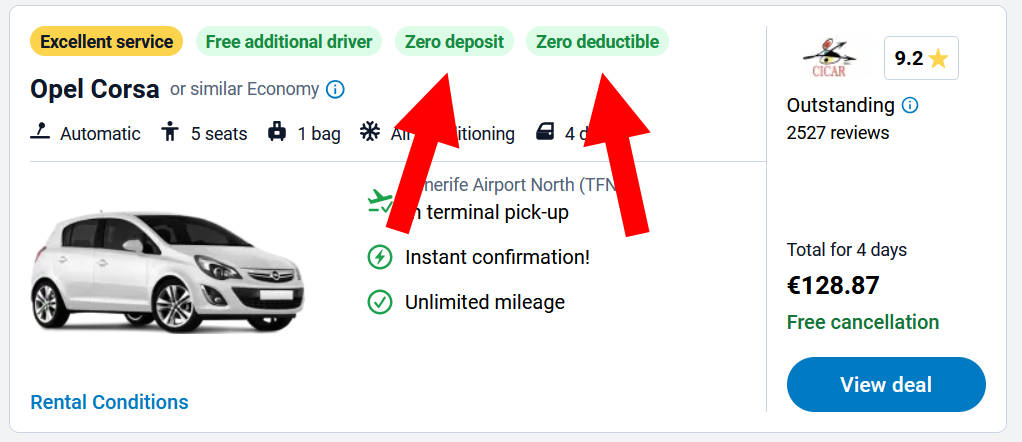
Below I will post a very simple and short instruction that will help you start searching for good offers in 60 seconds, but before I do that, it is worth considering what the filters we use actually give us.
Filter: no deposit
In practice, the "no deposit" option means that the selected offer releases you from any financial liability. If you read the first part of this article carefully, you know that by default, the rental company requires a deposit, meaning it holds funds on your card as a security deposit. The deposit amount is equal to your share of the cost of repairing the damage to the car. Therefore, if you choose the "no deposit" rental option, meaning the deposit is 0 (zero), it means your liability is 0, meaning you are released from any financial liability.
Filter: no credit card required
Some rental companies, even if you have full insurance and zero liability, still require a credit card to rent a car. If you don't have one, the rental company won't give you the car or will offer to purchase an additional service that allows you to pick up the car without a card (I call this the absent-mindedness tax). This is one of those things people sometimes forget, and the rental company is happy to make a few pennies off this minor oversight. Therefore, it's worth specifying in the search box that you're only interested in paying by debit card.
When searching for offers for myself, I usually use both filters at the same time.
Car rental without a deposit
step 1 - go to the website offer comparison websites - [click]step 2 - fill out the form (entering the dates and place of pickup of the car) and press "Search"
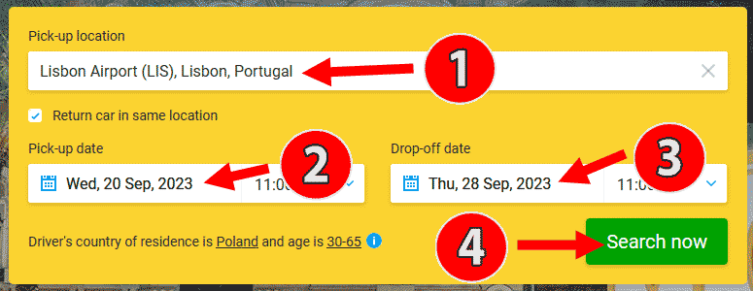
2 - date of collection of the car
3 - date of return of the car
4. - button "Search"
step 3 - after a while you will receive the search result. Then in the options and filters panel, search for the section "Refundable deposit” and check the option “A deposit is not required".
step 4 - Finished! The search results only include offers without a deposit!
The location of the key search engine elements on your computer and phone screen can be found in the image below.
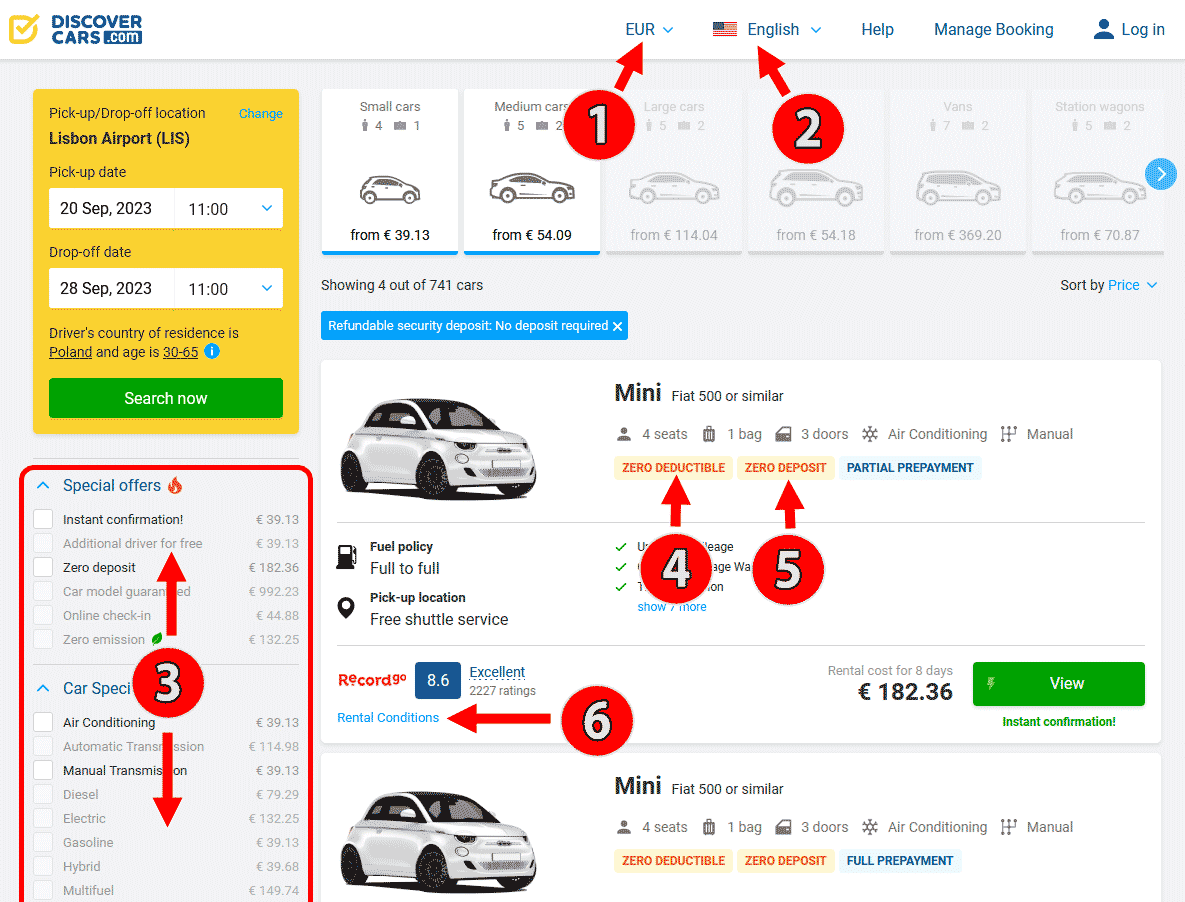
1. Select currency
2. Language selection
3. Search options and filters panel
4. Quick information on the offer: without own participation
5. Quick information on the offer: without credit card
6. Detailed rental conditions (by clicking)
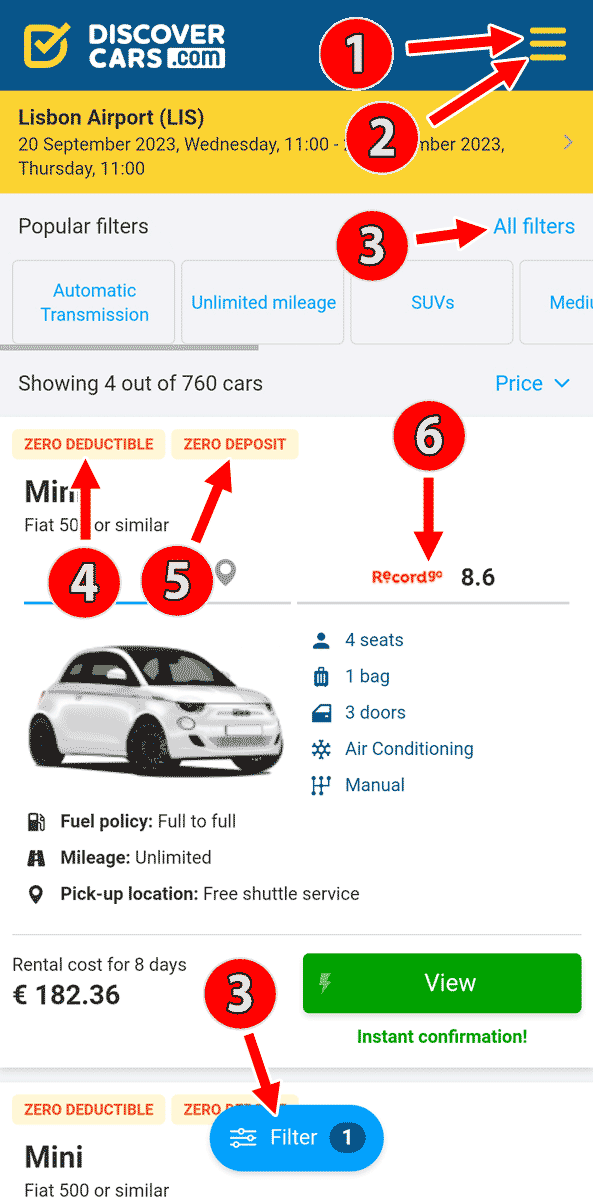
2. Language selection
3. Search options and filters panel
4. Quick information on the offer: no own contribution
5. Quick information on the offer: no credit card required
6. Detailed rental conditions (by clicking)
Car rental without a credit card
step 1 - go to the website offer comparison websites - [click]step 2 - fill out the form (entering the dates and place of pickup of the car) and press "Search"
step 3 - in the options and filters panel (3) search for the section “Payment by card on delivery” and check the option “Debit card"
step 4 - Finished! The search results only show rental offers without a credit card
The location of key elements on the search engine page (on your computer and phone) can be found in the images above.
There are also many situations in which it is consciously worth using both types of insurance, i.e. full insurance from the rental company and full insurance from a comparison website. And this is not an uncommon situation.I encounter it regularly and use it often myself. Why?
I'm already translating!
In my experience, the best-priced, secure offers with full insurance (where there's no deposit and no credit card required) are those that unfortunately exclude tires, rims, windows, mirrors, and undercarriage. This is standard practice. Always check this when choosing an offer. However, purchasing additional insurance for these items directly from the rental company is quite expensive. Full insurance on a comparison website is often more than half the price and covers all these items. So what do I do?
1. I take an attractively priced offer with full insurance (thanks to this, I do not need a credit card or a deposit).
2. I take full insurance from a comparison website, which includes insurance for tires, rims, windows, mirrors and chassis, which is usually two or three times cheaper than buying the same insurance from the rental company on site.
Financial traps: how to avoid paying extra for rent?
A low daily price in search engines often acts as a lure. "Low-cost" rental companies may offer a car for just a few euros a day, knowing they'll make up for this with hidden fees that the average traveler only learns about when signing the contract. In the case of offers with full insurance, meaning "no deposit" and "no credit card required," this is very rare (I don't think I've encountered this before), but there are also additional costs that can arise, regardless of the type of contract you have. As your advisor in the rental world, I'll show you the most common ways to extract extra money.
Fuel Policy: Full/Full vs. Full/Empty
This is where the biggest margins lie. In Spain, you'll find two main models:
Full/Full : you pick up the car with a full tank and return it with the same. This is the only fair solution . You only pay for the fuel you actually use, filling up at a station outside the airport (where prices are lower).
Full/Empty (Full-Empty / Pre-purchase): You receive the car with a full tank of gas, which you must pay for upon delivery (often at an inflated rate). You can return the car with an empty tank.
What's the catch? The rental company adds a service fee (refueling fee) of around €50. You won't get this amount back, even if you return the car almost full. Furthermore, no one can use every last drop of fuel, so the rental company makes money twice: on the service fee and on the fuel you leave in the tank.
Logistics fees: airport and night hours
Many people don't realize that the time and place of pickup have a price.
Some rental companies charge an additional fee just for picking up the car at the airport (airport tax). Check if the final price includes this (and again… I haven't seen this added fee in a fully insured offer so far).
If your flight lands after 10:00 PM or departs at 6:00 AM, be prepared for an additional fee ranging from €30 to as much as €60. Airport offices are open late, but overtime is always charged to the customer. The most common solution for returning a car outside of opening hours is to leave the car in a secure parking lot designated by the rental company. In practice, if you need to be at the airport at, say, 4:00 AM, you drive to the 24-hour secure parking lot designated by the rental company. You leave your car there, and the parking attendant will transport you from the parking lot to the airport using a valet shuttle. This explains the additional fee mentioned earlier.
Before renting, however, make sure your chosen rental company offers this service, and request it when picking up the keys. The rental company will immediately collect the appropriate fee and notify the chosen parking lot that it should be ready for your arrival on a specific day.
Hint:
Sometimes it is cheaper to take a taxi to the hotel and rent a car the next day from an office in the city center.
Accessories that sometimes drain your wallet unnecessarily
Rental companies make a fortune on accessories. Before you check the box when booking, check the costs:
Child seats : These can cost €10-15 per day. For a 10-day trip, you'll pay €150. That's about the price you'll need to buy a new seat at a local supermarket. Many airlines allow you to bring your own seat for free.
GPS : In the age of Google Maps and EU roaming, paying €10 a day for navigation is pure nonsense.
Additional driver : If you don't choose an all-inclusive package (where a second driver is often free, like Wiber ), the extra charge can be €5-10 per day. It's essential to register the second driver (if you're taking turns driving). If something happens while the unregistered driver is driving, your insurance will not cover the full liability.
Crossing state borders
Planning to hop from Malaga to Gibraltar? Or perhaps you'd like to travel from Vigo to Portugal?
Cross Border Fee : Most rental companies require additional insurance for trips abroad (around €30-50 for the entire rental). If you go without reporting a problem and have a breakdown, your SCDW insurance will be void!
Islands vs. Venezuela : Remember that a car rented on the mainland is usually not allowed on ferries to islands (e.g., from Valencia to Mallorca) without special permission. Traveling by ferry between islands (e.g., from Fuerteventura to Lanzarote) is usually not a problem, but always check!
Administrative penalties and cleanliness
These are the fees that most often appear after returning home. Surprised? It happens sometimes, so it's worth knowing when it might happen.
Management Fee (fine handling): If you're caught by a speed camera, the rental company will charge you between €30 and €60 just for providing your details to the police. You'll have to pay the fine separately when it arrives, using the details the rental company provided to the police.
Special cleaning : Standard dirt (a little dust, crumbs) is included. However, beach sand on the upholstery, dog hair, or smoking in the car almost guarantees a fine of €100-150.
Losing your keys or using the wrong fuel : this can cost you around €200-500 (re-key coding). Even "Full" insurance policies often exclude keys and filling the tank with the wrong fuel from their coverage.
More situations in which an additional fee may be charged are discussed in detail in the post: How to avoid additional fees at a car rental company – [click]
How Comprehensive Insurance Saved My Budget – A True Story from Fuerteventura
While renting a car in Fuerteventura, Spain, I had an unfortunate and unusual experience. On my last day, when I was about to fill up, the fuel cap lock broke and I couldn't open the fuel filler. After partially inserting the key, it got stuck in the lock and wouldn't go any further. Worse still, it wouldn't come out either. I decided against forcing the key out, fearing I'd break it or get stuck in the cap, leaving me unable to start the car.
There was still enough fuel in the tank to get to the airport and return the car. I decided to risk the fine for returning the car with a half-full tank and report the problem immediately upon returning the car. Just to be safe, I recorded a video showing the difficulty inserting the key all the way, opening the fuel tank, and then removing the key from the cap. You can watch the video below.
Watch a short video documenting the fuel filler problem:
When returning the keys to the rental company, I described the entire situation and showed them this video. The woman took the key, added my comments to the computer, and said, "OK, that's all, you can safely go to your plane."
I expected the rental company to charge me for refueling (after all, I returned the car with only 1/3 of the tank), but I also thought that if they added an additional service charge for refueling (EUR 50), I would have to file a complaint.
How did this story end?
Probably because I was fully insured, I wasn't charged anything. Not even for missing fuel. Nothing. Absolutely nothing.
I admit that it surprised me very positively.
The most common examples found online are negative (people are more likely to express their frustration, and no one wants to write about positive events), so I decided to provide a real example based on my own experience.
Nothing easier! Check out Cicar's profile and prices on DiscoverCars!
You will also see independent opinions and ratings from other customers!
Where to rent a car without a deposit? A guide to the regions of Spain.
Spain is diverse not only in terms of landscape but also in the availability of "no deposit" offers. Below, you'll find a breakdown by key region. Note that I've prepared a detailed, dedicated guide for each of these cities, which you can find a link to below.
Group A: Andalusia and the Hot South
Andalusia is a land of white towns, flamenco and the best scenic roads.
Malaga:
The ultimate rental hub, AGP Airport offers the most competitive pricing, resulting in the lowest prices for all-inclusive packages in all of Spain. [Check out the Malaga guide]
Seville:
An ideal base for sightseeing Cadiz i GrenadaRenting here is a bit more expensive than in Malaga, but still very accessible without a credit card [Check out the Seville guide]
Group B: Mediterranean Coast and Catalonia
The coastal strip from Costa Brava to Costa Blanca is the most popular destination for holidays with a car.
Alicante :
The gateway to the Costa Blanca. A huge selection of local players offering no-deposit rentals. [Check out the Alicante guide]
Valencia:
A city of modernity, where it is worth renting a car to escape to the wilder beaches south of the metropolis [Check out the Valencia guide]
Girona:
A cheaper alternative to BarcelonaPerfect if you're planning a road trip around the Costa Brava and the Pyrenees. [Check out the guide for Girona]
Barcelona:
The key point and the most frequently chosen starting point for trips around Catalonia [Check out the guide for Barcelona]
Group C: Northern Spain (España Verde)
A completely different side of Spain – green, oceanic, with phenomenal cuisine. Here, a car is essential to reach the cliffs and villages of Asturias and Galicia.
Bilbao and Santander:
Key entry ports to the Basque Country and Cantabria [Check out the guide for Bilbao] | [Check out the guide for Santander]
Santiago de Compostela & Vigo:
Galicia is a region where local rental companies often have a more "family" approach to customers. [Check out the guide for Santiago] | [Check out the guide for Vigo]
Coming soon: Dedicated guide for Asturias (Oviedo/Gijón).
Group D: Madrid and the Center
The capital is an ideal starting point if you plan to visit Toledo, Segovia, or the Sierra de Guadarrama mountains. All the major players operate from Barajas Airport with no deposit offers. [Check out our guide for Madrid]
Group E: Balearic and Canary Islands
On islands the rules are often even simpler than on the mainland.
Mallorca and Menorca:
A kingdom of safe rentals. Distances are short, and rental companies are geared towards family travelers. [Check out the guide for Mallorca] | [Check out the car rental guide for Menorca]
Ibiza:
An island that has much more to offer than just clubs. Your own car will allow you to reach hidden, unspoiled coves in the north and the most beautiful sunset viewpoints. [Check out the Ibiza car rental guide]
Tenerife:
The island is best explored by car (especially the drive up to the volcano) Teide) [Check out the Tenerife car rental guide]
Gran Canaria:
An island of extraordinary contrasts. From the urban streets of Las Palmas, through the green mountain valleys, to the famous dunes of Maspalomas. A car will allow you to explore not only the touristy south but also the island's less obvious corners. [Check out our Gran Canaria car rental guide]
Lanzarote:
An island of volcanoes, lava flows, and extraordinary landscapes. Your own car gives you the freedom to explore Timanfaya National Park, the volcanic valleys, and the small towns scattered throughout the island. [Check out our Lanzarote car rental guide]
Fuerteventura:
An island of vast beaches, wild bays, and rugged, desert landscapes. Distances between the most interesting sites are considerable, so a private car makes sightseeing and reaching less accessible beaches much easier. [Check out our guide to renting a car in Fuerteventura]
The best car rental search and price comparison engines
I've been renting cars for over a decade and observing the market for the same amount of time. In my opinion, the best two comparison sites are: DiscoverCars and Rentalcars (now acquired by Booking.com), of which the former is my absolute favorite. Why? I've explained it in the brief description below.
Therefore, conduct your main search in Discover CarsYou can search in a second search engine to verify whether the offer from Discover Cars is actually the best.
Discover Cars - [click]
The Discover Cars comparison site places great emphasis on including as many local companies as possible. It's simply excellent in this regard! Furthermore, it boasts a vast database of global companies. It's a great tool for instantly comparing local prices with those of the biggest market players. Sometimes (if you're lucky) you'll come across temporary price promotions here that can save you a lot of money. Discover Cars is a must-search database.
Rentalcars - [click]
Rentalcars is (arguably) the world's largest database of car rental offers. For years, it was number one globally, but things change over time, so it's hard to say whether it's still the largest. However, it focuses primarily on the largest and most extensive car rental chains, so offers from smaller, local companies are often missing. However, it's always worth checking to see if a major company has decided to run a promotion.
PLEASE NOTE ! Rentalcars has now been integrated with Booking.com (Booking owns Rentalcars), so you effectively make your reservations through Booking.com. The booking landing page will feature the Booking logo or the logos of both companies. I'm not convinced this is an advantage... in my opinion, probably not. Why? Read about it in a separate post, where I describe in detail how booking systems work and why most people get caught out and overpay ! You'll also learn the most effective booking strategy.
Other search engines and comparison engines
You'll find many other search engines and car price comparison sites online. Searching most of them doesn't improve the search results and often yields identical results to the sites suggested above. Why? Because they're merely copies of the largest and best search engines. The largest market players electronically share their databases with other sites (using API keys), and new sites emerge that essentially search the same database. It's obvious that you won't get any better or more interesting offers from them. You'll get exactly the same results.
Searching for copies of the same databases makes no sense, although there is one exception. Car Rental Online – [click] It uses DiscoverCars' database, but also offers a wealth of useful information related to the destination: road regulations, fuel prices, maps with precise rental locations, lists of tourist attractions (sometimes with ready-made sightseeing itineraries), and year-round weather data. A complete set of essential information for every traveler.
Logistics, Payments and FAQs: Everything You're Afraid to Ask
Reservation rules are one thing, but the reality at the counter can be dynamic. To help you feel confident, I've prepared answers to the questions that land in my inbox most frequently.
Will Revolut work in a Spanish rental company?
In 95% of cases – YES, provided you have purchased full insurance (Full Insurance / No Excess).
Rental companies such as Wiber Centaur they accept Visa/Mastercard debit cards (including Revolut) without any problems.
FAQ – Frequently asked questions by travelers
Do I need a credit card to make an online reservation?
Yes and no. In reservation systems where full or partial payment is made immediately upon booking, it's most often possible to do so by debit card. A credit card is increasingly less necessary, especially if you choose the fully insured option. In that case, it's not even necessary when picking up the car.
I'm under 25. Can I rent a car without a deposit?
Yes, but be prepared for an additional "Young Driver" fee. Spanish companies are liberal, but consider those under 25 (and sometimes 21) to be at increased risk. The fee is typically €5–15 per day.
What if your insurance doesn't cover tires and windows?
This is a classic trap. Even packages called "Full" sometimes exclude these features. Always check that the option you choose is "Full Coverage," which includes everything. If not, pay the extra few euros for peace of mind. A tire repair in Spain costs around €80-100.
Can I drive a rental car into Portugal?
Yes, but you'll need to purchase the Cross-Border option. It typically costs between €30 and €60 for the entire rental period. If you don't, and your car breaks down in Portugal, your SCDW insurance will be invalidated, and towing costs will be astronomical.
What to do in the event of an accident or burglary?
If you have full insurance from the rental company, stay calm. It's your responsibility to:
1. Call the rental company and inform them about this fact
2. Call the police to take a report
Without a police/insurer report, the protection will not work!
How to pay a fine from a Spanish speed camera?
The rental company will charge your card an administration fee (around €43-50) simply for providing your details to the police. The fine itself will be mailed to your address in Poland. You can pay it online for a 50% discount if you pay promptly (the relevant information is on the documents included with the fine).
Does third-party insurance (e.g. Revolut Premium) exempt me from the deposit?
NO. This insurance works on a refund basis: the rental company holds, for example, €1200 on your credit card, and if something happens, you ask Revolut to refund the amount. Without a credit card, this option won't work at the rental office.
Do I have to wash the car before returning it?
A standard clean is sufficient. However, if the car is full of sand, pet hair, or stains on the upholstery, the rental company will charge €100-150 for a "Special Cleaning."
Safe Pickup Checklist (even with Full Insurance)
Even though you have full insurance, it's worth spending 5 minutes at the start to avoid any arguments when returning your car.
[ ] Photos/Video : Walk around the car and record a video with your phone. Focus on the rims and mirrors.
[ ] Fuel : Take a picture of the fuel gauge and odometer immediately after turning the key.
[ ] Interior : check the car for burn holes in the upholstery or cigarette burns (very important!).
[ ] Equipment : make sure you have a reflective vest and a homologated V16 warning light connected to the DGT system in the trunk (from 1 January 2026, for vehicles registered in Spain, the only recognised warning device).
Summary: Your safe journey through Spain
Renting a car in Spain without a credit card or deposit is not a myth. It's the most sensible way to explore this country. By choosing reputable companies and opting for full SCDW insurance, you're buying yourself peace of mind. Remember to always read the fuel policy and avoid offers that are "too good to be true."
Spain awaits—from the cliffs of Galicia to the sand dunes of Andalusia. Enjoy your journey!
Important to me!
Give the article a good rating (5 stars welcome 😀)!It's free, a for me it is very important! The blog lives on visits and thus has a chance to develop. Please do it and ... thank you in advance!
If you like my guides, you will certainly find the one I created useful guide catalog - [click]. There you will find ready-made ideas for your next trips, descriptions of other tourist destinations and an alphabetical list of guides divided into countries, cities, islands and geographical regions.
I also post link to Facebook profile - [click]. Come in and press "Follow"then you will not miss new, inspiring posts.
Unless you prefer Instagram. I'm not a social media demon, but you can always count on something nice to look at on my instagram profile - [click]. The profile will gladly accept any follower who likes it.
I read ALL the comments (and many times). Under each of them I could write that Thank you very much, because you are real fantastic. I often come back to comments because they give me motivation and energy. For me this is invaluable a treasure trove of good emotions!
Thank you for this here (I don't want to clutter the comments with repeated thanks). Know that by leaving a kind word here, you are doing a really good job for me!
I make the content I create available free of charge with copyright, and the blog survives from advertising and affiliate cooperation. So, automatic ads will be displayed in the content of the articles, and some links are affiliate links. This has no effect on the final price of the service or product, but I may earn a commission for displaying ads or following certain links. I only recommend services and products that I find good and helpful. Since the beginning of the blog's existence, I have not published any sponsored article.
Some of the readers who found the information here very helpful, sometimes ask me how you can support the blog? I do not run fundraisers or support programs (type: patronite, zrzutka or "buy coffee"). The best way is to use links. It costs you nothing, and support for the blog is self-generating.
Pozdrawiam